

Paid advertising for a local service business should be simple. Someone needs HVAC repair, a plumber, or an electrician. They search, they click an ad, and they call the business that looks trustworthy and answers fast. In reality it rarely works that cleanly. Budgets get spent, clicks come in, leads feel random, and the owner decides that PPC for contractors just does not work, or that Google and Facebook are broken.
That conclusion is almost always wrong. Ads usually fail because they are disconnected from strategy and unsupported by a real funnel. The platforms are not broken. The system behind them is. Here is what actually goes wrong across HVAC, plumbing, electrical, garage door, pest control, and franchise operators, and what the ones who win do differently.
Ads Are Not the Solution. They Are the Amplifier.
Think about how you would find a plumber if your water heater stopped working tonight. You wouldn’t scroll through the first page and start reading articles. You would grab your phone, type “water heater repair near me,” and look at the map showing three nearby businesses. You would glance at their ratings, skim one or two reviews, and tap “call” on whichever company looked close, professional, and trustworthy.
Your customers do exactly the same thing. HVAC lead generation isn’t really about SEO in the abstract. It is about winning that thirty second decision on a phone screen. Three things determine whether you win: whether customers can find you, whether they trust you, and whether you answer when they contact you. Get those three things right and the calls follow. Miss any one of them and even strong rankings may not produce enough business.
Let’s take them in order because that is also how you should build your lead generation system.

Fast, reliable, and hassle-free – from booking to done
Why Contractor Ads Commonly Fail
Across hundreds of local campaigns the same structural problems repeat, and none of them are platform specific.
The first is no clear positioning. Most ads sound identical. Licensed and insured. Family owned. Affordable. Full service. These describe a business but do not differentiate it, and homeowners do not compare credentials, they compare outcomes. Strong positioning answers one question plainly. Why should someone call you instead of the next company in the results? When an ad cannot answer that, click costs rise and lead quality falls.
The second is advertising services instead of problems. Businesses advertise what they do. Customers search for what went wrong. “Full service plumbing” describes a category. “Emergency leak fixed today” matches intent. Problem based messaging outperforms generic service language on both Google and Meta, consistently.
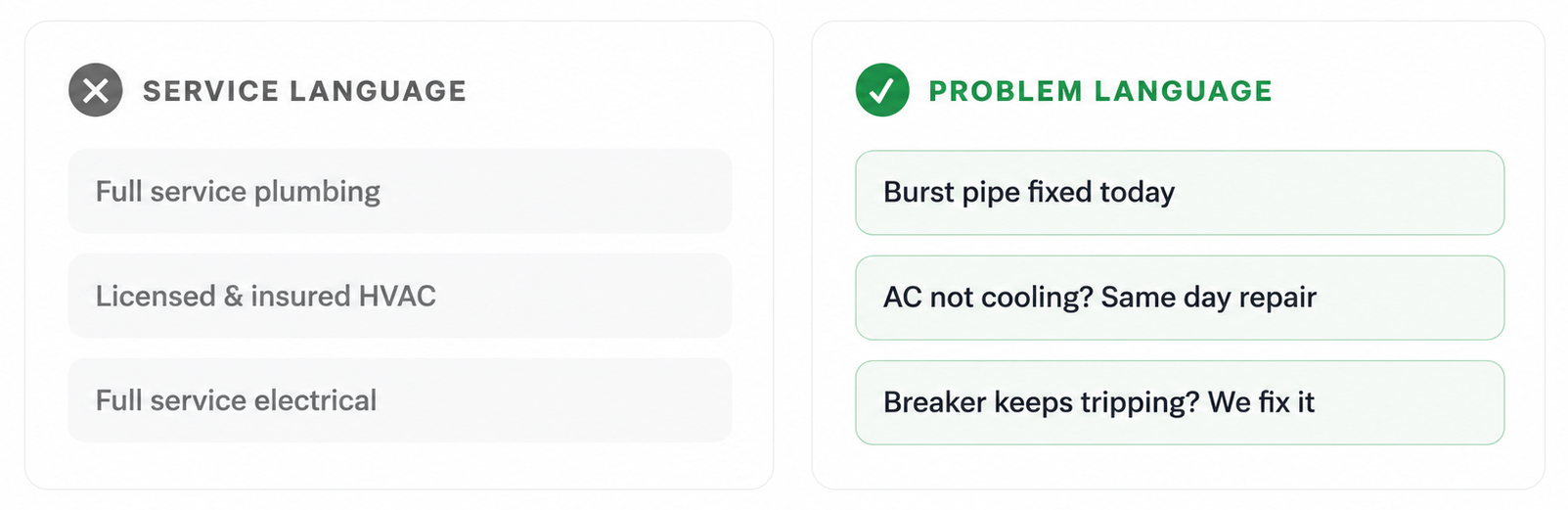
Customers search for what went wrong, not what you offer.
Google Ads for Contractors, Done Right
Google Ads is the highest intent channel for local services, and also the easiest place to burn money. The usual mistakes are bidding on broad keywords with mixed intent, sending traffic to generic pages, and not tracking calls or booked jobs properly. Terms like HVAC services or plumber near me pull in research, price shopping, and browsing along with buyers.
High performing accounts focus on intent rich queries instead, the searches that signal urgency, because urgency converts. AC repair near me. Emergency plumber open now. Garage door stuck halfway. The structural fix that makes the biggest difference is organizing the account around problem clusters. Rather than one broad HVAC campaign, split into AC repair, heating repair, emergency service, and maintenance, and give each cluster tightly grouped keywords, matching ad copy, and its own dedicated landing page. That alignment is what lifts Quality Score, lowers cost per click, and raises conversion. Google rewards relevance between the search, the ad, and the page, so the more precisely each cluster matches intent, the cheaper and better it performs. Building and holding that structure is the core of paid ads that actually book jobs, and it is where most accounts either work or quietly waste budget.
Want to know where your calls are
leaking right now?
Facebook Ads for Contractors, Done Right
Facebook and Instagram work differently from search. They do not capture existing demand, they create awareness and urgency, and that is where most local businesses misuse them. The common failures are trying to sell everything in one ad, overproduced creative, vague messaging, and weak follow up.
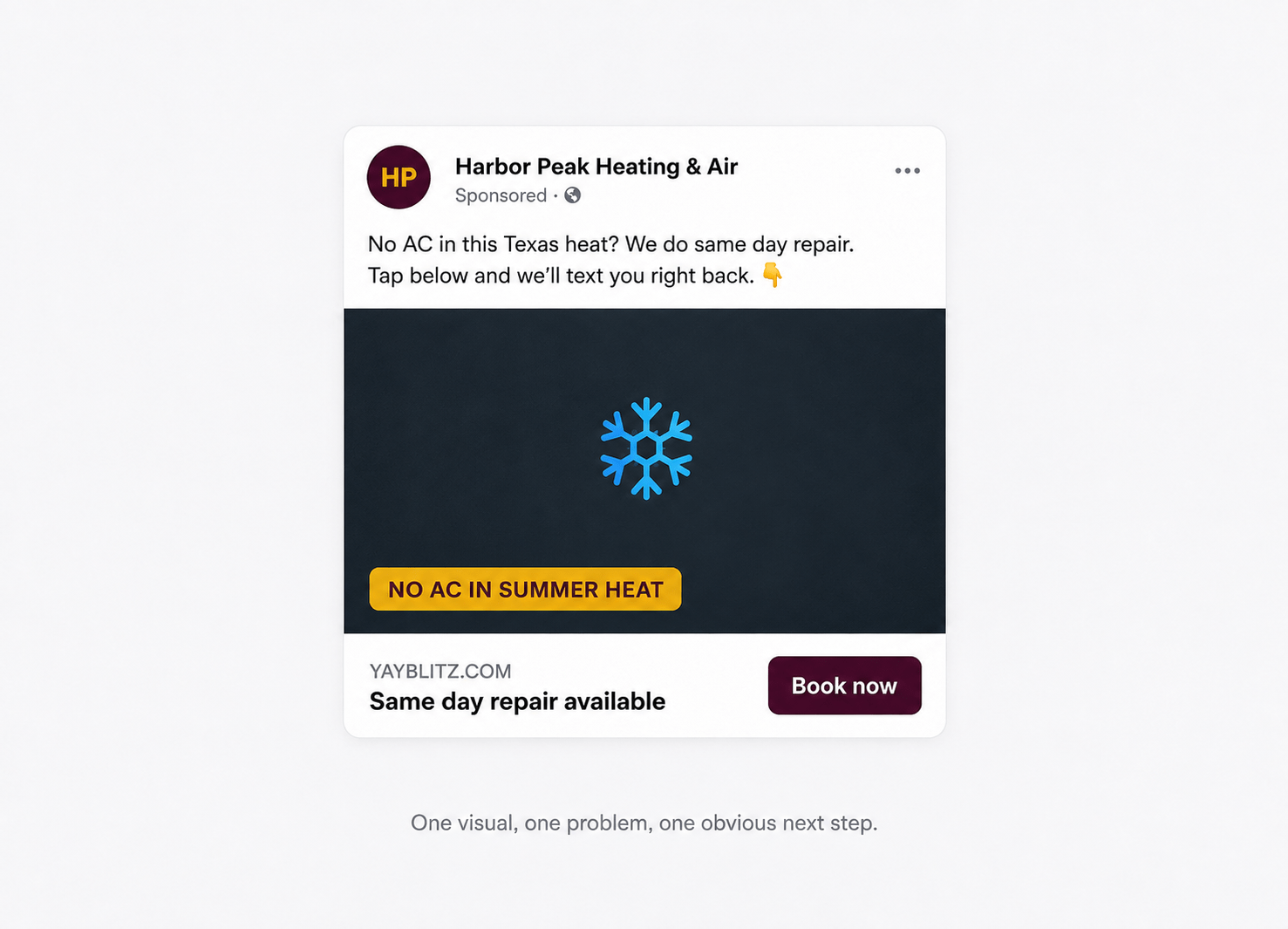
The best Facebook ads for contractors are rarely flashy. They are clear. One simple visual, one specific problem, one obvious next step. A short clip of a leaking pipe with the line water damage spreads fast and a book emergency repair button. An image of a dead AC unit with no AC in summer heat and same day repair available. Clarity beats creativity every time in local service ads, because the goal is not to entertain, it is to make the right homeowner stop and act.
The Landing Page Problem
Even well targeted ads fail if they send traffic to the wrong place, and this is one of the biggest leaks in local advertising. Most ads dump paid clicks onto a homepage or a service category page built for exploration, not conversion. Paid traffic needs focus.
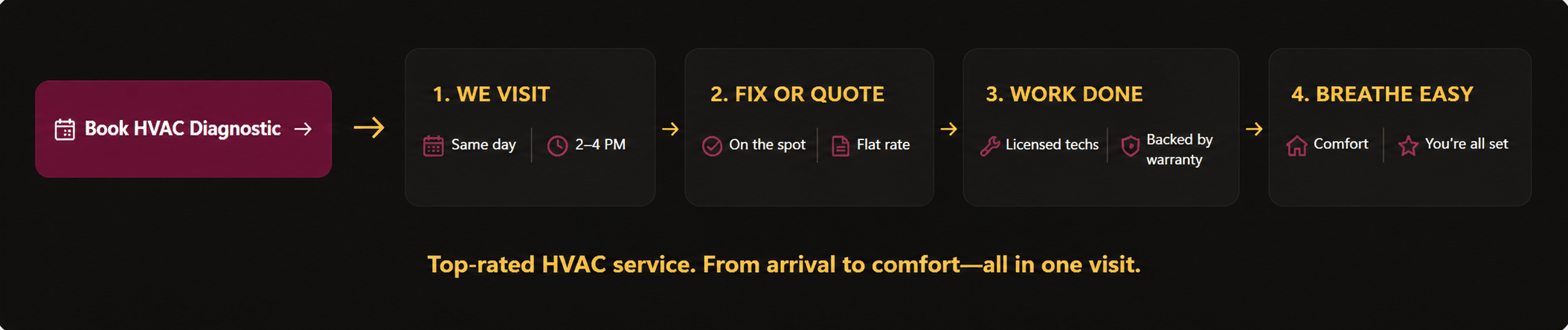
A strong local service landing page does five things immediately. It confirms the problem, shows the solution, builds trust fast, removes distractions, and makes the next step obvious. It should feel like a continuation of the ad, not a reset. If the ad says emergency AC repair, the page should open with those exact words. Message match is not a nice to have, it is a conversion multiplier, and it is the single fix that most often turns a losing campaign into a profitable one.

The Hidden Killer: Slow Follow Up
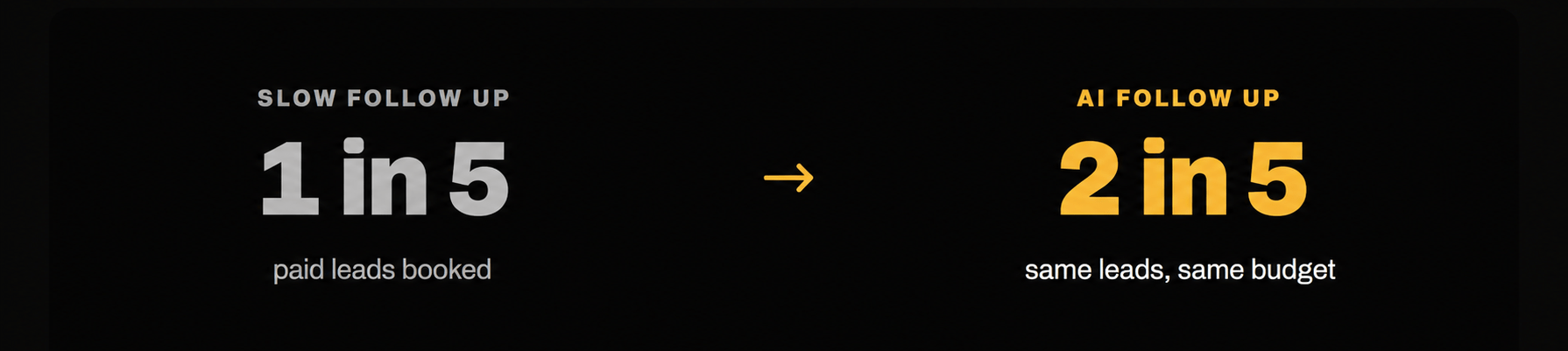
Many contractors lose more leads after the click than before it. Speed to lead matters more than most owners realize, because homeowners often contact several companies within minutes and the first professional response usually wins. Hours later is too late. Next day is usually gone. Research covered by Harvard Business Review on the short life of online sales leads found most businesses respond far too slowly, and that a few minutes versus an hour dramatically changes the odds of connecting.
The problem is that a busy crew cannot answer in minutes every time, which is exactly where a modern AI system earns its place. The moment a paid lead calls and misses you, a missed call text back can fire automatically so they know they are seen. A new form can trigger an instant reply within seconds, any hour of the day. An AI assistant can ask the basic qualifying questions, confirm the problem and urgency, and offer real appointment windows before a competitor picks up, then keep a polite follow up cadence running on its own if the homeowner goes quiet. Every lead lands in one place instead of a voicemail or a sticky note. This kind of automated lead management does not replace your team, it protects the ad spend you already made, and on its own it can roughly double close rates without raising budget by a dollar. It is usually the highest return fix an owner can make, and it is exactly the sort of AI follow up system we build for local service businesses.
Cheap Leads Are Usually Expensive
Many owners chase the lowest cost per lead. It is a trap. Cheap leads usually mean low intent, poor fit, and wasted time. High performing advertisers optimize for cost per booked job, not cost per lead, and that one change reframes everything. It pushes you toward better messaging, tighter targeting, and higher quality traffic. A ninety dollar click that becomes a four thousand dollar job is not expensive. A twenty five dollar lead that never books is pure waste.
Funnels Are the Missing Link
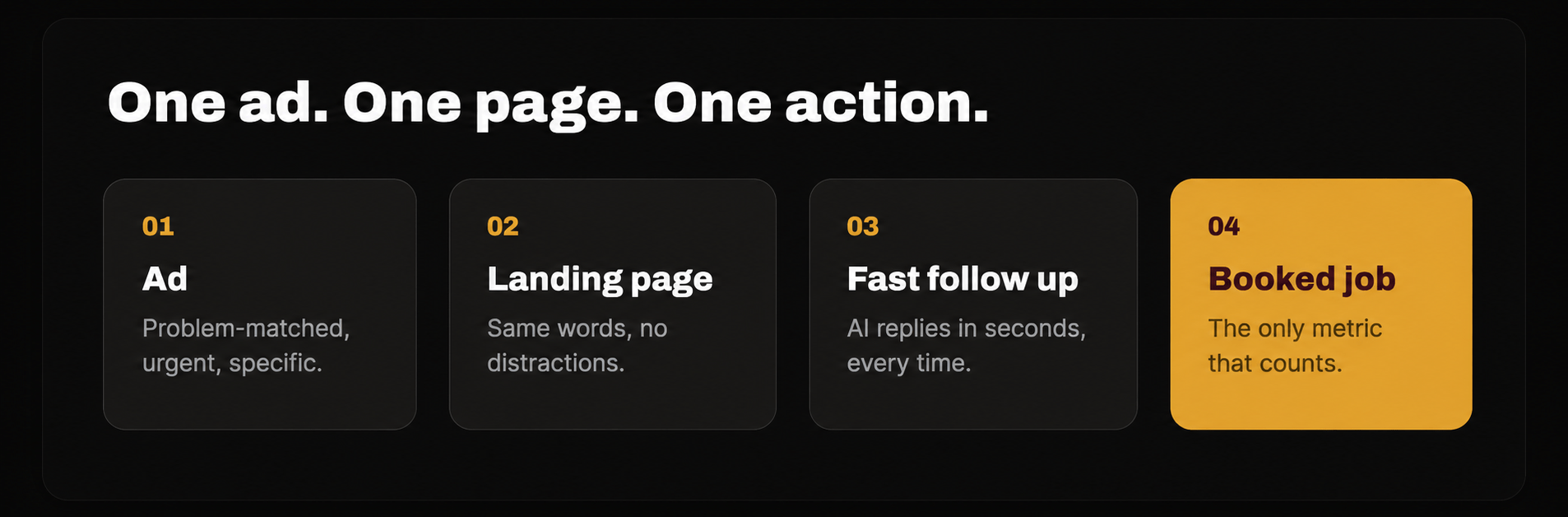
Ads do not work in isolation, they need a funnel, which is simply the path from click to conversion. Good funnels remove friction, hold message consistency from ad to page to follow up, and guide the homeowner toward one action. For local services this does not need to be complicated. It needs to be intentional. One ad, one page, one action. Anything else is noise that leaks conversions.
What Smart Local Service Owners Focus On
The owners who win with paid ads do not obsess over platforms or chase the next tactic. They focus on fundamentals. Is our message clear. Does the page match the ad. How fast do we respond. Are we tracking real outcomes rather than clicks. Fixing those almost always improves performance faster than adding budget, and it is why the businesses that win are not experimenting constantly, they are executing consistently.
Frequently Asked Questions
Usually it is not the ads, it is the system around them. The most common causes are broad keywords with mixed intent, sending clicks to a generic page instead of a matched landing page, and slow follow up after the call. Tighten those three and the same budget starts booking more work
Yes, but differently from Google. Facebook and Instagram create demand rather than capture it, so they work best with one clear problem, one simple visual, and one obvious next step, backed by fast follow up. Vague or overproduced creative is where most contractor Facebook ads fail.
It varies widely by trade and market, and clicks in high intent categories can be expensive. That is why cost per click is the wrong number to watch. Track cost per booked job instead, because a pricier click that converts beats a cheap one that never calls back.
Tighten targeting and match types, use problem based keywords that signal real intent, add negative keywords, and qualify fast with an automated intake. An AI assistant that asks a couple of qualifying questions the moment a lead comes in filters out most low fit inquiries before they waste your team’s time.
They can work together. Local Services Ads are a pay per lead product with the Google Guaranteed badge, while standard Google Ads give you more control over messaging and landing pages. Most contractors benefit from both, as long as the follow up system behind them is fast enough to convert what they generate.
The Bottom Line
Local service ads fail for predictable reasons. Unclear strategy, weak design, ads disconnected from the funnel, and slow follow up. Align those and advertising becomes predictable instead of a gamble. The platforms were never the problem.
If your ads are running but results feel inconsistent, the issue is almost never the platform, it is where the system is leaking. A short strategy review can show exactly where, and most fixes are simpler than expected.
Related reading: HVAC lead generation for the organic side, and our lead follow up guide for the system that converts every lead these ads produce.
 Funnel Strategy
 Graphic & Web Design
 Paid Local Ad
 Marketing Strategy