

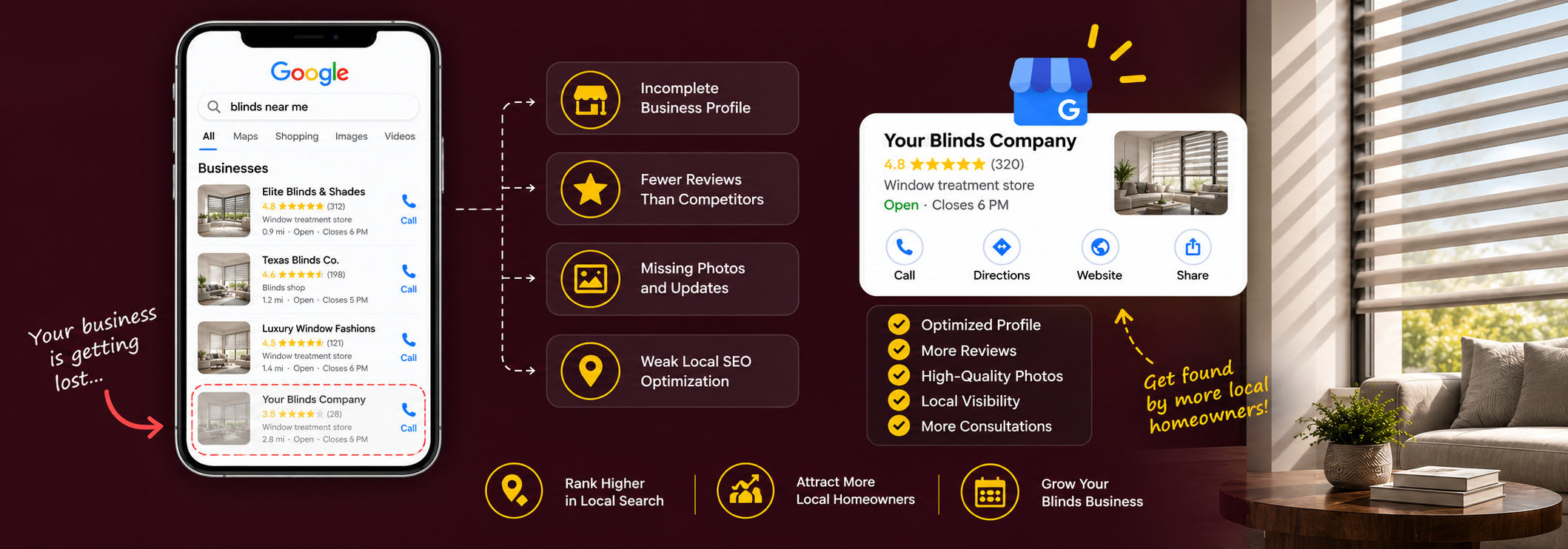
If you own a blinds or shutters company, one of the most frustrating local marketing problems is seeing a competitor above you on Google Maps when you know your products, installation, and customer service are at least as good.
Your profile may already be verified. The phone number is correct. You have reviews. You uploaded photos. Your website is linked. You may even post updates from time to time. Yet a homeowner standing ten minutes away searches for blinds near me, window treatments near me, or plantation shutters near me and another company appears first.
That is where Google Business Profile optimization becomes a business issue rather than a marketing checklist. The goal is to help Google understand exactly what your company is, where it genuinely operates, what it sells, and why a nearby homeowner should trust it enough to call, visit the website, get directions, or request a consultation.
Your Google Business Profile Is Not a Checklist
A profile can be complete and still be commercially weak. That happens because completion is only one part of local visibility. Google says local results are mainly based on relevance, distance, and prominence. Those three factors explain much more than the idea that filling every field automatically earns a top position.
An owner cannot control every part of that equation. You cannot move your showroom closer to every homeowner, and you cannot pay Google for a better organic Maps position. What you can do is remove ambiguity around relevance, strengthen real local prominence, represent the business accurately, and make the profile more persuasive when it does appear. That is the owner level objective.
Three factors, not one checklist
How well your business matches what the person is searching for.
How far the business is from the searcher or the location used in the query.
How well known and trusted the business appears, including reviews and web signals.
The Local Searches Worth Fighting For
Homeowners do not all search for your company the same way. One person searches for a broad provider such as window treatments near me. Another already knows the product and searches plantation shutters near me. Someone else searches motorized blinds in a specific suburb. Another searches your brand after seeing a referral or social ad.
Your profile should help Google and the customer understand those relationships, but it should not try to become a stuffed list of every keyword the business wants. A strong local system connects the profile to accurate categories, useful services, a relevant website, genuine reviews, real project photography, and clear local information. The website then goes deeper into products, locations, comparisons, and conversion.
Start With Eligibility Before You Try to Rank
Window treatment companies operate in different ways, and the business model affects how the profile should be represented. Some have a real showroom customers can visit. Others are entirely shop at home, measuring and installing at the customer location without receiving customers at their own address. Some are hybrid businesses.
Google distinguishes between storefront, service area, and hybrid businesses. If customers do not visit your address, Google says the address should not be shown publicly. A virtual office does not become an eligible showroom simply because the address is convenient for Maps. Before worrying about rankings, make sure the profile reflects the real operation.
Storefront
A staffed showroom where customers visit during stated hours. The address is public and accurate.
Service area
Consults, measures, and installs at the customer's home. No public address, since customers never visit it.
Hybrid
A staffed showroom plus an in home consultation team. Both realities represented accurately.
Choose Categories Based on What the Business Actually Is
Category selection sounds like an SEO task, but it is really a positioning decision. Your primary category should describe the core business as specifically and accurately as possible. Secondary categories can represent other genuine parts of the business, but they should not be used simply because a keyword has search volume. Do not turn the category list into a wish list.
For the owner, the useful question is not How many categories can we add? It is Which category most accurately tells Google what business we are in, and which additional categories reflect real revenue producing services? Review the category strategy whenever the business changes, since a company that has moved heavily into motorization, commercial work, or a showroom model may no longer be represented as clearly as it was several years ago.
Use Services to Show What You Actually Want to Sell
Google Business Profile can allow service businesses to list services and organize them into categories. This is useful for window treatment companies because the commercial offer is rarely one generic product. A company may sell plantation shutters, roller shades, cellular shades, Roman shades, wood blinds, faux wood blinds, motorized shades, drapery, exterior shades, and commercial window treatments.
The owner should prioritize clarity over quantity. If motorized shades are a high value growth category, make sure the profile and website both make that capability obvious. If the company no longer sells a certain product, remove outdated information rather than allowing old services to create weak inquiries. Your Profile and Website should tell the same product story.
Adding twenty cities does not mean ranking in twenty cities
Google allows service area businesses to define up to twenty service areas, and its guidance says the overall area generally should not extend much beyond about two hours of driving time from the business base. The service area tells customers where you operate, but local ranking still considers distance. A blinds company based in Fort Worth should not expect to become equally strong in every part of Dallas Fort Worth simply because more cities were added.
Look at where your best projects actually come from. Which neighborhoods produce whole house shutter projects? Which areas are profitable after drive time, sales time, measurement, installation, and follow up? Your local marketing should follow those economics, not a bigger service area list.
Show the actual business
The Arcadia Blinds Case Study shows why deliberate photography matters at a brand level too.
Completed installations across different rooms and window types, not stock interiors.
Real large openings, clean installations, controls where appropriate, finished rooms.
What a visit actually looks like, or the real consultation, measuring, and installer experience.
The owner should ask a simple question while reviewing the photo gallery: if a homeowner looked only at these images, would they understand the kind of projects we want more of? Fresh project photography also helps the profile look alive without inventing activity for the sake of an algorithm.
Reviews Should Help the Next Homeowner Decide
Owners often focus on the review count and average rating, but the content of the reviews matters to the buyer too. A useful review can describe what was installed, how the consultation went, whether measurements were accurate, how communication felt, and whether the installer respected the home. Those details answer the questions a homeowner has before inviting someone into the house.
Google says more reviews and positive ratings can help local ranking, and responding to reviews also shows customers that the business values feedback. Do not buy reviews or offer incentives in exchange for positive ratings. Build the request into the real customer journey. Respond to positive and negative reviews like an owner whose future customers are reading.
Google requires the real business name
A common local shortcut is adding products or cities to the business name even when those words are not part of the real company name. Google requires the profile to represent the business as it is consistently represented in the real world. For example, if your company is called Oakline Shutters, changing the profile name to Oakline Shutters Blinds Shades Plantation Shutters Dallas is not a sustainable brand strategy.
A strong owner should protect the real brand while improving relevance through legitimate categories, services, website content, reviews, project proof, and local authority.
Your Website and Profile Need to Tell One Story
Google says Business Profile information can be informed by multiple sources, including a company website and other public information. If the profile says you specialize in plantation shutters and motorized shades, but the website barely mentions them, the overall local story is weak. If the phone number, business name, or hours disagree across important properties, the experience feels unreliable.
This is why Local SEO vs Paid Ads is only part of the conversation. Maps, organic search, paid search, and website conversion all meet at the same business information. For a window treatment company, the profile may create discovery, but the website often has to close the trust gap before the consultation is booked.
Accurate Hours Can Be a Sales Advantage
Hours look like basic administration until a customer searches at the exact moment your competitor appears open and you appear closed. Keep regular hours accurate, update special hours around holidays, and if a showroom has different consultation hours from the office phone line, make sure the customer can understand what is available. Do not mark the business open twenty four hours merely because a form can be submitted at any time.
For owners running a shop at home model, the bigger operational question is what happens when someone finds the profile outside normal hours. If the profile sends a strong lead to the website at 8:00 p.m., the inquiry process should still acknowledge the homeowner and set expectations for the next contact. That is where AI Lead Management for Contractors can support the local funnel after discovery.
Maps Visibility Is Only Valuable If the Profile Converts
Being visible for blinds near me is not the finish line. When the profile appears, the homeowner still has to choose between several businesses. They see reviews, photos, category information, hours, distance, website links, and other details. That is a comparison environment. The phone number must work, the website should open to a credible mobile experience, and the product story should be obvious.
A weak profile loses visibility. A weak conversion experience wastes visibility. That is why Google Business Profile optimization should be reviewed with Blinds Website Design and the broader Window Treatment Marketing funnel, even though each page owns a different SEO topic.
Read the Performance Data Like an Owner
Google Business Profile performance data can show how customers discover the profile and what actions they take on Search and Maps. Do not turn this into another vanity dashboard. The most useful questions are commercial: which search terms bring the profile into view, are calls and consultation inquiries rising, and are those interactions coming from the right service areas?
The further the owner can follow that chain, the more intelligently the local strategy can be managed. A profile that receives more views but no increase in qualified consultations has improved visibility without improving the business result.
One rank number is not the market truth
Distance is part of local ranking, so visibility can change across a metro. A company may appear strongly near its showroom and much weaker fifteen miles away. Owners should think in geographic coverage rather than one rank number. Track important searches from different parts of the real service area, then compare visibility with lead and sales data.
This can reveal useful decisions. Perhaps the business is strong around Fort Worth but weak in a high value suburb, or a profile performs well in one city but the website page for a key product is weak. Ranking data becomes valuable when it leads to a business decision.
What to Fix First If the Profile Is Not Producing Enough Consultations
Do not start by posting more often or uploading one hundred random photos. Start with the fundamentals: confirm the profile is eligible and represented correctly, check whether the business should be storefront, service area, or hybrid, verify the real business name is used, and review the primary category and secondary categories.
Update products or services to match what the company actually wants to sell, make service areas accurate, fix hours, phone, and website information, add strong real project photography, build a consistent review request process, and make sure the website supports the same products and locations. Only after those fundamentals are strong should ongoing activity become the focus. The owner should be able to answer three questions at any time: where are we visible, what type of customer is that visibility producing, and what happens after they contact us.
Thirty questions for the profile you have today
Eligibility, categories & services
15 itemsProof, hours & measurement
15 itemsFrequently Asked Questions
Why does my competitor rank above me on Google Maps even though I have more reviews?+
Will adding more service areas help me rank in more cities?+
Should a shop at home blinds company show its home address?+
How many Google Business Profile categories should I use?+
Do Google Business Profile posts improve rankings?+
What should I measure besides Google Maps rankings?+
Your Maps Listing Should Be a Sales Asset, Not a Directory Entry
A Google Business Profile is often one of the first places a nearby homeowner encounters your company. It should tell Google what the business really is, tell the customer what you sell, represent the service area honestly, show real work, carry the voice of real customers, connect to a website that continues the same story, and create a path into a consultation your team can actually convert.
For a blinds and shutters owner, the useful question is not are we optimized. The better question is when a profitable homeowner near us searches for the products we want to sell, do they find us, trust us, contact us, and eventually buy? That is the standard Google Business Profile optimization should be measured against.
Yay Blitz helps blinds, shutters, and other local service businesses connect Local SEO vs Paid Ads, Graphic and Web Design, Paid Local Advertising, lead tracking, and follow up into one measurable customer acquisition system. If nearby homeowners are finding your competitors first, or your Google Maps visibility is not turning into enough qualified consultations, start with a free strategy assessment.
 Funnel Strategy
 Graphic & Web Design
 Paid Local Ad
 Marketing Strategy