

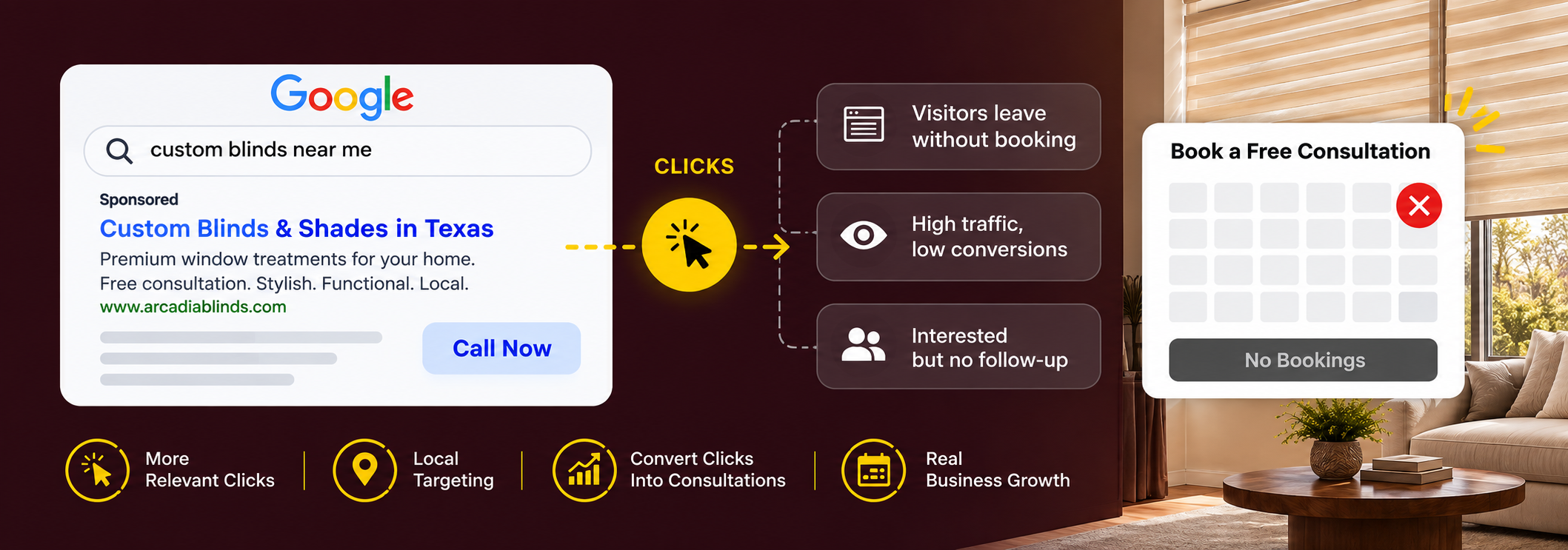
Your Google Ads account may be doing exactly what you asked it to do and still be wasting money. It can generate clicks. It can produce forms. It can even show a cost per lead that looks respectable in a monthly report. But if those leads do not become booked in home consultations, completed appointments, quotes, and profitable installed jobs, the account is not really working for the business.
A blinds and shutters company does not make money when someone clicks an ad. It makes money when the right homeowner in the right service area wants a product the company is good at selling, books a consultation, completes the measure, receives a quote, and buys. Google Ads should be built backward from that outcome.
Window treatments are not one product and not one buying decision. Someone replacing two basic blinds behaves differently from a homeowner planning whole home plantation shutters. If all those searches enter one campaign, see one generic ad, land on one general page, and get counted as the same lead, the account loses the information needed to improve.
Why Window Treatment PPC Often Looks Better Than It Really Is
Paid search can create the illusion of control because the dashboard is full of numbers. Impressions, clicks, click through rate, conversions, and cost per conversion all look precise. The problem is that the wrong conversion can make the entire account look healthier than the business actually feels.
Imagine an owner reviewing two months of advertising. The first month generated 45 leads at $70 each. The second month generated only 30 leads at $95 each. A basic report says the first month was better. Now follow the leads further. The first month produced 12 booked consultations, eight completed appointments, and three sold jobs. The second month produced 20 booked consultations, 17 completed appointments, and nine sold jobs. The second month had the worse cost per lead and the stronger business result.
Separate Campaigns Around Real Buying Intent
A common account structure problem is grouping every window treatment term together because the products feel related to the business owner. They may be related operationally, but they are not always the same search intent. Someone searching for plantation shutters is telling Google something very specific. The campaign should preserve that information rather than blending it into a general window coverings group.
A practical account may separate meaningful product themes such as custom blinds, plantation shutters, motorized shades, roller and cellular shades, commercial window treatments, and brand searches. High value geographic markets may also deserve separate campaigns when performance, budget, or service capacity differs significantly by area.
The goal is not to create dozens of tiny campaigns. It is enough separation to answer which products generate the best qualified consultations, which have the strongest close rate, which cities create the best installed revenue, and which campaign deserves more budget next month. If the account cannot answer those questions, it is too blended.
Keywords Are the Starting Point, Not the Final Truth
Keywords tell Google what kinds of searches you want to reach. Search terms tell you what people actually typed before seeing or clicking an ad. Depending on match type and campaign settings, ads can still appear for searches that are broader, adjacent, or simply wrong for the business. The Search terms report should be part of the regular management routine, not something checked only after performance drops.
Location Targeting Should Follow Job Economics
Window treatment companies often serve broad metropolitan areas, but that does not mean every ZIP code deserves equal paid media investment. Review paid performance by geography. Which ZIP codes create qualified consultation requests? Which areas generate completed appointments? Which areas consume budget but rarely sell?
Be careful with location settings as well. A local blinds company generally wants people who are actually in or regularly in the service area, not simply people elsewhere who happen to show interest in that city. This is a good moment to compare notes with Paid Local Advertising for how location settings apply across other local service categories.
The principle is simple. Paid geography should follow profitable service delivery, not the largest radius the sales team is willing to drive once.
Your Ad Should Continue the Homeowner's Thought
A search for plantation shutters should lead into a plantation shutter conversation. A search for motorized shades should lead into a motorized shade conversation. Many paid accounts lose relevance between the search and the page. The keyword is specific, but the ad becomes generic, sending the visitor to a homepage showing blinds, drapery, shutters, shades, and a general contact button.
Google recommends that ads, keywords, landing pages, and calls to action closely match. If the search is for plantation shutters, the ad can reinforce shutters, local service, consultation availability, measurement, and installation. The landing page should then continue exactly that promise. Do not make the customer wonder whether they landed in the right place.
Track Calls as Carefully as Forms
Window treatment buyers do not all convert through forms. Some call directly from an ad, others review the website first and call afterward. Google Ads supports phone call conversion tracking, including calls made after someone visits the website from an ad. Do not assume every call is a qualified lead. Where possible, connect call outcomes to the CRM or sales process so a ringing phone becomes a measurable one.
A qualified lead is still perishable
The homeowner who just searched for plantation shutters may have contacted two or three businesses. If one company confirms the request immediately and gets the consultation scheduled while another responds the next day, the slower business may blame Google Ads for a lead that was actually lost after the click.
AI Lead Management for Contractors can help with immediate acknowledgment, routing, missed call recovery, and structured follow up, supporting the salesperson rather than replacing the personal conversation a design driven purchase needs. Track the consultation booking rate by source before simply changing bids.
The Quote Stage Belongs in Your Google Ads Report
For a custom blinds and shutters business, a lead is only the beginning. Even a booked consultation is not revenue. Whole home projects, plantation shutters, motorization, and premium materials can involve a meaningful purchase decision, and customers may need time to discuss budget, compare products, or coordinate a remodel.
Track which campaigns create completed consultations, which completed consultations receive quotes, which quotes sell, and sold value and gross profit where possible. When that data exists, the business may discover that one expensive keyword creates high value projects while a cheaper keyword creates appointment volume with weak revenue, information a basic cost per lead report hides.
Use Qualified Lead and Sold Customer Data to Improve Bidding
Google Ads can learn from more than raw form submissions. Enhanced conversions for leads can use first party customer information to help match offline outcomes back to ad interactions, letting a company with a CRM send stronger outcomes such as qualified leads or sold customers back into the advertising system instead of treating every submission as equally valuable.
This became especially important in 2026: Google combined enhanced conversions for web and leads into a unified setting and moved offline conversion and enhanced lead uploads toward Data Manager and the Data Manager API. A blinds company does not need to become an advertising technology company to benefit. It needs clean lead stages.
A useful CRM path could be New Lead, Qualified Lead, Consultation Booked, Consultation Completed, Quote Sent, Sold, Lost, and Installed. The names can vary, but the sales team should be able to distinguish a raw inquiry from a real customer.
Budget Around Customer Acquisition Cost, Not Cost per Click
Blinds owners often ask what they should pay per click or what a good cost per lead should be. Those numbers are useful for comparison, but the more important question is how much the business can afford to spend to acquire a profitable customer.
The cheaper leads created the more expensive customers. Add average sold project value and gross profit and the difference can become even larger. Track marketing spend, leads, qualified leads, booked consultations, completed consultations, quotes, sold jobs, installed revenue, and gross profit by campaign where the data allows it. Cost per booked consultation and customer acquisition cost are usually far more useful management numbers than cost per click alone.
Search Should Usually Capture Demand Before You Chase Reach
Search campaigns are valuable because they can reach people who are actively expressing product or provider intent. A homeowner searching for custom plantation shutters near me is in a different stage from someone casually watching home design content. That does not mean Search should be the only paid channel, but the account should know what problem each channel is solving before adding more.
For a business with weak conversion tracking and no reliable connection from lead to sale, adding more campaign types can create more activity without creating more clarity. Get the paid search foundation working first, and read Local SEO vs Paid Ads for how paid and organic demand capture should divide the work. Then expand deliberately.
Thirty questions for the account you have today
Products, geography & keywords
15 itemsTracking, follow up & profit
15 itemsFrequently Asked Questions
What is window treatment PPC?+
Are Google Ads effective for blinds and shutters companies?+
Should blinds companies send Google Ads traffic to the homepage?+
What should a blinds company track from Google Ads?+
How much should a window treatment company spend on Google Ads?+
Is cost per lead the most important Google Ads metric?+
Stop Paying for Clicks You Cannot Trace to Revenue
The strongest Google Ads account for a blinds and shutters company is not the one with the most keywords, the lowest cost per click, or the most form submissions. It is the account that makes the path from search to sold job visible.
Start with the products you actually want more of. Separate meaningful buying intent. Review the searches customers are really using. Protect the budget with thoughtful negative keywords. Put more emphasis on profitable service areas. Match the ad to the product and the landing page to the ad. Make the consultation easy to book. Respond quickly. Track the quote. Connect sales outcomes back to the campaign.
Yay Blitz helps blinds, shutters, and other local service businesses connect PPC for Contractors, Paid Local Advertising, Graphic and Web Design, Local SEO vs Paid Ads, conversion tracking, and lead follow up into one measurable growth system. If your Google Ads are generating clicks or leads but not enough profitable in home consultations and sold window treatment projects, start with a free strategy assessment.
 Funnel Strategy
 Graphic & Web Design
 Paid Local Ad
 Marketing Strategy