

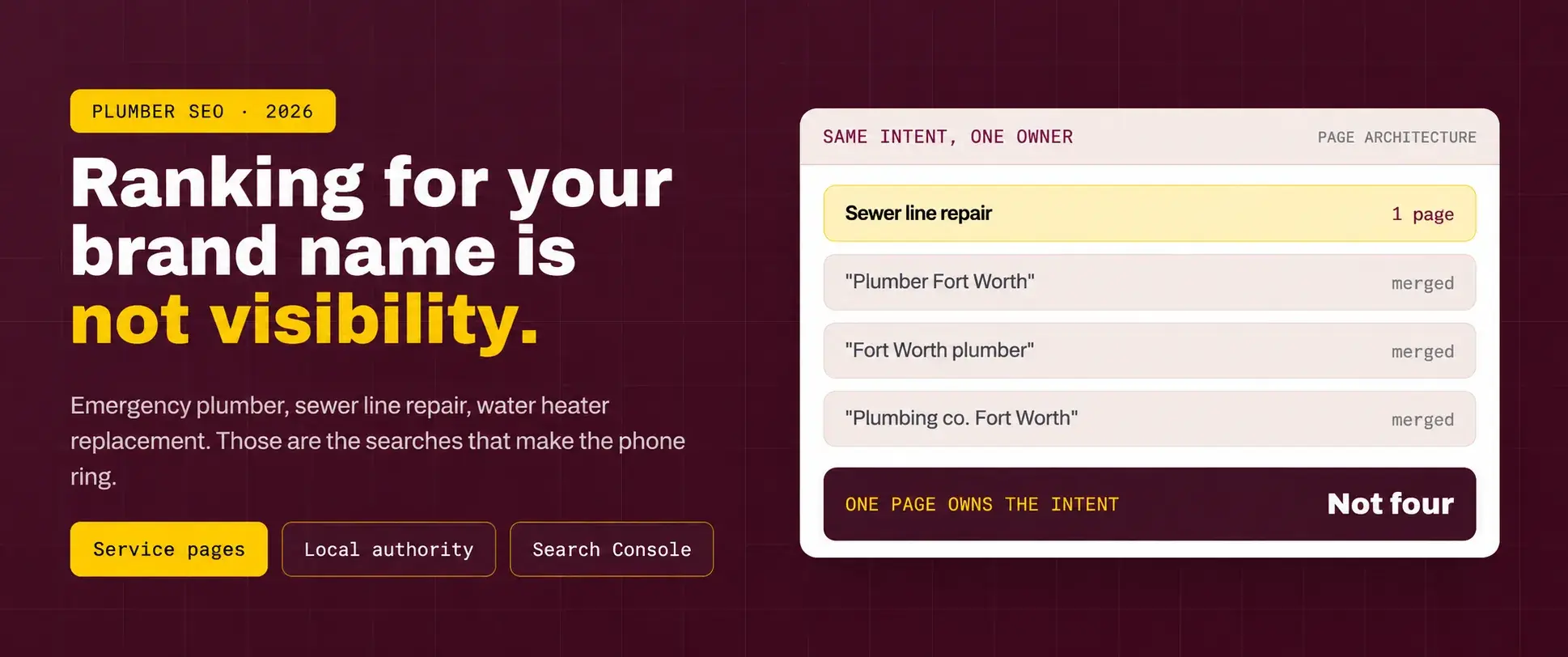
A plumbing company can rank for its own name, have a professional website, and still be almost invisible when a homeowner searches for the services that actually make the phone ring. Ranking for the brand proves Google can find the business. It does not prove the company is competing for searches such as emergency plumber, sewer line repair, water heater replacement, drain cleaning, or plumber near me.
For a local plumbing company, SEO should not be a race to publish the most pages or collect the most keywords. The goal is to become visible when a nearby customer has a real plumbing need, show Google enough relevant and trustworthy information to understand why the company is a strong result, and turn that visibility into a qualified call or appointment.
That changes the question from "How do we rank number one for plumber?" to "Which searches represent the jobs we want, which pages should answer them, where can we realistically compete, and what happens after the customer finds us?"
What SEO for Plumbers Actually Needs to Accomplish
SEO for plumbers has two jobs. Google needs to understand the business, its services, location, website, and important pages. Then the customer needs to see a relevant, credible result that makes calling or booking feel easy.
That means rankings are not the final measure of success. A plumbing company should care about nonbranded visibility, qualified organic calls, form inquiries, booked appointments, completed jobs, and revenue from organic search. A ranking increase matters when it produces more of the work the business wants.
SEO should therefore sit inside the broader plumbing marketing system. Local visibility, reviews, website conversion, call handling, and follow up all affect whether search demand becomes revenue.
Build a Service Page Architecture Google and Customers Can Understand
The homepage should explain the company and major services at a high level. Important services should have dedicated pages when there is enough distinct customer intent and business value to justify them: emergency plumbing, drain cleaning, sewer line repair, water heater repair, water heater replacement, leak detection, repiping, and commercial plumbing.
Each page should answer the questions a homeowner is likely to have before calling. What problem does the service solve? What are the common signs? What happens when the plumber arrives? Which areas are served? What proof shows the company is credible? What should the customer do next?
Google recommends creating helpful, reliable content for people rather than pages primarily designed to manipulate rankings. A strong plumbing service page should be useful even if the visitor arrived directly and never knew what keyword you were targeting.
Three phrases, one intent, one page
"Plumber Fort Worth," "Fort Worth plumber," and "plumbing company Fort Worth" usually represent the same core intent. Creating separate near duplicate pages for each phrase does not create three useful assets. Choose which page owns the intent and make that page substantially useful. Supporting pages should exist only when they solve a different service, customer need, or location problem.
Location Pages Need Real Local Value
City pages can help plumbing companies that genuinely serve multiple markets, but they should not be simple city name swaps. A strong location page can explain the real services offered in that market, realistic service boundaries, local project examples when available, customer proof from the area, and links to the most important service pages. A Fort Worth page and an Arlington page should not contain identical paragraphs with only the city name changed.
Website location pages also do not remove geography from Google Maps. Google says local results are mainly influenced by relevance, distance, and prominence . A plumber can serve a large metro while still appearing differently from neighborhood to neighborhood.
Internal Linking Turns Pages Into a Plumbing Topic System
A plumbing website should not feel like a collection of isolated pages. Internal links help customers move between related topics and help Google discover and understand important pages. Google recommends descriptive internal anchor text and says every page you care about should have a link from at least one other page on the site.
An article about signs of sewer line damage can link naturally to the sewer line repair page. A water heater guide can link to repair and replacement services. A location page can link to the major plumbing services offered in that market. Use links where the next page genuinely helps the reader rather than forcing them into every paragraph.
Content Should Support Services Instead of Competing With Them
Blogs can help plumbing SEO when they answer real customer questions and strengthen the service architecture. Useful topics might include signs you may need sewer line repair, why a water heater keeps running out of hot water, what causes low water pressure, or when old plumbing pipes should be replaced.
The purpose is not to hit an arbitrary publishing quota. Google says there is no preferred word count and warns against producing search engine first content simply to attract visits. A useful plumbing article should answer a real question and lead naturally toward the relevant service when commercial help is appropriate.
Local Authority Matters Beyond Your Own Website
Google describes prominence partly through information it finds about a business across the web, including links. Useful local authority can come from legitimate community organizations, trade associations, local sponsorships, supplier relationships, local news coverage, and chambers of commerce. The goal is not hundreds of random directory links. It is to make the company's real local presence visible online and keep business information consistent across important sources.
Track Organic Search Beyond Rankings
Rank tracking is useful for diagnosing visibility, but it should not be the only SEO report. Google Search Console shows which queries and pages receive impressions and clicks , and Google recommends focusing on trends in impressions and clicks rather than average position alone.
Review nonbranded queries, service pages gaining or losing clicks, queries with strong impressions but weak click through rate, and location pages gaining visibility. Then connect search data with call tracking and CRM data wherever possible. A page that ranks well but produces no qualified calls needs a different solution from a page that receives no visibility at all.
Local SEO and Paid Search Should Support Each Other
SEO does not need to replace advertising. Organic visibility can build durable presence for core services and local searches. PPC for Contractors can create immediate demand capture for services or locations where the company wants more volume now. The useful question is not simply Local SEO vs Paid Ads . It is which combination produces the strongest flow of profitable jobs at the right time.
SEO also stops creating value when qualified calls are not worked properly. AI Lead Management for Contractors can support missed call recovery, faster acknowledgment, and consistent follow up so organic opportunities do not disappear after the customer makes contact.
Twenty questions for the website you have today
Architecture & local presence
10 itemsTechnical & measurement
10 itemsFrequently Asked Questions
What is SEO for plumbers?+
How long does plumber SEO take?+
Should every plumbing service have its own page?+
Do plumbers need city pages for SEO?+
Do Google reviews help plumber SEO?+
How should a plumbing company measure SEO?+
Build Plumber SEO Around the Jobs You Want to Win
The best SEO for plumbers is not built around ranking for the largest possible list of keywords. It is built around making the company a strong answer for searches that represent real, profitable customer demand.
Start with the services you want to grow. Give each important search intent a clear page. Support those pages with useful content, realistic location coverage, Google Business Profile, genuine reviews, local authority, and sensible internal links. Keep the site technically accessible and make it easy for a customer to call. Then measure the path from search visibility to qualified traffic, calls, appointments, completed jobs, and profitable customers.
Yay Blitz helps local service companies connect organic visibility with PPC for Contractors , website conversion, paid local advertising , and lead handling so every channel can be evaluated by the jobs it produces. Start with a free strategy assessment to identify where your plumbing search visibility, website, or lead handling system is losing opportunities.
 Funnel Strategy
 Graphic & Web Design
 Paid Local Ad
 Marketing Strategy