

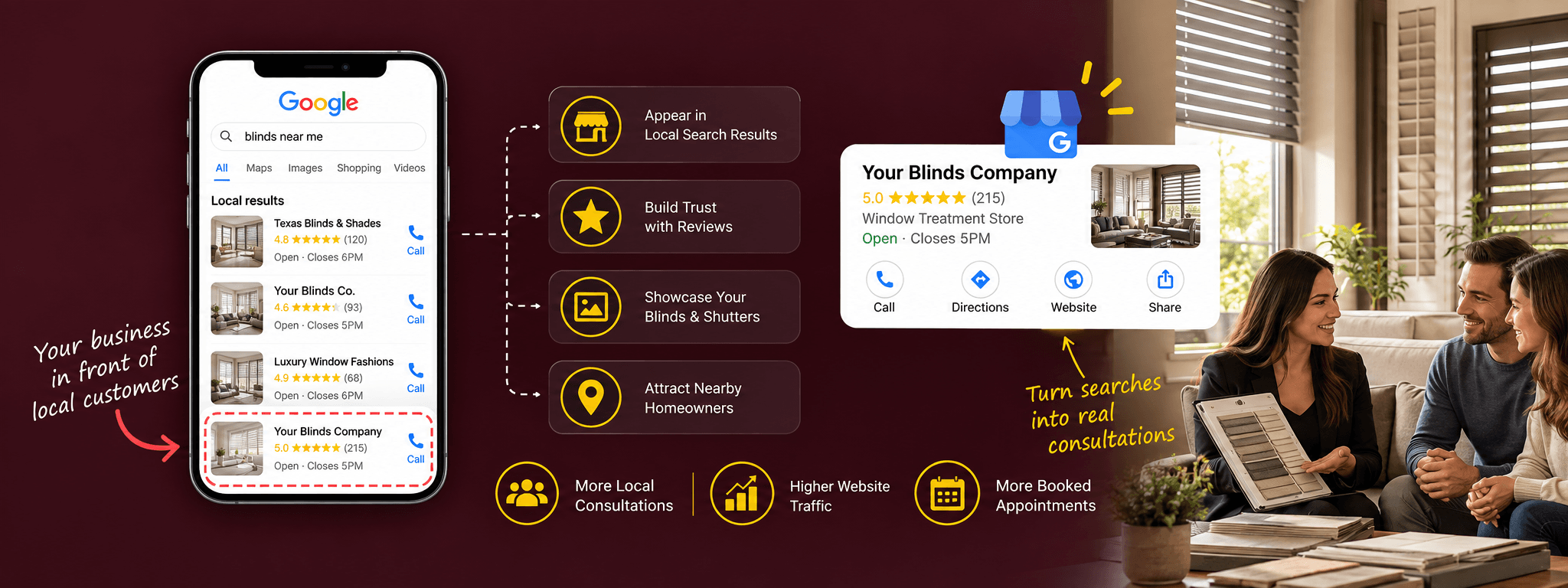
Your blinds and shutters business may not have a traffic problem. It may have a Google understanding problem. A homeowner in your market searches for plantation shutters, motorized shades, custom blinds, or a window treatment company near them. Google has to decide which local business best matches that exact need. If your website gives every product one short paragraph on a general services page, uses the same copy across several city pages, and sends every visitor to a generic contact form, a competitor with a smaller company but a clearer local search structure can win the click and the consultation.
That is the real job of window treatment SEO. It is not to make a website rank for as many phrases as possible. It is to make the right products, service areas, proof, and consultation paths easy for Google and homeowners to understand.
If your team is already installing beautiful work but organic search is not producing enough qualified consultations, start by fixing the structure before publishing another twenty blog posts.
Why a Good Blinds Website Can Still Lose Local Search
Many window treatment businesses have attractive websites. They show beautiful rooms, respected product brands, years of experience, and a consultation form. The problem is that visual quality alone does not tell Google which page should rank for which buying decision.
A site can look excellent while still making several SEO mistakes at once. Plantation shutters and motorized shades may share one generic product page. Important service areas may appear only in the footer. Project galleries may contain dozens of strong images with almost no descriptive context. Several pages may target nearly the same phrases.
The owner sees a complete website. Google sees unclear page ownership. The solution is to give every important search intent a clear destination and make the whole site support that structure.
Give Each Profitable Product One Clear Home
One of the most useful improvements a blinds and shutters company can make is to stop asking one page to rank for every product. If plantation shutters are an important revenue category, they deserve a useful plantation shutters page. If motorized shades are strategically important, they deserve a page that actually explains motorization.
The page does not need to repeat a keyword in every paragraph. It needs to satisfy the buyer. A useful product page can explain what the product is best for, room applications, light and privacy considerations, material choices, measurement, installation, and what happens during a consultation. This is also where good Graphic and Web Design supports SEO. Google may bring the visitor to the page, but the page still has to earn the consultation.
A homeowner searching for motorized shades in Dallas should not need to click through a general blinds page, open a menu, find shades, and then discover that motorization is mentioned near the bottom. The landing page should confirm quickly that the company provides motorized window treatments, serves the relevant area, and can help the homeowner choose and measure the right solution.
Build a Local Keyword Map Instead of Chasing One Big Keyword
Window treatment companies often focus on broad phrases such as window treatments, blinds, or shutters. Those terms can be useful for understanding the market, but local buyers often search with more specific intent. These groups should not all point to the same page.
Google Business Profile Should Reinforce the Website
Google Maps can be one of the first places a homeowner encounters a local window treatment company. Google says local results are mainly influenced by relevance, distance, and prominence. A complete profile can help Google understand the business, but service area settings do not erase distance and a long list of cities does not create a ranking radius.
For SEO purposes, the important principle is consistency. If the website emphasizes plantation shutters, custom blinds, motorized shades, and in home consultations, the Business Profile should accurately represent those real services. Maps and the organic website should support each other rather than operate like separate marketing assets.
Internal Links Tell Google Which Pages Matter
A good window treatment site should not make every page live in isolation. Google uses links to discover pages and understand relationships between content, and recommends descriptive anchor text that helps people and Google understand what the linked page is about.
A guide about choosing window treatments for large windows can link to roller shades, motorized shades, and custom blinds where relevant. Every important product or local page should be reachable through crawlable links. This is also how you avoid cannibalization — the commercial service page owns the main product intent, and supporting articles answer narrower questions and link back to it. Do not create five pages that all want to rank for the same buyer.
Content Should Help a Homeowner Make a Decision
Window treatment content often fails because it is written around keywords instead of the questions customers actually ask during consultations. The best topics usually already exist inside the sales process.
Google recommends people first content that provides substantial value and demonstrates real expertise. A window treatment company has an advantage here because its consultants and installers hear these questions every week. A practical article written from real customer questions will usually be more persuasive than another generic post called Ten Window Treatment Trends for This Year.
Technical SEO Should Make the Good Pages Easy to Find and Use
Technical SEO matters, but it should support the commercial architecture rather than become the strategy itself. Make sure important pages can be crawled and indexed, keep URLs stable, fix broken internal links, and make mobile pages easy to use.
Image optimization matters more in this niche than in many service categories because galleries and project photography are central to the sale. Use descriptive filenames, useful alt text, and compression that protects visual detail. A file named motorized_roller_shades_living_room.webp is more useful than IMG_4829.jpg. The alt text should describe what a person would need to understand about the image, not repeat the same SEO phrase twenty times.
Real relationships, not bought links
Local rankings are not created by on page optimization alone. A real window treatment company leaves evidence across its market: local directories, manufacturer or dealer listings, chambers of commerce, design partnerships, builders, interior designers, and local publications. Do not buy hundreds of low quality directory links because a report says you need more backlinks.
Start with accuracy and relevance. Make sure core business information is consistent across important local platforms. Build relationships with designers, builders, and remodelers where it makes commercial sense. The objective is not to manufacture authority — it is to make the company's real local presence visible online.
Measure SEO Through Consultations, Not Rankings Alone
A ranking report can tell you whether visibility is changing. It cannot tell you whether the business is making more money. Google Search Console can show queries, impressions, clicks, and landing page performance — useful for understanding whether pages are gaining visibility and whether the title is attracting clicks. The business should then follow the visitor further.
A general blinds page may get 1,500 organic visits and produce 20 consultation requests, while a plantation shutters page gets only 400 visits but produces 18 requests and six whole home sales. The general page has more traffic. The shutter page may be far more valuable. That is why window treatment SEO should be reviewed by product and revenue, not only by total sessions.
Twenty five questions for the site you have today
Architecture & proof
13 itemsTechnical & measurement
12 itemsFrequently Asked Questions
What is window treatment SEO?+
What should a blinds and shutters company try to rank for?+
Should every city have its own window treatment page?+
Should every blinds product have a separate page?+
Does Google Business Profile replace local SEO?+
How should a window treatment company measure SEO results?+
Stop Trying to Rank for Everything
The blinds and shutters companies that win local search are not necessarily the ones with the most pages. They are the businesses that make their most profitable products easy to understand, connect those products to real local demand, prove the quality of their work, build a coherent site, and give the homeowner a clear next step.
Start with the products you actually want to sell. Give each important buyer intent one clear destination. Build location pages only where they are useful. Turn installations into proof. Strengthen Google Business Profile and local authority. Use internal links to connect the site. Then follow organic traffic all the way to the consultation and sold job.
Yay Blitz helps blinds, shutters, and other local service companies connect Local SEO vs Paid Ads, Graphic and Web Design, Branding and Lead Quality, conversion tracking, and funnel strategy so search visibility becomes measurable booked work rather than another marketing report. If your blinds or window treatment company is visible online but the right local homeowners are still not booking enough consultations, start with a free strategy assessment.
 Funnel Strategy
 Graphic & Web Design
 Paid Local Ad
 Marketing Strategy