

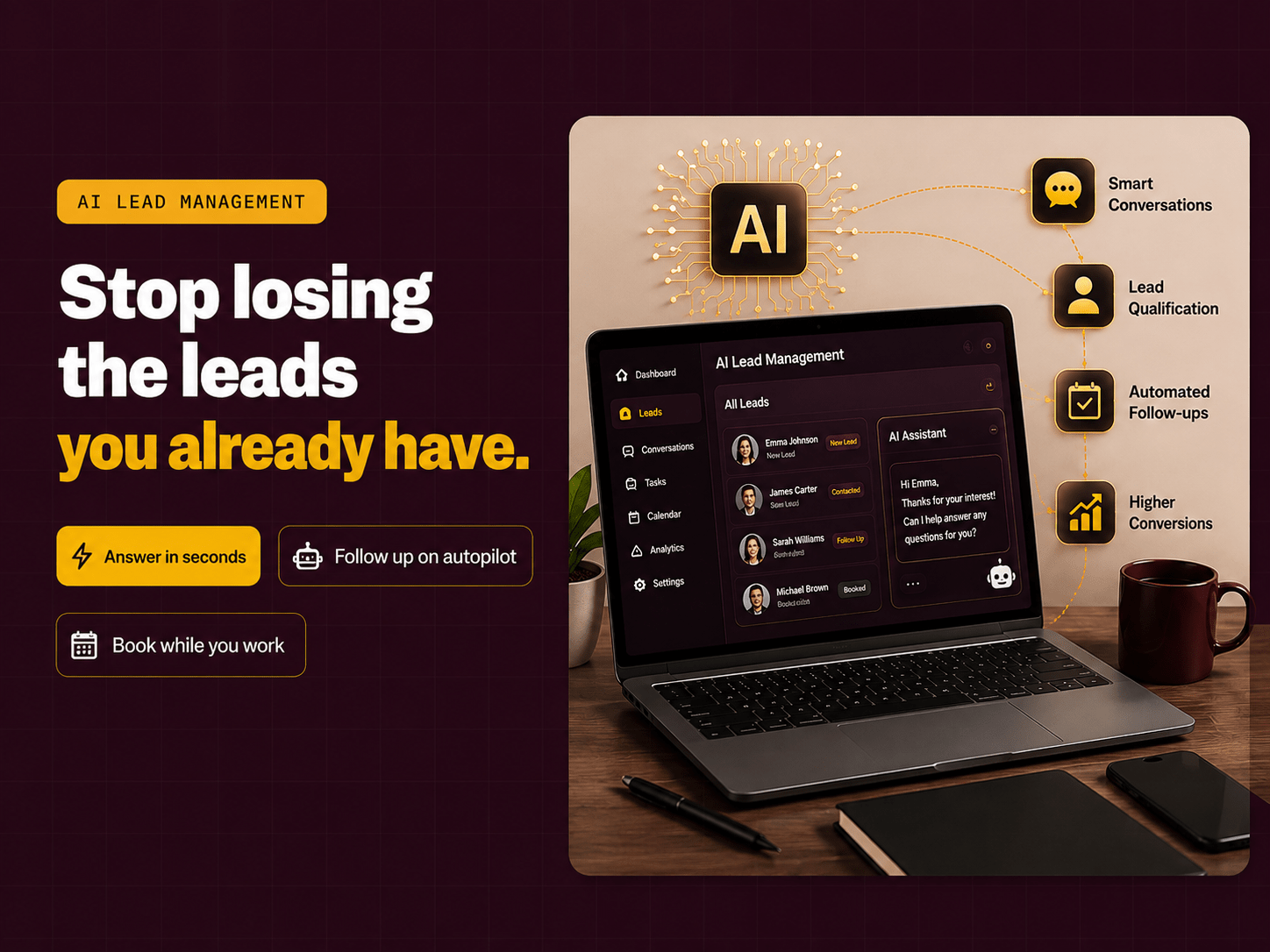
Most contractors do not lose money on the leads they fail to generate. They lose it on the leads they already have. The call that goes to voicemail while the crew is on a roof. The web form that sits until the next morning. The estimate request that gets one reply and then silence. Every one of those is a job you paid to attract and then quietly let walk to a competitor.
AI lead management is how you stop that from happening. It is not a gimmick or a chatbot bolted onto your website. It is a system that captures, answers, qualifies, follows up with, and organizes every lead automatically, so that speed and consistency stop depending on whether your team happens to be free. This guide explains what an AI lead management system actually does for a contractor, the parts that matter, where humans still win, and how to start without overcomplicating it.
What AI Lead Management Actually Is
Think of AI lead management as the system that runs the gap between "a lead comes in" and "a job gets booked." A human is great at quoting a complex job, reading a customer, and doing the work. A human is terrible at answering every call within sixty seconds, sending the fourth follow up on day nine, and making sure no inquiry ever falls through a crack, especially when the day gets busy. AI is the opposite. It is excellent at speed and consistency and never forgets.
So a good system does not replace your people. It handles the fast, repetitive, easy to drop parts, and hands the human parts to humans at the right moment. That single division of labor is what turns a leaky, feast or famine pipeline into a steady one.
Why Contractors Lose Leads in the First Place
Before the fix, it helps to name the leaks, because they are almost always the same few.
The first is slow response. Home service customers often contact several companies within minutes, and the first professional reply usually wins. Research covered by Harvard Business Review on the short life of online sales leads found that most businesses respond far too slowly, and that a few minutes versus an hour dramatically changes whether you ever connect. On a job site, answering in minutes by hand is close to impossible.
The second is missed calls. A call that goes to voicemail during a job is usually a call that never comes back. The third is one and done follow up. A lead that does not reply to the first text is not a no, it is a not yet, but most companies quit after one attempt. The fourth is after hours. Emergencies and evening searches do not wait for business hours. And the fifth is scattered leads, when inquiries live half in a voicemail box, half in a texting app, and half in a form inbox, so nobody has a clear picture of what is actually in the pipeline. AI lead management closes all five.
AI Handles
Where Humans Win
AI lead management is not about replacing your office or making your business feel like a machine. The AI qualifies and holds the lead. A human closes it. That balance is the whole point, and the systems that ignore it, the ones that feel robotic and cold, are the ones that fail.
What This Looks Like on a Normal Day
Picture a Tuesday. You are on a roof at 2pm and a homeowner calls about a unit that stopped cooling. You cannot pick up. Within seconds they get a text. The assistant confirms the problem, offers a window tomorrow, books it, and drops the whole conversation into your CRM with the lead source tagged. You never touched your phone. That evening you review three new qualified, booked leads instead of returning nine voicemails, half of which already called someone else. When the job wraps, a review request goes out automatically. That is AI lead management doing its job.
Common Mistakes to Avoid
A few things separate a system that works from one that annoys customers. Do not automate the human parts. Do not skip the human handoff. Do not let the messaging sound robotic or spammy. Do not forget to track outcomes. And do not buy a pile of tools without a system connecting them, because disconnected apps create more gaps, not fewer.
How to Get Started
You do not need to build all of this at once. Start where the leak is biggest. For almost every contractor that means turning on missed call text back and instant response first. Once those are running, layer in the automated follow up cadence, then a single CRM, then automated booking and review requests. If you are also running paid traffic, this matters double, because slow follow up quietly burns the budget behind your contractor ads one lead at a time. The same discipline underpins any strong lead engine, whether that is HVAC lead generation or any other trade — and it all builds on solid AI lead follow up .
Frequently Asked Questions
What is AI lead management for contractors? +
How does 24/7 lead follow up automation work? +
Will AI follow up feel robotic to my customers? +
How many times should the system follow up with a lead? +
Does AI lead management replace my office staff? +
How do I automate contractor lead follow up? +
The Bottom Line
You already spend money and effort to make the phone ring. AI lead management makes sure you stop losing what you paid for. Answer in seconds, follow up on autopilot, book while you work, and keep every lead in one place, and your booking rate climbs without a bigger ad budget. The tools are not the point. The system is.
Want to see where your leads are leaking right now, and where automation would win them back? That is the purpose of our free audit We map your response times, follow up, and tracking, then show you plainly what is costing you jobs. No pitch, just the scoreboard that counts.
 Funnel Strategy
 Graphic & Web Design
 Paid Local Ad
 Marketing Strategy