


If your remodeling pipeline feels like a rollercoaster, you are not alone. Most Dallas Fort Worth remodelers have months that are fully booked and months that feel like starting from zero. It is easy to read that as a demand problem. In one of the fastest growing metros in the country, it almost never is. It is a system problem. The remodeling companies that grow steadily in DFW are not the ones with the most leads. They are the ones with a system that turns interest into booked projects on repeat.
This guide walks through how home remodeling leads actually work in the Dallas Fort Worth market in 2026, what separates a valuable lead from a time waster, and the channels and systems that produce a predictable pipeline. It is written for contractors, not marketers, so there is no jargon, just what works.
The Dallas Fort Worth Remodeling Market in 2026
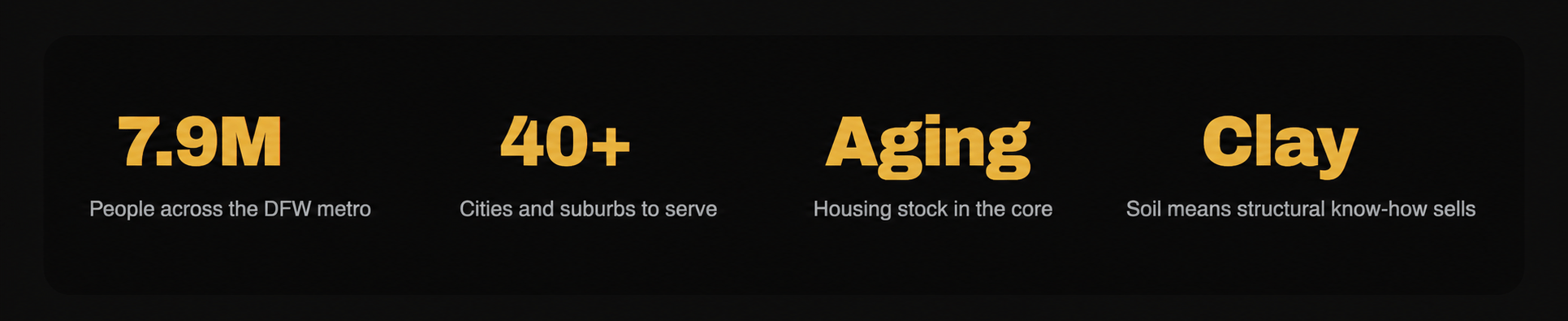
DFW is a remodeler’s market, and that cuts both ways. Strong population growth and rising property values keep demand high, but they also pull in a crowd of competitors, which means visibility and trust decide who gets the call.
A few realities shape remodeling demand here specifically. Established neighborhoods across Dallas and Fort Worth, from East Dallas and Oak Cliff to older parts of Fort Worth and the mid century suburbs, carry aging housing stock that owners are choosing to update rather than leave. At the same time, the newer high growth suburbs like Plano, Frisco, Prosper, McKinney, Southlake, and Arlington drive a steady stream of higher end kitchen and bathroom projects. North Texas is also built on expansive clay soil, so foundation movement is a familiar issue, and additions or major remodels often come with structural considerations that homeowners want a credible pro to handle. Long hot summers push demand for energy efficiency upgrades, window and insulation work, and outdoor living spaces. And because permitting and inspection rules differ across Dallas, Fort Worth, and the surrounding cities, homeowners lean toward remodelers who clearly know the local process.
None of that changes the fundamentals of lead generation. It changes the emphasis. In a market this competitive, a remodeler who is easy to find, obviously trustworthy, and fast to respond will win far more than one who simply does good work quietly. National context helps here too. Groups like the National Association of Home Builders track remodeling activity that has stayed strong nationwide, and DFW consistently runs ahead of the national pace.
What Counts as a Quality Home Remodeling Lead
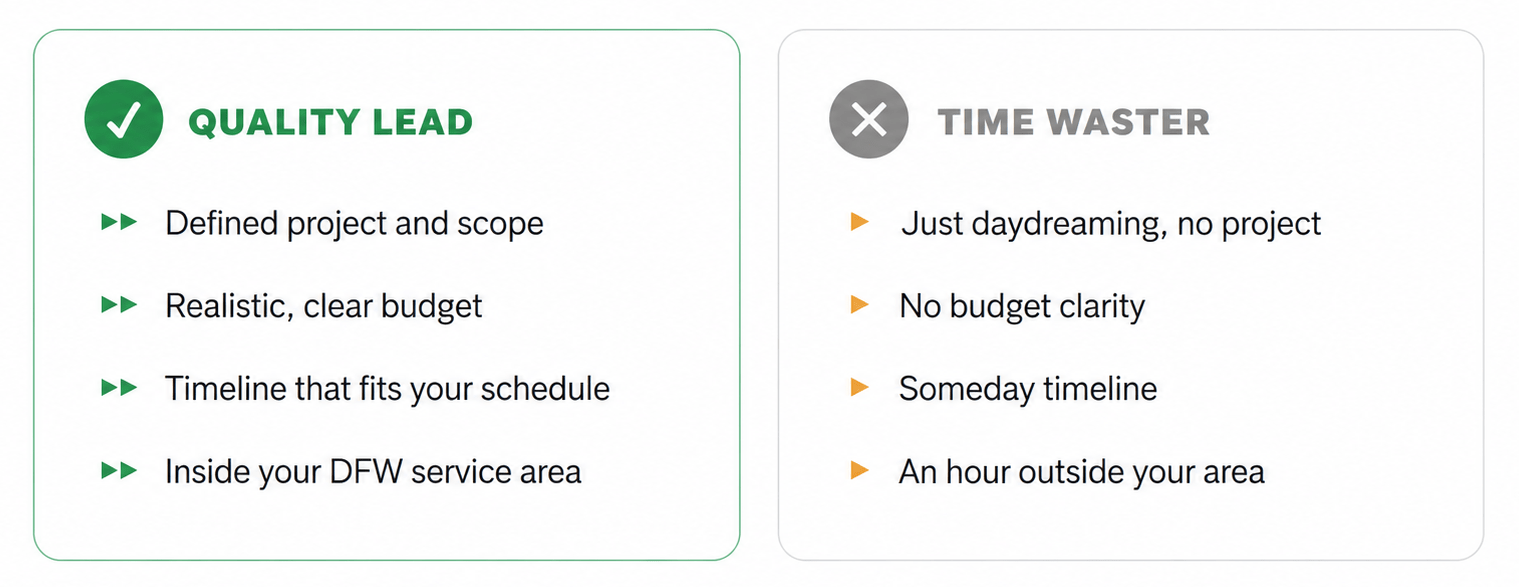
A home remodeling lead is not just a form fill or a phone call. It is a homeowner with a defined project, a realistic budget, a timeline that fits your schedule, and a location inside your service area. That last point matters more in DFW than most places, because a lead in the wrong suburb can mean an hour in traffic each way.
The reason this distinction matters is simple. Most businesses chase volume when they should chase intent. A high quality lead has usually already researched options and is ready to engage seriously. A low quality lead is still daydreaming or has no budget clarity. The gap between the two shows up directly in your close rate, your wasted drive time, and your profit. The goal is never more leads. It is more of the remodeling leads that actually convert.
How Dallas Fort Worth Homeowners Choose a Remodeler
A typical DFW homeowner starts with a search like kitchen remodel contractor near me, then explores listings, reads reviews, and sizes up credibility. They lean on platforms like Houzz and Angi for project galleries and verified feedback, and many check the Better Business Bureau before they ever reach out. Almost all of them compare several contractors first.
The takeaway for your marketing is that visibility has to exist across multiple touchpoints, not just one. If a homeowner finds you on Google, sees a thin profile with six reviews, then finds your competitor with fifty recent reviews and a full photo gallery on Houzz, you have already lost. Reviews carry unusual weight here. Research from BrightLocal shows the vast majority of people read them before choosing a local business.
Want to know where your calls are
leaking right now?
The Channels That Produce Remodeling Leads in DFW
No single channel is a pipeline. A system is. Here is how the main channels earn their place.
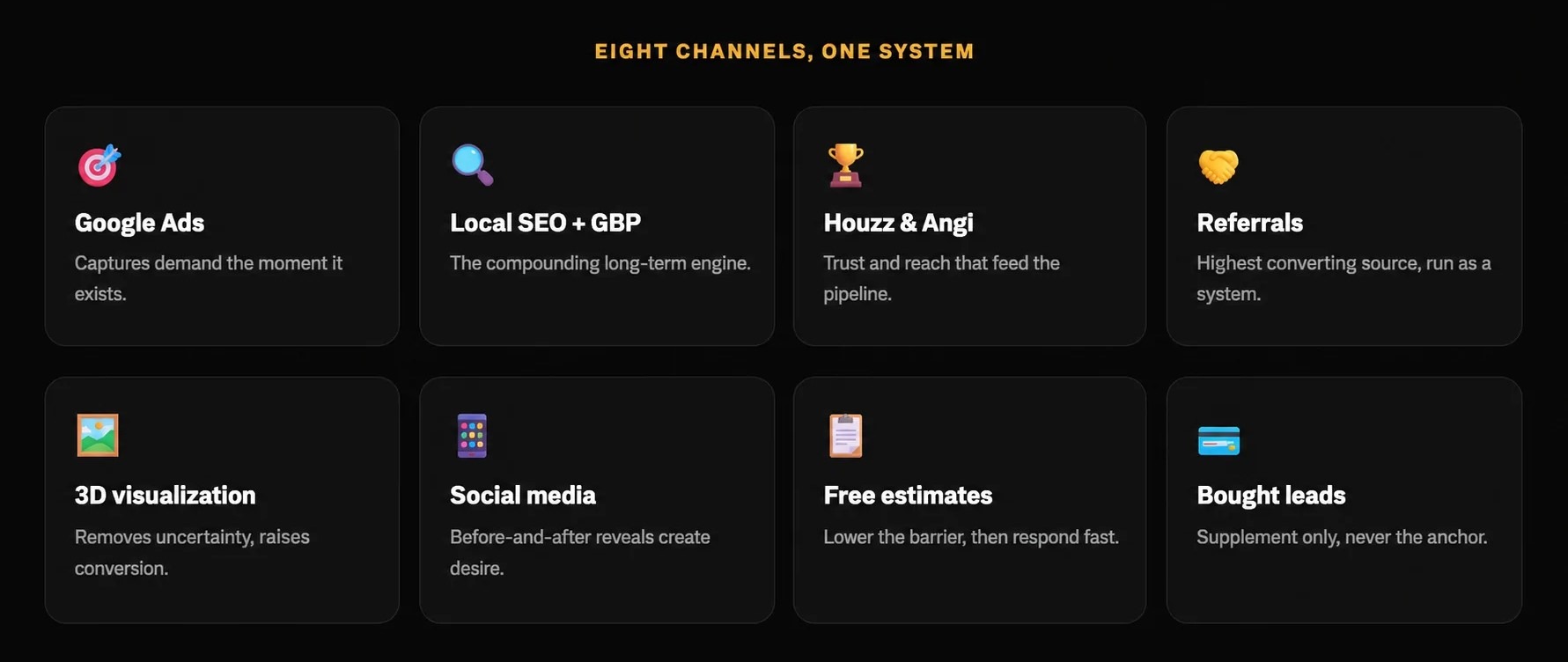
Any one channel is fragile.Together they become a predictable flow.
Google Ads captures demand the moment it exists. When a homeowner searches for a remodeler, they are in decision mode. Paid search puts you in front of that intent immediately, which makes it the fastest channel to switch on. Success depends on tight alignment between the search, the landing page, and how fast you respond. In a market as competitive as DFW, a slow reply to a paid lead is money set on fire.
Local SEO and your Google Business Profile build the long term engine. This is the compounding channel. Optimizing your website and your Google Business Profile is what makes you show up when someone in your area searches locally. Google itself explains that local visibility comes down to relevance, distance, and prominence, and its guidance on local ranking is worth reading. Real home remodeler lead generation through SEO is not one page. It is a structured system of location specific service pages for the DFW cities you serve, supporting content, and a steady flow of reviews.
Industry platforms strengthen trust and reach. Listings on Houzz, Angi, and HomeAdvisor add both visibility and credibility, and consistency across them makes you more familiar and more likely to be shortlisted. Treat them as trust builders that feed your pipeline, not as your whole pipeline.
Referral systems turn happy clients into a channel. Referrals are the highest converting lead source in remodeling because trust already exists, yet most companies treat them passively. Build a real system with follow up, a simple way to refer, and a reason to do it.
Visualization tools raise conversion. Homeowners hesitate when they cannot picture the finished result. 3D renderings and design previews remove that uncertainty, and confidence is what turns a maybe into a signed contract.
Social media creates desire, not just awareness. Most remodelers use it as a gallery. The ones who win use it for transformation stories, before and after reveals, and real project journeys, which is what actually drives inquiries.
Free estimates lower the barrier to reach out. They work when the intake is built to capture scope, budget, and timeline, and when you respond fast. A free estimate that sits for two days is worse than no offer at all.
Buying leads can supplement, never anchor. Purchased leads add volume in slow stretches, but quality varies and shared leads pit you against three competitors on speed and price. Use them to fill gaps while your owned channels grow, and track every source so you know what a booked job actually costs you.
Speed and Follow Up: Where Most DFW Remodelers Lose the Job
You can do everything above and still lose, because the leak that costs the most is what happens after the lead comes in. A homeowner who requests an estimate and does not hear back within the hour has usually already contacted someone else. Speed is the quietest killer, and follow up is a system, not a single call.
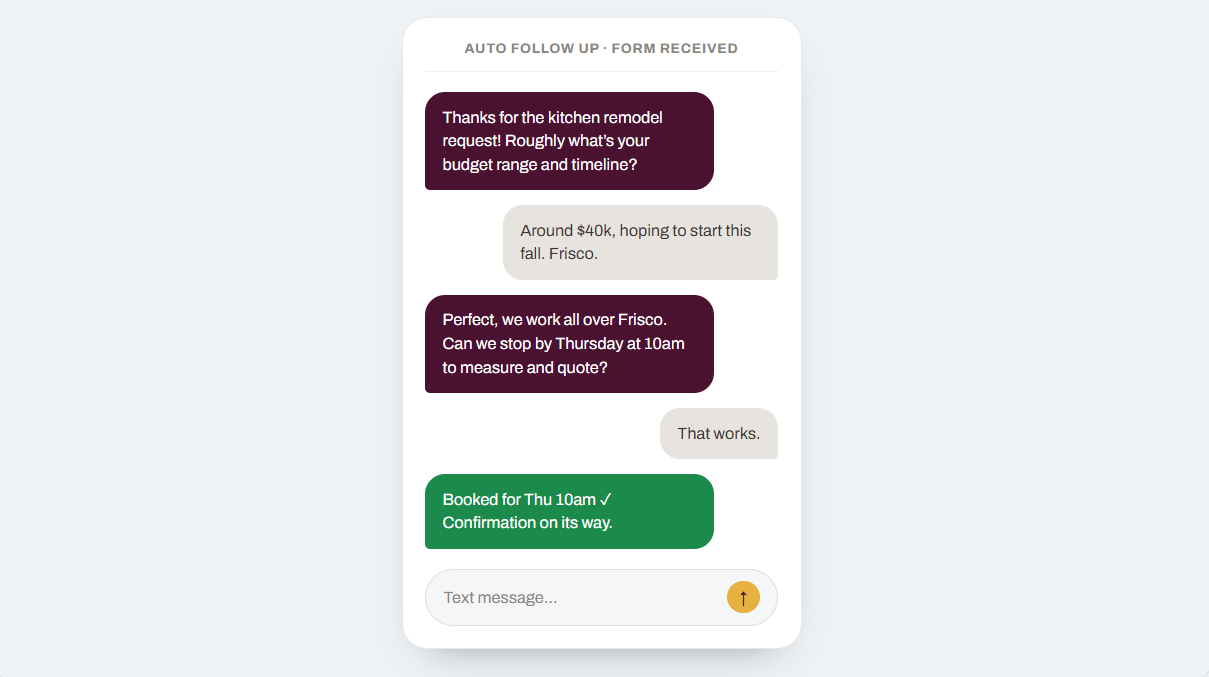
This is where a modern AI system changes the math for a busy remodeler. The moment a call is missed or a form comes in, a missed call text back can go out automatically, so the lead knows they have been heard even while your crew is on a job site. An AI assistant can reply within seconds around the clock, ask the basic questions about the project, scope, and timeline, and offer real appointment windows before a competitor picks up. If the homeowner does not respond, the system keeps a polite follow up cadence running on its own over the next several days instead of quitting after one try, and every lead lands in one place so nothing gets lost in a voicemail or a sticky note. This kind of automated lead management is exactly what lets a small DFW remodeler follow up like a company three times its size, and it is often the single highest return upgrade an owner can make.
Build a System, Not Isolated Tactics
The most common mistake is treating each channel as a separate decision. Owners ask whether they should do SEO or ads. The answer is both, working together. SEO builds long term visibility. Paid ads capture demand today. Referrals bring trust. Content builds authority. Platforms validate credibility. Fast AI driven follow up converts all of it. Together they create a predictable flow instead of a rollercoaster.
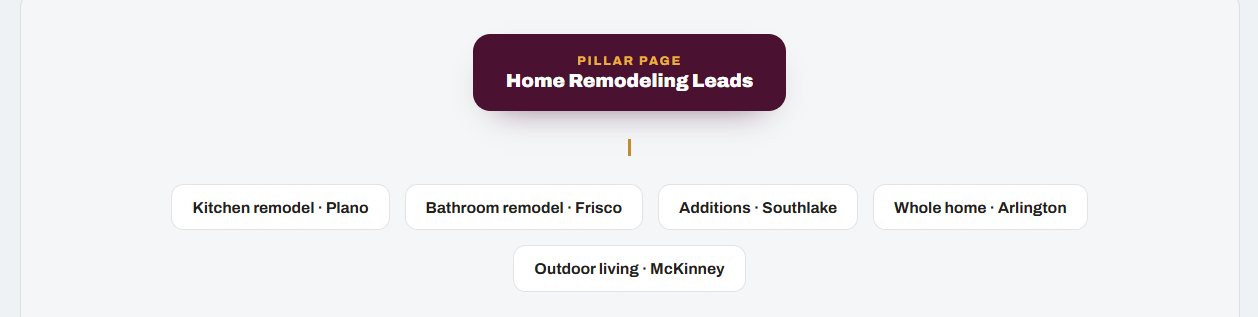
To rank across the DFW area, structure content in topic clusters, with strong pillar pages supported by related articles and location specific service pages for the cities you serve. One caution that matters in 2026. Do not spin up thin city pages that only swap the town name, because Google treats those as doorway pages and can penalize them. Each local page needs real substance, the neighborhoods you cover, local project examples, permitting notes, and genuine differences, or it does more harm than good. Done right, this hub and spoke structure is how a DFW remodeler earns visibility city by city without getting flagged.
Frequently Asked Questions
Combine channels into a system. Local SEO and an optimized Google Business Profile make you findable, Google Ads captures homeowners in decision mode, reviews and platforms like Houzz and Angi build trust, and fast follow up converts the interest. No single channel is a pipeline on its own.
Focus on owned channels. Rank your site and Google Business Profile locally, build dedicated pages for kitchen and bathroom remodeling and for the DFW cities you serve, collect reviews consistently, and turn past clients into a referral system. These compound over time and lower your cost per lead instead of raising it every month.
A defined project, a realistic budget, a timeline that fits your schedule, a location inside your service area, and accurate contact details. One factor decides everything even for strong leads, and that is how fast you respond.
Buying leads can fill slow periods, but use it as a supplement, not a foundation. Quality varies by provider, shared leads force you to compete on speed and price, and the moment you stop paying the leads stop. Track cost per booked job, not cost per lead.
In minutes, not hours. Homeowners often hire whoever answers first. During business hours aim to reply within five minutes, and after hours use an automatic text so the lead knows they have been heard. An AI follow up system makes that possible even when your crew is busy.
The Bottom Line
Most Dallas Fort Worth remodelers do not have a lead problem. They have a system problem. When marketing is a pile of isolated tactics, results stay unpredictable. When it is a structured system that makes you visible, trusted, fast, and easy to say yes to, the pipeline becomes steady.
If your lead flow feels inconsistent, the issue is structure, not effort. At Yay Blitz we build complete lead generation systems for DFW home service businesses, combining local SEO, paid advertising, conversion focused design, and AI powered follow up into one strategy. Want to see where your remodeling pipeline is leaking? Book a free strategy call and we will map it out plainly. No pitch, just the scoreboard that counts.
home remodeling leads guide is the pillar. Link out to the trade siblings: the HVAC lead generation post
 Funnel Strategy
 Graphic & Web Design
 Paid Local Ad
 Marketing Strategy