

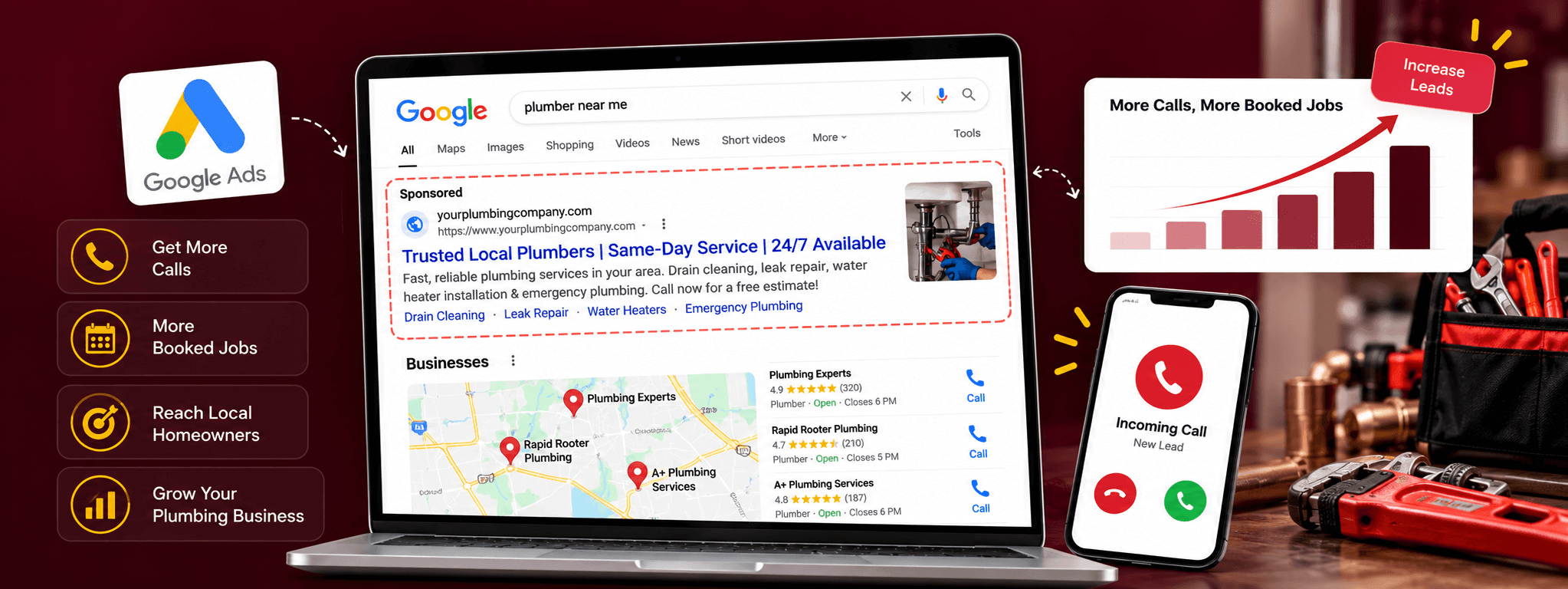
A plumbing company can spend $5,000 on Google Ads, generate dozens of calls and form submissions, and still finish the month unsure whether the campaign actually worked. The dashboard may show conversions, a reasonable cost per lead, and steady click volume, but the owner is asking a more practical question: how many profitable plumbing jobs did we book?
That gap between advertising metrics and business outcomes is where many plumbing campaigns break down. Google Ads can put a plumber in front of a homeowner at the exact moment a pipe bursts, a water heater fails, or a sewer line backs up. It can also burn through budget on weak search intent, the wrong service areas, generic landing pages, missed calls, and conversions that never become customers.
Good Google Ads for plumbers should therefore be built around one outcome: profitable booked work from the services and locations the company actually wants to grow.
What Google Ads for Plumbers Actually Needs to Accomplish
Paid search has a simple job. It should capture high intent local demand, send the right customer to the right message, make contacting the business easy, and give the plumbing team a realistic opportunity to book the job.
Clicks are not the final score. Neither are form submissions. A plumbing company should care about qualified calls, booked appointments, completed jobs, customer acquisition cost, average job value, gross profit, and revenue attributed back to the campaign.
That means Google Ads should sit inside the broader plumbing marketing system. If the campaign targets strong searches but the office misses half the calls, the problem is not only advertising. If the ads are relevant but every visitor lands on a generic homepage, conversion can suffer.
Build Campaigns Around Plumbing Service Intent
One of the fastest ways to lose control of plumbing ad spend is to place unrelated services inside one broad campaign and expect one message to work for everyone. A homeowner searching for an emergency plumber has a different need from someone researching water heater replacement. Separate important service categories when their intent and economics are meaningfully different.
Strong urgency. Availability, location coverage, and the next action need to be obvious. Calls are often the dominant conversion.
May deserve different ad groups depending on spend and volume. Message should match the specific problem searched for.
Repair and replacement should not share a landing page. One is urgent, the other wants options and financing.
Longer decision cycles benefit from detailed landing pages, proof, and follow up after the first inquiry.
Commercial plumbing should usually be separated from residential demand when the business actively wants both. Property managers and facilities teams have different service expectations, buying processes, and job values.
Two paid leads. The platform sees two leads. You don't.
Close drive, high value. Strong return.
Same paid cost, low value. Drive time erases the margin.
Build geography around technician capacity, drive time, average job value, service type, response time, and local competition. Google notes location targeting uses multiple signals and is not guaranteed to be perfectly accurate — review actual geographic performance instead of assuming settings are working exactly as intended.
Ad Copy Should Match the Search and the Operation
A strong plumbing ad does not need clever copy. It needs relevance and credibility. If the search is for sewer line repair, the ad should clearly speak to sewer line problems. Useful messaging can include the specific service, realistic availability, service area, licensed or insured status, financing where genuinely offered, and review strength.
Do not advertise promises the operation cannot deliver. If the company does not provide true twenty four hour response, do not build the campaign around it. Google's Quality Score framework reinforces the same principle: ad relevance, expected click through rate, and landing page experience are core diagnostic components.
Do Not Send Every Click to the Homepage
The homepage has to serve many audiences. A paid landing page can continue one specific conversation. Someone who searched for emergency drain cleaning should not have to hunt through a general plumbing website to figure out whether the company clears drains and serves the area.
Google recommends matching the landing page closely with the ad and keywords. This is where Graphic and Web Design becomes part of paid search performance. Design should support trust and action, not simply make the page look modern.
Feed Qualified and Closed Leads Back Into Google
This is one of the most important 2026 measurement improvements for local service advertisers. Google's enhanced conversions for leads can connect online lead activity with offline outcomes using first party customer data and conversion information from the CRM or lead management system. Google recommends qualified lead or converted lead goals for lead generation advertisers using this setup.
For a plumbing company, that means the account can move beyond teaching Google that every form submission or long phone call is equally valuable.
When possible, feed the later stages back into the advertising system. Google also changed enhanced conversions in 2026, combining web and lead settings and moving offline data workflows further into Data Manager. The business principle is straightforward: optimize toward the customers you actually want, not just the easiest actions to count.
A Low Cost Per Lead Can Still Be Expensive
Consider two hypothetical plumbing campaigns.
Campaign A looks better if the report ends at CPL. Campaign B is acquiring paying customers more efficiently. The same logic applies to service mix: a $180 sewer replacement lead can be more valuable than a $70 low value inquiry if it closes well. This is why good PPC for Contractors should be measured through booked work rather than the cheapest lead number.
What Should Google Ads Cost for Plumbers in 2026?
Published benchmarks vary widely because markets, services, campaign structure, and lead definitions vary. Current 2026 industry guides commonly place nonbranded plumbing Search leads somewhere from roughly the low $100s into the high $100s, while other datasets show wider ranges. Treat those figures as reference points, not targets.
A Dallas Fort Worth plumber, a small suburban plumbing company, and a business targeting emergency service in a highly competitive metro should not expect identical costs. Instead of asking only "Is our CPL above the average?" ask what percentage of leads are qualified, what percentage book, what percentage become customers, what the customer acquisition cost is, and what gross profit the campaign produces.
Budget Should Follow Demand and Capacity
More budget is useful only when the business can convert and fulfill the additional demand. If the plumbing team is fully booked for the next three days, increasing emergency ad spend may create missed calls and frustrated customers.
Paid Local Advertising works best when the budget has a specific job to do. "Get more plumbing leads" is vague. "Add twelve more profitable water heater and sewer jobs this month inside our core service area" creates a much clearer operating target.
Sending every click to the homepage and ignoring the search terms report.
Targeting too much geography and mixing residential with commercial intent.
Counting spam and wrong service inquiries as leads, optimizing for CPL alone.
CRM outcomes never connected back to advertising, campaigns changed before enough data exists.
The most expensive problems are often structural rather than advanced. Many of these do not require a new ad platform. They require cleaner campaign architecture and better measurement.
Twenty two questions for the account you have today
Structure & targeting
11 itemsConversion & measurement
11 itemsFrequently Asked Questions
Are Google Ads worth it for plumbers?+
How much do Google Ads cost for plumbers?+
Should plumbers use broad match keywords?+
Do plumbers need dedicated landing pages for Google Ads?+
What is more important, cost per lead or customer acquisition cost?+
Should plumbers use Google Ads and local SEO together?+
Build Google Ads Around Booked Plumbing Jobs
Google Ads can be one of the fastest ways for a plumbing company to reach a homeowner with an immediate need. It can also become one of the fastest ways to waste budget if the campaign is disconnected from service economics and the front office.
Start with the jobs you want. Separate important service intent. Review the searches customers actually type. Protect the budget with negative keywords. Target areas the company can serve profitably. Match each ad with the right landing page. Track calls and forms properly. Then follow the lead through qualification, booking, completed work, and revenue.
Yay Blitz helps local service companies connect paid search, website conversion, lead tracking, and follow up so advertising can be evaluated by the jobs it produces rather than isolated platform metrics. Start with a free strategy assessment if you want to identify where your plumbing Google Ads account is losing budget, leads, or booked work.
 Funnel Strategy
 Graphic & Web Design
 Paid Local Ad
 Marketing Strategy