

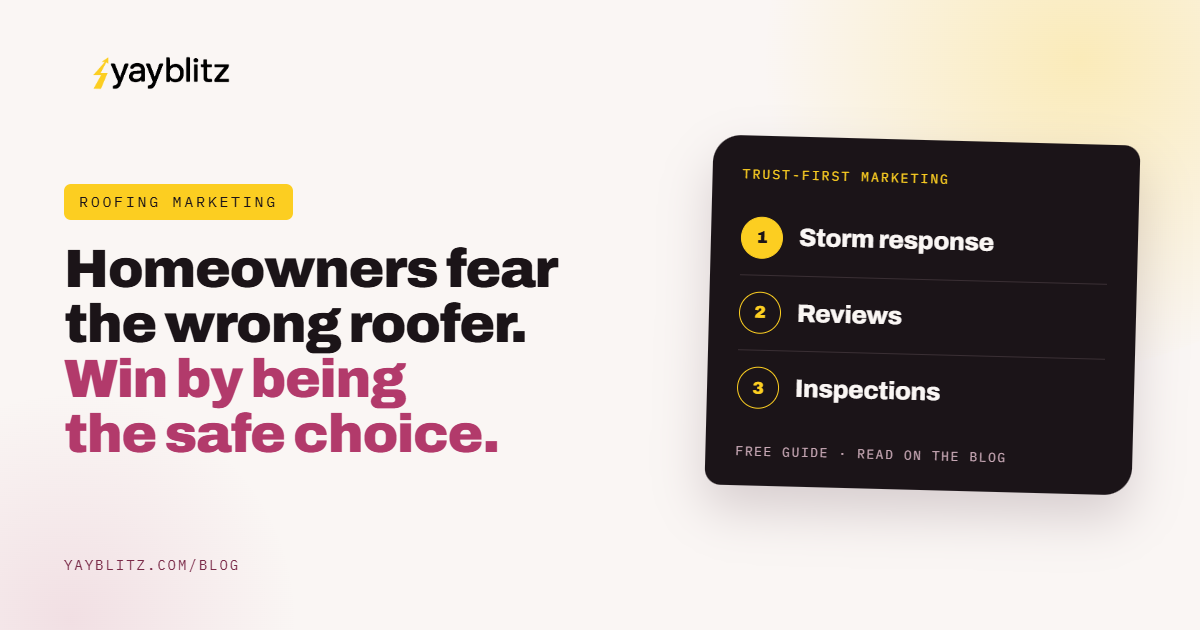
Roofing demand comes in two shapes. Retail replacements build slowly: an old roof, a leak, a home sale. Storm work arrives all at once after hail or wind, along with out-of-town crews knocking on every door.
Both reward the same thing: being the company homeowners trust. The BLS projects roofer employment to grow 6% through 2034, faster than average, and much of that work is replacement and repair. Marketing should make you the obvious local choice for both.
Roofing companies win more jobs by being the safest local choice: a complete Google Business Profile with steady reviews, a website that shows local projects and explains insurance, fast documented inspections, and Local Services Ads or Google Ads in core towns. Add a storm response plan and financing for retail replacements.
Track every lead from source to signed contract so you can drop channels that only produce inspections.
What Marketing Works Best for Roofing Companies?
Channels that catch active roof problems, then a process that builds trust fast.
Many roofers buy leads that only produce inspections. A better mix catches homeowners with a real need, then wins them with a clear inspection report and a written proposal the same day or the next.
How Do Roofers Build Trust Online?
Show local proof everywhere a homeowner looks.
After a storm, homeowners get a flood of door knockers. The roofer with a local track record and clear reviews from neighbors wins, even at a higher price.
How Do Roofers Show Up in Local Search?
A complete Google profile, service pages, and town pages with real roofs.
Set your primary category to Roofing contractor. List services separately: roof replacement, roof repair, storm damage, inspections, gutters, commercial roofing. Post photos of finished roofs weekly with the town in the caption.
Build a page for each core town showing two or three roofs you completed there, common local roof types and weather risks, and a review from a homeowner nearby. Avoid duplicate pages with only the town name changed; they rarely rank and look careless.
How Do Reviews Help Roofing Companies Win Jobs?
They’re the main proof a homeowner has that you’ll show up and stand behind the work.
From BrightLocal’s 2026 survey. Roofing reviews age fast in a homeowner’s eyes, so ask after every job, not in bursts. Ask at the final walkthrough and send a direct link the same day. Reply to each review and mention the town and roof type.
Do Local Services Ads and Google Ads Work for Roofers?
Yes, with tight service areas, fast answering and lead disputes.
Local Services Ads charge per lead and show your badge and reviews at the top of search. Answer every call live; LSA rewards responsiveness. Dispute leads outside your service or job type.
For Google Ads, split campaigns by repair, replacement and storm damage, target only towns you serve, and use call extensions. Send clicks to a matching page with tap-to-call, a short form and local proof. Exclude “jobs,” “salary” and DIY terms. Read PPC for contractors for common mistakes.
How Should Roofers Market After a Storm?
Have a plan ready: pages, ads, scripts and crew capacity, before the first hail.
Be honest about insurance. Don’t promise a claim will be approved or offer to cover deductibles; in many states that’s illegal. Explain the process and let the homeowner and insurer decide.
Do Free Roof Inspections Work?
Yes, when they’re fast, documented and honest.
A free inspection lowers the barrier to calling. It works when the report is useful: clear photos, what you found, what’s urgent, and what can wait. Homeowners trust a roofer who says “you have a few years left” more than one who says every roof needs replacing.
Send the report and proposal within a day. Then follow up on day 2, 5 and 14 with a short message, a nearby project photo and a financing option. See AI estimate follow-up for an automated sequence.
How Do Roofers Show Up in AI Search?
Clear facts on services, towns, warranties and insurance, plus recent reviews.
BrightLocal found 45% of consumers have used AI for local recommendations. AI tools describe roofers using your website, Google profile, reviews and mentions across the web.
How Should a Roofing Company Measure Marketing?
By signed roofs and revenue per source.
A channel that sends many inspections but few signed roofs is expensive, even with cheap leads. Record source and job value in your CRM and review monthly.
What Mistakes Should Roofing Companies Avoid?
Overpromising on insurance, slow proposals, and buying inspections you can’t close.
Should Roofers Focus on Retail or Storm Work?
Build a retail base you can count on, and treat storm work as a surge you’re ready for.
Companies that rely only on storms ride a roller coaster: feast after a big hail event, then layoffs. A steady retail base keeps crews busy and gives you a reputation that wins storm work when it comes.
Retail homeowners shop more carefully. They read reviews, compare two or three proposals and often ask about financing. That’s where clear proposals, warranties and follow-up make the difference.
How Do Roofers Use Financing and Proposals to Close?
Show monthly options on every replacement proposal and make the proposal easy to compare.
A new roof is a large, often unplanned expense. Showing a monthly payment option next to the total helps homeowners who would otherwise delay. Follow your lender’s rules and federal advertising rules for credit terms, and don’t promise approval.
How Do Roofers Get Referrals From Realtors and Inspectors?
Be the roofer who answers fast, inspects quickly and writes clear reports for a sale.
Home sales create urgent roof questions. Inspectors flag issues, buyers ask for credits, and realtors need a roofer who can inspect within days and write a clear, neutral report. Be that roofer and you’ll get steady referrals.
Past customers are the other referral source. Send a thank-you, a one-year check-in and a referral invitation. Neighbors who watched the crew work are often next.
How Do Roofers Use Photos and Video to Build Trust?
Show homeowners what you see on the roof, and show the crew doing the work.
Most homeowners never go on their roof. They rely on what you tell them, which is exactly why they’re wary. Photos and short videos close that gap. Show the damaged shingle, the lifted flashing or the soft decking, with a clear note on what it means.
Reuse every asset. A finished roof becomes a project page, a Google post, a social post and a follow-up email to neighbors. Ask permission before showing a home’s address, and blur house numbers.
Video also helps after storms, when homeowners are flooded with door knockers. A short, calm explanation of how to spot legitimate damage builds more trust than any flyer.
What Does a 90-Day Marketing Plan Look Like?
Fix trust and response first, then add paid reach and a storm plan.
Track inspections, proposals, signed roofs and source weekly. Adjust spend toward the channels that produce signed roofs at a cost you’re happy with.
The 16-point roofing marketing checklist
Tick what you already do well. The first unticked items are usually your next best move.
Trust
4 itemsLeads
4 itemsLocal search
4 itemsStorm
4 itemsMost roofers don’t need more inspections. They need more trust and faster proposals. That’s fixable.
Roofing marketing questions
How do roofing companies get more leads?+
What is the best marketing for roofers?+
How should roofers market after a storm?+
Do free roof inspections bring in jobs?+
Should roofers publish prices?+
How do roofers compete with storm chasers?+
Be the Safe Choice
Roofing marketing is mostly trust. The companies that grow show local proof, explain insurance honestly, inspect fast and follow up. Storms bring demand; trust decides who gets it.
Homeowners don’t buy roofs. They buy confidence.
Yay Blitz helps roofing companies connect Graphic and Web Design, Paid Local Advertising, and AI Lead Management into one measurable system for getting and converting leads.
Want a second opinion? Book a Free Strategy Assessment. We’ll review your profile, ads and inspection process and show where signed roofs slip away.
 Funnel Strategy
 Graphic & Web Design
 Paid Local Ad
 Social Media Marketing