

Interior design is a referral business that pretends to be a social media business. Owners spend hours on Instagram, then admit most of their best projects came from a past client, a builder or a realtor.
That doesn’t mean online marketing is wasted. It means it has a different job: make you easy to find when a referral looks you up, make your fit obvious, and turn an inquiry into a paid consultation without ten emails.
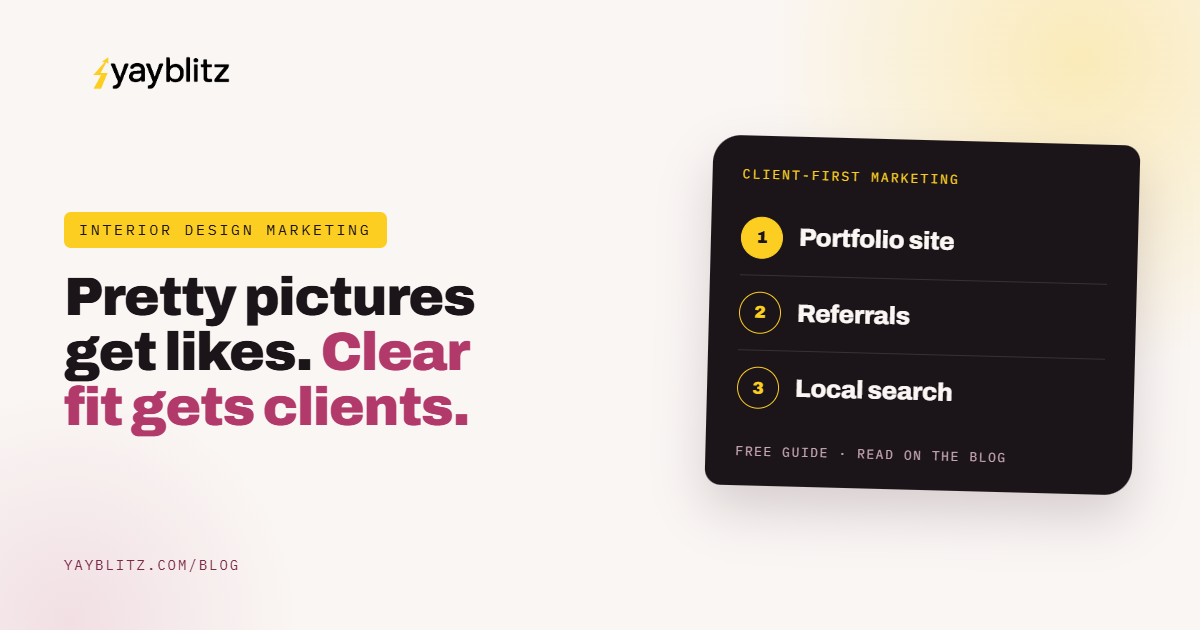
Interior designers win better clients by making fit obvious: a portfolio site with services, service area and a starting budget, a complete Google Business Profile with steady reviews, and a referral system with past clients and trade partners. Instagram and Houzz support that by showing finished work, not by replacing it.
Then follow up on every inquiry within a day and track which sources produce signed projects.
What Marketing Works Best for Interior Designers?
The channels where people already trust you: referrals, local search, and a site that answers the budget question.
Most studios have more inquiries than they think. The problem is mix: too many small, undecided or budget-mismatched leads, and not enough of the projects they want. The fix is less about reach and more about clarity.
The BLS counted 87,100 interior designer jobs in 2024, with growth about as fast as average through 2034. That’s a crowded field in most metros. The studios that stand out say plainly what they do and who it’s for.
How Do You Build a Portfolio Site That Qualifies Clients?
Show the work, explain the process, and publish a starting investment so the right people book.
A clear starting budget is the single most useful line on a designer’s site. It saves you from discovery calls that can’t become projects, and it makes the people who do book feel confident they’re in the right place.
How Do Interior Designers Show Up in Local Search?
A complete Google Business Profile, a page per service, and steady reviews.
When someone hears your name from a friend, they Google it. When someone needs help with a kitchen refresh, they search “interior designer near me” or “kitchen designer in [town].” Both paths land on your Google Business Profile.
Add a website page for each main service and one for your core city. Keep it specific: what the service includes, typical timeline, a project from that area, and a starting price. Location pages work when they show real local projects, not swapped town names.
How Do Reviews Help Interior Designers Get Clients?
They give a referral the proof they need, and they feed your ranking and AI answers.
Those figures come from BrightLocal’s 2026 Local Consumer Review Survey. Designers often have few reviews because projects are long and clients are few. That makes each one count more.
Ask at the reveal, when the client is happiest. Send a direct review link by text the same day, and make it easy: “Would you share a few words about the project? It helps other homeowners find us.” Reply to every review within a few days, mentioning the room and town.
How Do You Get More Referrals From Builders, Realtors and Trades?
Treat referral partners as a channel: a short list, regular contact and a simple way to send work.
Past clients are the other half. Send a thank-you after install, a one-year anniversary note with photos, and an invitation to refer friends. Nielsen found 88% of people trust recommendations from people they know more than any other source.
Is Instagram or Houzz Worth It for Interior Designers?
Yes, as a portfolio and trust signal. Rarely as the main source of signed projects.
Instagram and Pinterest show your style and keep you familiar. Houzz helps with renovation-minded homeowners who browse by project type. All three work best when each post points to a real project page on your site with the town, scope and budget range.
Short videos of a reveal or a sourcing trip often outperform polished stills. Keep a simple rule: every finished project gets a gallery page, one carousel, one short video and a Google profile post.
How Should Interior Designers Handle Inquiries and Consultations?
Reply within a day, qualify by budget and timing, and make the first meeting count.
A paid or credited first consultation filters out browsers and values your time. Many studios charge for the in-home visit and credit it toward the design fee if the client signs. Either way, send a short recap afterwards with next steps and a proposal date.
Then follow up. Proposals that sit for two weeks usually go cold. A planned sequence of three or four friendly check-ins over 30 days, by email and text, wins more projects. See AI estimate follow-up for a simple setup.
How Do Interior Designers Show Up in AI Search?
Make your services, area, prices and reviews easy for AI tools to read and quote.
BrightLocal found 45% of consumers have used AI tools to find local business recommendations, up from 6% a year earlier. When someone asks ChatGPT or Google’s AI Mode for “an interior designer in [town] for a kitchen refresh,” those tools pull from your site, Google profile, reviews and mentions elsewhere.
What Should an Interior Designer Spend on Marketing?
Budget from your project value and close rate, not a fixed monthly fee.
Use your own numbers. Most of a designer’s marketing cost is time: photography, writing project pages, partner coffees. Pay for professional photos of every major project; they’re used everywhere for years. Add paid search only for a specific gap, such as a new town or service, and judge it on signed projects.
What Mistakes Should Interior Designers Avoid?
Hiding prices, skipping follow-up, and measuring likes instead of projects.
Start with the basics in order: site clarity, Google profile, reviews, partner list, follow-up. Most studios see the biggest improvement from the first three alone.
What Does a 90-Day Marketing Plan Look Like?
Fix clarity in month one, build trust in month two, and add reach in month three.
Keep a simple monthly scorecard: inquiries, qualified inquiries, consultations booked, proposals sent, projects signed, and the source of each. After 90 days you’ll know which two or three channels produce your best projects, and you can put more time there.
If you serve more than one area, repeat the plan town by town. A page with two real projects in a neighborhood, a few reviews that mention it and a partner who works there will do more than a dozen generic location pages.
The 16-point interior designer marketing checklist
Tick what you already do well. The first unticked items are usually your next best move.
Website
4 itemsTrust
4 itemsLocal search
4 itemsFollow-up
4 itemsMost studios don’t need more followers. They need clearer fit and faster follow-up. That’s fixable.
Interior designer marketing questions
How do interior designers get clients?+
Should interior designers publish prices?+
Is Instagram enough to market an interior design business?+
Should interior designers charge for consultations?+
How do interior designers rank on Google?+
How much should an interior designer spend on marketing?+
Make Fit Obvious, Then Follow Up
The studios with the best clients aren’t always the most famous. They say who they serve, where, and from what budget. They make referrals easy, ask for reviews at every reveal, and answer inquiries fast.
Clarity attracts the right clients. Speed keeps them.
Yay Blitz helps interior design studios connect Graphic and Web Design, Paid Local Advertising, and AI Lead Management into one measurable system for getting and converting leads.
Want a second opinion? Book a Free Strategy Assessment. We’ll review your site, Google profile and inquiry process and show you what to fix first.
 Funnel Strategy
 Graphic & Web Design
 Paid Local Ad
 Social Media Marketing