

A cleaning business is one of the lowest-cost service businesses you can start. You don’t need a truck full of equipment or a trade license, and demand is steady: busy families, older homeowners, rental hosts, landlords and offices all need regular cleaning. Many clients stay for years once they find someone they trust.
Trust is the whole business. Clients give you keys and codes, let you into their homes when they are away and judge you on details. New cleaning businesses often underprice, skip insurance and bonding, rely on one person doing every clean and struggle when they try to hire. The owners who grow build trust, systems and pricing that leave room for a team.
This guide covers how to start a cleaning business step by step: choosing residential or commercial, legal setup, insurance and bonding, supplies, startup costs, services, pricing, policies, branding, website, Google Business Profile, first clients, reviews, ads, lead response, software, recurring revenue, hiring, mistakes and your first 90 days.
To start a cleaning business, choose your niche, register the business, get general liability insurance and a janitorial bond, buy professional supplies, write clear checklists and policies, and price by home size and frequency from your real labor cost plus profit.
Then build a simple website and a complete Google Business Profile, win clients through referrals and local groups, ask for reviews after early cleans, answer inquiries quickly and focus on weekly and biweekly recurring clients so you can hire and train a team.
Is a Cleaning Business Worth Starting in 2026?
Yes. Startup costs are low, demand is steady and recurring clients make revenue predictable.
Residential cleaning has a simple model: clients book recurring visits, and each visit is a fixed price. Once you have a base of weekly and biweekly clients, you can forecast revenue, schedule a team and grow by adding cleaners rather than working longer hours yourself.
The challenges are labor and trust. Cleaning is physical, staff turnover is common across the industry and clients notice small mistakes. Businesses that win set clear standards, pay and treat cleaners well, communicate reliably and price for a team rather than a solo cleaner.
Clients don’t buy cleaning. They buy trust that it will be done right every time.
Should You Start Residential or Commercial Cleaning?
Most start residential because it’s easier to win first clients, then add commercial when they have a team.
Residential cleaning includes recurring home cleaning, deep cleans, move-in and move-out cleans and short-term rental turnovers. Clients are easy to reach through referrals and local search, and recurring visits build steady revenue.
Commercial cleaning includes offices, medical practices, retail and common areas. Contracts can be larger and more stable but often require evening work, formal bids, specific insurance and a team that can cover every night. Many owners start residential, build systems and staff, then add selected commercial contracts.
Do You Need a License to Start a Cleaning Business?
Usually just a general business license, but check your city, county and state.
Most places don’t require a special license to clean homes, but you typically need a general business license and may need to collect sales tax on cleaning services in some states. Some cities have additional rules for home-based businesses.
Check local requirements before your first paid job. The SBA’s guide to licenses and permits explains where to look. Keep copies of everything, because commercial and property management clients may ask.
How Should You Set Up the Business Legally?
Pick a structure, register your name, get an EIN and open a business bank account.
Many cleaning businesses start as an LLC to separate business and personal liability. The SBA explains the options in choosing a business structure.
Register your business name, get a free Employer Identification Number from the IRS and open a separate bank account. When you hire, learn the difference between employees and contractors. Misclassifying cleaners is a common and costly mistake, so get advice from an accountant or employment professional.
What Insurance and Bonding Does a Cleaning Business Need?
General liability and a janitorial bond at minimum, plus workers’ compensation once you hire.
Cleaners work inside clients’ homes around valuables, so insurance and bonding are part of what you sell. General liability covers accidental damage, such as a broken item or a damaged floor. A janitorial bond can protect clients if an employee is found responsible for theft.
- →General liability: accidental damage and injuries to others
- →Janitorial bond: client protection against employee theft
- →Workers’ compensation: usually required once you have employees
- →Commercial auto: if you use vehicles for work
Mention “insured and bonded” on your website, quotes and Google profile. The SBA’s business insurance guide explains the main types.
What Supplies and Equipment Do You Need?
Professional supplies, a reliable vacuum, microfiber, caddies and clear checklists.
You don’t need much, but quality matters. A good commercial vacuum, plenty of color-coded microfiber cloths, mops, caddies and professional cleaning products help you clean faster and more consistently.
- →Vacuum: commercial-grade with HEPA filtration
- →Microfiber: color-coded for kitchens, bathrooms and general surfaces
- →Mops and buckets: or a flat mop system for speed
- →Products: a small set of professional cleaners that cover most surfaces
- →Caddies: organized kits so every cleaner carries the same tools
- →Safety: gloves, labeled bottles and product safety sheets
Decide whether you’ll bring your own products or use the client’s, and state it in your policies. Bringing your own makes quality more consistent.
How Do You Work Out Your Startup Costs?
List supplies, insurance, bonding, legal, marketing, software and early payroll, then get local quotes.
Cleaning has some of the lowest startup costs of any home service business, but don’t underestimate them.
See the SBA guide to funding your business if you need financing.
Which Services Should You Offer First?
Recurring home cleaning first, plus deep cleans and move-in or move-out cleans.
Recurring weekly, biweekly and monthly cleaning should be the core. It gives you predictable revenue and lets you plan staff. Deep cleans are often a first visit before recurring service, and move-in and move-out cleans bring in new clients and realtor referrals.
Once you have a reliable team, consider short-term rental turnovers, post-construction cleaning, office cleaning or add-ons like inside the oven, inside the fridge and interior windows. Add each service with a clear checklist and price.
How Should You Price Cleaning Services?
Price by home size, condition and frequency, based on labor time, wages, supplies and profit.
Many new cleaning businesses price as solo cleaners and then can’t afford to hire. Price as if someone else is doing the cleaning. Estimate how long each home takes, multiply by the full cost of a cleaner’s hour including wages, taxes and insurance, add supplies, travel and overhead, then add profit.
Most companies quote by bedrooms, bathrooms and square footage, with a higher price for the first deep clean and lower prices for more frequent visits. Set a minimum visit charge. Our guide on pricing home services shows the full method.
If your price only works when you clean every house yourself, you’ve priced a job, not a business.
What Policies Should a Cleaning Business Have?
Clear policies for cancellations, access, pets, what’s included, satisfaction and payment.
Policies protect your time and set expectations. Write them down, share them before the first clean and link to them on your website.
- →Cancellations: notice required and any fee for late cancellations or lockouts
- →Access: how keys and codes are stored and protected
- →What’s included: checklists for standard and deep cleans
- →Satisfaction: how quickly you’ll return to fix missed areas
- →Payment: card on file and when it’s charged
- →Safety: what you won’t clean, such as biohazards or heights
How Do You Choose a Name and Brand?
A clear, warm name that says cleaning, used consistently everywhere.
Clients are inviting you into their homes, so your brand should feel trustworthy and professional. Choose a name that’s easy to say and remember, includes “cleaning” or “maids” if possible and isn’t too close to local competitors.
Use matching shirts and name badges, and keep the same name, phone number and service area across your website, Google profile and invoices. Consistent branding helps clients recognize your team and helps search engines and AI assistants understand your business.
Do You Need a Website?
Yes. Show services, service areas, what’s included, insurance and bonding, reviews and an easy booking or quote form.
Clients want to know what’s included, how pricing works and whether they can trust you. A website that answers those questions and makes it easy to book or request a quote will convert far better than a social media page alone.
Include a page for each service, the areas you serve, your checklist, policies, team photos and reviews. Our home service website guide and house cleaning SEO guide explain how to build and rank those pages.
How Do You Set Up Your Google Business Profile?
Create and verify it as a service-area business, choose accurate categories, add services and photos, and get reviews.
When someone searches “house cleaning near me,” the map results decide who gets most of the calls. Set up your profile as a service-area business, choose the most accurate category, list every service and add your service areas, following Google’s business representation guidelines.
Upload team and before-and-after photos, post regularly and reply to every review. Our Google Business Profile checklist covers each setting.
How Do You Get Your First Clients?
Referrals, local groups, realtors and property managers, plus a strong Google profile.
Your first clients are often friends, neighbors and their referrals. Ask each one to introduce you to two people. Local Facebook groups and Nextdoor are popular places for people asking for cleaner recommendations.
- →Referrals: a thank-you credit for clients who refer a recurring client
- →Realtors: move-in and move-out cleans for their buyers and sellers
- →Property managers: turnover cleans between tenants
- →Short-term rental hosts: reliable turnovers between guests
Track where every client comes from. It shows you where to spend more time and money.
How Do You Get Reviews Early?
Ask after the first or second clean, make it one tap and reply to every review.
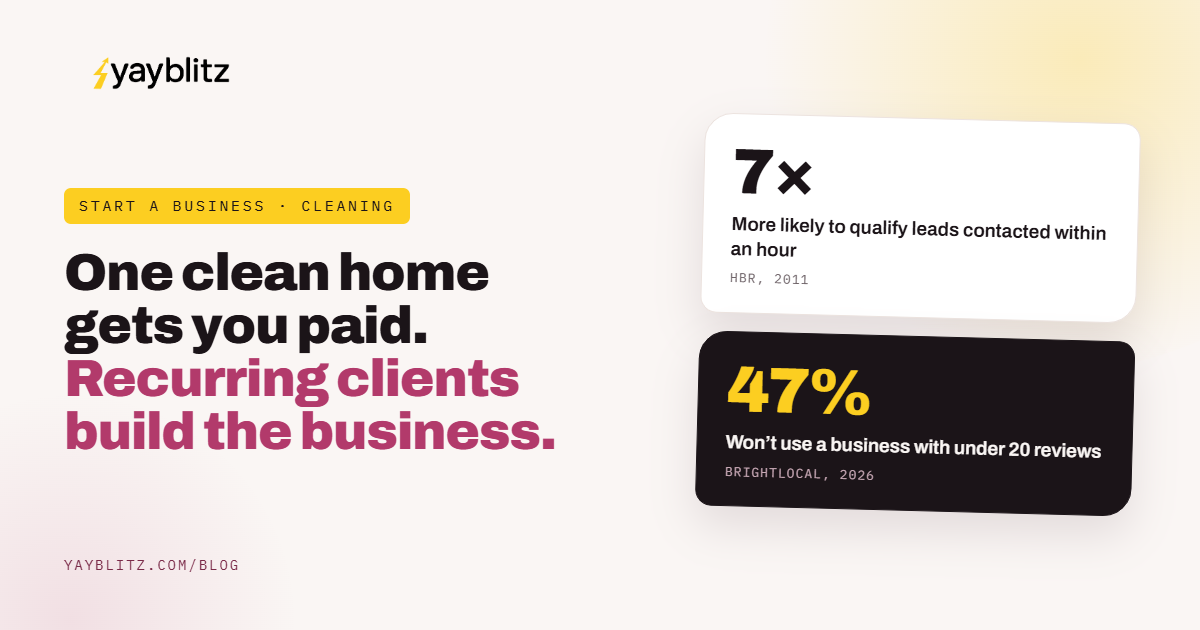
Reviews matter even more when strangers are letting you into their homes. BrightLocal’s 2026 survey found 47% of consumers won’t use a business with fewer than 20 reviews, so build your count steadily.
Ask clients after they’ve experienced your service once or twice, with a direct link by text. Ask them to mention what they liked and their neighborhood. Our guide on how to get more Google reviews includes request templates.
Should You Use Paid Ads When You Start?
Once your website, profile and reviews are ready, start small with Local Services Ads or targeted Search ads.
Ads can bring clients quickly, but cleaning searches also attract job seekers and people looking for products. Use negative keywords and focus on recurring and deep cleaning searches in your best neighborhoods.
Our guide to Google Ads for house cleaning covers campaign structure, keywords and tracking.
How Fast Should You Answer Inquiries?
Within minutes. Clients often contact several companies and book the first one that responds clearly.
A Harvard Business Review study found businesses that responded within an hour were about seven times more likely to qualify a lead. When you’re cleaning, use instant text replies, online booking and an instant quote form so clients get an answer even when you can’t pick up.
Our speed-to-lead guide shows simple systems for small teams, and our guide to an AI receptionist explains how to answer every call.
What Software Do You Need?
Cleaning or field service software for booking, scheduling, checklists, payments and reminders.
Software helps you schedule recurring visits, assign cleaners, store access notes securely, share checklists, charge cards automatically and request reviews. It also makes the business easier to run as you add staff.
Look for recurring scheduling, client notes, card on file, automated reminders, review requests and simple reports showing revenue per cleaner and per hour.
How Do You Build Recurring Revenue?
Turn first cleans into weekly or biweekly plans and make it easy to stay.
Offer a recurring plan at the end of every first clean, with lower prices for more frequent visits. Keep the same cleaner or team with each client when you can; clients value consistency.
Reach out to one-time clients, such as move-out or deep clean customers, a few weeks later with a recurring offer. Our guide to customer retention for home services covers simple reminder systems.
How Do You Hire and Keep Good Cleaners?
Pay fairly, train with clear checklists, schedule reliably and recognize good work.
Hiring is often the hardest part of growing a cleaning business. Look for reliability and attention to detail as much as experience. Run background checks where allowed, train new cleaners alongside experienced ones and give them clear checklists for every service.
Retention comes from fair pay, predictable schedules, respect and recognition. Share good reviews with the cleaner who earned them. Lower turnover means happier clients and less time spent hiring.
What Mistakes Do New Cleaning Businesses Make?
Underpricing, no insurance or bonding, no policies, misclassifying workers and relying on one cleaner.
- →Underpricing: prices that can’t support a team
- →No insurance or bonding: a single incident can end the business
- →No written policies: disputes over cancellations, access and scope
- →Misclassified workers: tax and legal problems later
- →No checklists: inconsistent quality between cleaners
- →Slow replies: losing clients to faster competitors
What Does Your First 90 Days Look Like?
Set up in month one, win first recurring clients in month two and build systems in month three.
By day 90 you should know your real cost per clean, how long each home type takes and how many recurring clients you need before hiring.
The 16-point cleaning business startup checklist
Tick what you already have. The first unticked items are your next moves.
Setup
4 itemsOperations
4 itemsMarketing
4 itemsGrowth
4 itemsFrequently Asked Questions
How much does it cost to start a cleaning business?+
Do you need a license to start a cleaning business?+
Do cleaning businesses need to be bonded?+
How should I price house cleaning?+
How do cleaning businesses get clients?+
Is a cleaning business profitable?+
Should I start residential or commercial cleaning?+
How do I keep cleaning clients?+
Build a Cleaning Business People Trust With Their Keys
Set up properly, insure and bond, price for a team, write clear checklists and policies, get found on Google, answer quickly and turn first cleans into recurring clients. That is how a cleaning business grows beyond the owner.
Every recurring client you keep is one less you have to find.
Yay Blitz helps cleaning businesses connect Graphic and Web Design, Paid Local Advertising, and AI Lead Management into one measurable system for getting and converting leads.
Want a second opinion? Book a Free Strategy Assessment. We’ll review your website, Google profile and inquiry follow-up and show you how to win more recurring clients.
 Funnel Strategy
 Graphic & Web Design
 Paid Local Ad
 Social Media Marketing