

A roof is one of the most expensive things a homeowner will ever buy, and most only buy one or two in their lives. They don’t know roofers personally, they’ve heard stories about storm chasers, and they want proof that a company is local, established and accountable. When they search “roof repair near me” or “roof replacement cost,” they’re looking for that proof.
This guide covers local SEO for roofing contractors: how Google ranks roofers, which searches matter, how to set up your profile, which pages to build, how to use project photos and manufacturer certifications, how to handle storm-season searches responsibly, and how to track results. For the foundations that apply to every trade, see our local SEO guide.
Roofing SEO is the work of ranking in Google’s map pack and local results for searches like “roof repair near me,” “roof replacement” and “storm damage roof inspection.” Google says local results depend on relevance, distance and prominence.
Roofers improve them with an accurate Google Business Profile, separate pages for repair, replacement, storm damage and materials, local project stories with photos, visible certifications and warranties, steady reviews and local links.
Why Does Local SEO Matter So Much for Roofers?
High ticket, low trust and storm spikes make local visibility decisive.
Roof replacements are large purchases, and homeowners rarely have a roofer they already trust. They search, compare and look for local proof. The companies that appear in the map pack with strong recent reviews and real local projects get most of the calls.
Storms make this more intense. After hail or high winds, searches for roof inspections and repairs spike, and out-of-town crews arrive to compete. A local roofer with years of reviews, local project pages and a permanent address has a real advantage, but only if customers can find it.
Demand is steady too. The Bureau of Labor Statistics projects roofer employment to grow 6% through 2034. More competition means visibility matters more each year.
How Does Google Rank Roofing Companies?
Relevance, distance and prominence.
Google says local results depend on relevance, distance and prominence. Roofers who serve wide areas should accept that distance limits map rankings far from the office and build strong town and project pages to compete in organic results there.
What Do Roofing Customers Search For?
Repair, replacement, storm, cost, material and inspection searches.
Map each group to one page. Avoid several pages competing for the same search. See local keyword research.
How Should Roofers Set Up Their Google Business Profile?
Specific category, complete services, real area and active photos.
Google’s guidelines require profiles to represent real businesses at real locations. Temporary storm offices and virtual addresses can lead to suspensions. See the Google Business Profile checklist.
Which Pages Should a Roofing Website Have?
One page per main service and material, plus storm and inspection pages.
Each page should open with a short answer and include local project photos, reviews mentioning that service and FAQs. See the home service website guide.
Why Are Local Project Stories So Powerful for Roofers?
They prove you work here, show quality and give search engines specific local facts.
A project story is a short page or section about one real job: the town or neighborhood, the problem, what you did, the materials, the timeline and before-and-after photos. For roofing, they are the strongest proof you can publish.
They answer the question every homeowner has: “Have you done this in my area, and was it good?” They also give Google and AI tools specific, local, verifiable information. A town page with five recent local projects is far more useful than a generic paragraph about serving that town.
Make project capture part of every job: drone or ladder photos before and after, the material and color, and one sentence about what made the job interesting. Ask permission before naming streets. Publish one or two stories a month.
How Should Roofers Show Certifications and Warranties?
Specific, verifiable credentials beat vague claims.
Many shingle manufacturers run contractor certification programs; GAF’s contractor program is one example. Certification can allow you to offer enhanced warranties and often includes a listing on the manufacturer’s contractor locator, which is a valuable link and referral source.
Show certifications, licensing where required, insurance and your workmanship warranty on every replacement page and in your profile description. Explain warranties in plain terms: what’s covered, for how long and by whom. Avoid badges you can’t back up.
Customers worried about storm chasers want to know you’ll be around to honor a warranty. Years in business and a permanent local address help answer that.
How Should Roofers Handle Storm Season Searches?
Prepare pages early, answer fast and be clearly local and trustworthy.
Storm damage searches rise sharply after hail, wind and severe weather. NOAA’s billion-dollar disasters data shows how frequent and costly severe storms have become in the US. Roofers in storm-prone regions should treat storm content as a core part of SEO.
Build a storm damage page before the season: what to check after a storm, how your inspection works, how documentation for insurance generally works and how to avoid scams. The FTC’s home improvement guidance offers consumer tips you can link to. Keep claims accurate; don’t promise insurance outcomes.
When a storm hits, post an update on your Google profile, make sure phones are answered, and publish a short local update about affected areas. Speed and honesty win storm leads; see speed-to-lead tips.
How Do Roofers Get More Reviews?
Ask at the final walkthrough and follow with a text link.
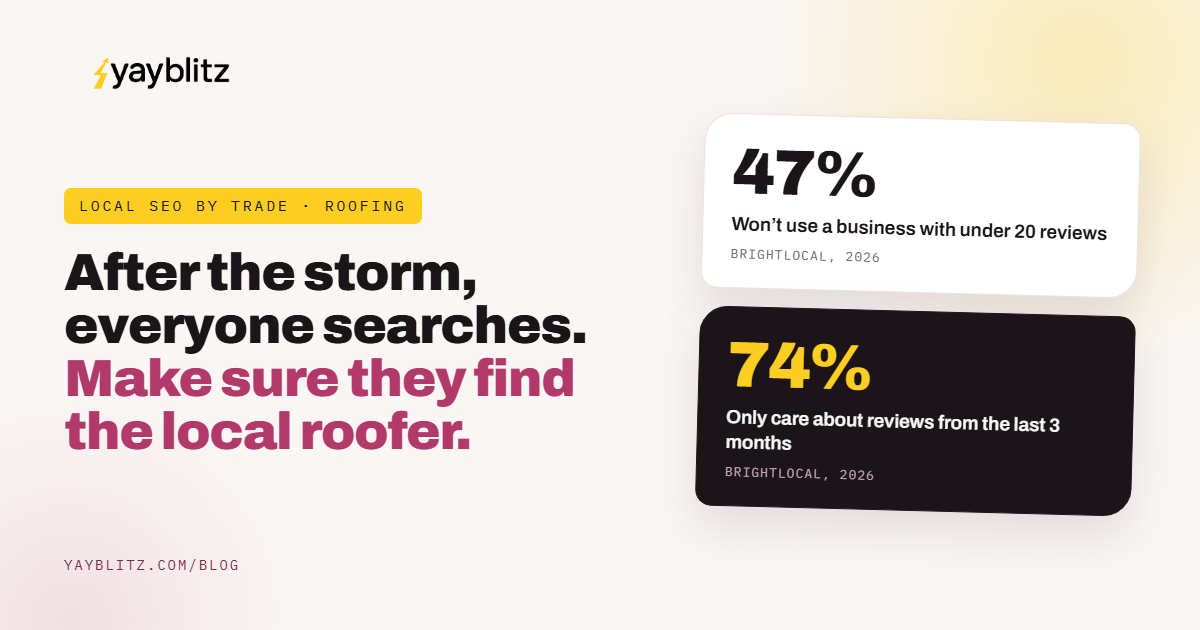
BrightLocal’s 2026 survey found 47% of consumers won’t use a business with fewer than 20 reviews and 74% only care about reviews from the last three months. Roofers often complete fewer jobs than service trades, so every job must produce a review request.
Ask in person at the final walkthrough, when the homeowner sees the finished roof. Send the review link by text the same day. Invite them to mention the material, the town and the crew. Reply to every review.
Never buy, gate or incentivise reviews. See how to get more Google reviews.
Should Roofers Build Town Pages?
Yes, for core towns with real projects; avoid doorway pages.
Roofers often serve large areas. Town pages for your core markets can help you appear in organic results there. Each needs local proof: recent projects with photos, a review from that town and local details such as common home ages, roof types and weather patterns.
Google’s spam policies warn against near-identical pages. Build fewer, better pages and list secondary towns on a service area page. See location pages that rank.
Which Links Help Roofing Companies?
Manufacturer locators, suppliers, associations and local partners.
Start with manufacturer contractor directories, roofing supply distributors, trade associations and the local chamber of commerce. Then look at partners: realtors who need inspections, home inspectors, insurance agents who recommend reputable roofers, and general contractors.
Community involvement earns links too: sponsoring local teams, helping a nonprofit with a roof, or offering storm safety tips to local news. Avoid buying links. See local link building.
What Content Should Roofers Publish?
Answers to the questions homeowners ask before they call.
Start each article with a direct two-sentence answer. Link to the matching service page. Follow Google’s guidance on helpful content.
How Does AI Search Affect Roofers?
AI tools look for clear facts, local proof and consistent details.
BrightLocal found 45% of consumers have used AI tools to find local recommendations. When someone asks “Who’s a reliable roofer in [town]?”, assistants summarise reviews, websites and listings.
Help them with plain facts: services, materials, towns, years in business, certifications and price ranges. Keep details identical across your site and listings. Encourage reviews that mention materials and towns. See how to get recommended by AI.
What Technical Basics Matter for Roofing Sites?
Fast pages, optimised photos and accurate structured data.
Roofing sites rely on photos, which can slow pages if not compressed. Resize and compress images, use modern formats and lazy-load galleries. Test with PageSpeed Insights on a phone.
Add local business structured data using the RoofingContractor type, matching your profile. Use Search Console to check indexing. See local business schema.
How Is Commercial Roofing SEO Different?
Different searches, buyers and proof.
Commercial buyers search for flat roof systems, TPO, EPDM, roof coatings, maintenance contracts and emergency leak response. They care about project scale, safety records, insurance and minimal disruption.
Build separate commercial pages with project examples by building type, maintenance programs and documentation you provide. Links from property management and facility associations help. Track commercial leads separately.
How Should Roofers Track SEO Results?
Calls, inspections booked and replacement jobs from search.
Roofing has long sales cycles. Track from first contact to signed contract, and compare with the same season last year. See tracking local SEO results.
What SEO Mistakes Do Roofers Make?
Generic pages, no local proof and storm shortcuts.
How Should Roofers Write Replacement Pages That Convert?
Answer cost, timeline, materials and warranty in the first screen.
A homeowner landing on your roof replacement page wants four answers quickly: roughly what it costs, how long it takes, which materials you install and what warranty they get. Put a short answer at the top that covers all four, then explain each in more detail below.
Walk through the process step by step: inspection, measurements, proposal with options, material selection, scheduling, tear-off, installation, cleanup, final walkthrough and warranty registration. Mention how you protect landscaping, how you handle nails and debris, and how you communicate during the job. These details answer the worries that stop people booking.
End with two or three local project examples and reviews that mention replacements. Link to material pages and the financing page if you offer one.
How Should Roofers Use Drone and Inspection Photos?
Show what customers can’t see from the ground.
Most homeowners never see their own roof up close. Drone and inspection photos let them see damage, wear and finished work. They also make powerful content for your profile, website and project pages.
Use inspection photos in reports and, with permission, in anonymised examples on your storm damage and repair pages: lifted shingles, hail bruising, flashing failures, ventilation problems. Pair each with a short explanation. Post finished-roof drone shots on your profile and project pages.
Check local drone regulations and get customer permission before publishing any photo that identifies a home.
How Should Roofers Handle Insurance Claim Content?
Explain the general process accurately; never promise outcomes.
Many storm-related roof jobs involve insurance. Homeowners search for help understanding claims, and clear content attracts them. Explain the general steps: documenting damage, contacting the insurer, the adjuster visit, the estimate and how contractors fit in.
Be careful with claims. Don’t promise that insurance will pay, don’t suggest waiving deductibles and follow your state’s rules on contractor involvement in claims. Recommend that homeowners read their own policy and talk to their insurer. Accurate, cautious content builds more trust than aggressive promises.
Link to consumer guidance such as the FTC’s home improvement advice, and explain how to verify a roofer’s license and insurance.
How Do Financing Pages Help Roofing SEO?
They capture budget-focused searches and remove a barrier to booking.
A roof replacement is a big unplanned expense for many homeowners. Searches like “roof financing” and “pay for a new roof monthly” show strong intent. If you offer financing through a lender, build a page explaining options, how to apply and typical terms, with the required disclosures.
Link the financing page from replacement and storm pages. Mention financing in your profile services if allowed. Track how many financed jobs come from search; they often have higher average tickets.
How Should Roofers Handle Seasonality Beyond Storms?
Plan content and posts around inspection, replacement and maintenance seasons.
Outside storm events, roofing demand still follows the calendar. Spring brings inspections after winter. Summer and early fall are peak replacement seasons in many regions. Late fall brings gutter and leak concerns before winter.
Update pages and publish Google posts ahead of each period: spring inspection reminders, summer replacement scheduling, fall gutter and maintenance checks. Use Google Trends for your region to confirm timing. Seasonal preparation means you’re visible when demand rises and can plan crews accordingly.
How Do Roofers Show They’re Local?
Permanent address, local projects, local reviews and community ties.
Customers worried about storm chasers look for signs a roofer is truly local. Show your permanent address if customers can visit, your years in business, the owner’s name and photo, local project stories, reviews from neighbors and community involvement.
Mention specific neighborhoods, local weather patterns and housing types on town pages. Sponsor local teams or community projects. These signals reassure customers and strengthen prominence in search.
How Should Roofers Respond to Negative Reviews?
Calmly, quickly and with a clear offer to resolve.
With large projects, occasional complaints are inevitable: delays, cleanup, communication. How you respond matters more than the complaint itself. Reply within a day or two, thank the customer, apologise for their experience, explain briefly what you’ll do and give a direct contact.
Then follow through. Many customers update their reviews after a fair resolution. Never argue publicly or share private details. BrightLocal found 80% of consumers are likely to use a business that responds to all its reviews, so replies are part of your marketing.
How Should Roofers Prioritise Pages If Time Is Short?
Repair and replacement first, then storm, then materials.
If you can only build a few pages this quarter, start with roof repair and roof replacement, since they match the highest-volume searches. Next, build your storm damage page before storm season. Then add material pages for the systems you install most.
Each strong page beats several thin ones. Give each one real photos, ranges, process and reviews before moving to the next.
What Does a 90-Day Roofing SEO Plan Look Like?
Profile and proof first, then pages, then links and content.
For the broader marketing picture, see roofing marketing.
The 16-point roofing SEO checklist
Tick what you already do well. The first unticked items are usually your next best move.
Profile
4 itemsProof
4 itemsWebsite
4 itemsMeasure
4 itemsLocal proof beats out-of-town promises. That’s fixable.
Roofing SEO questions
What is roofing SEO?+
What category should a roofer use on Google?+
Do roofers need separate pages for each service?+
How can local roofers compete with storm chasers?+
Do manufacturer certifications help SEO?+
How long does roofing SEO take?+
Should roofers publish prices?+
Be the Roofer Your Town Can Verify
Roofing customers want local proof. Build specific pages, publish real projects, show credentials, earn reviews and answer fast when storms hit.
Proof you were here beats promises you’ll be here.
Yay Blitz helps roofing contractors connect Graphic and Web Design, Paid Local Advertising, and AI Lead Management into one measurable system for getting and converting leads.
Want a second opinion? Book a Free Strategy Assessment. We’ll audit your roofing SEO and plan your next 90 days.
 Funnel Strategy
 Graphic & Web Design
 Paid Local Ad
 Social Media Marketing