

Most HVAC companies are started by a technician who got tired of making money for someone else. That’s a strong starting point: you already know the work, the equipment and what customers expect. What most new owners don’t know yet is how to price for profit, how to keep the phone ringing in mild weather and how to build a business that doesn’t depend on them turning every wrench.
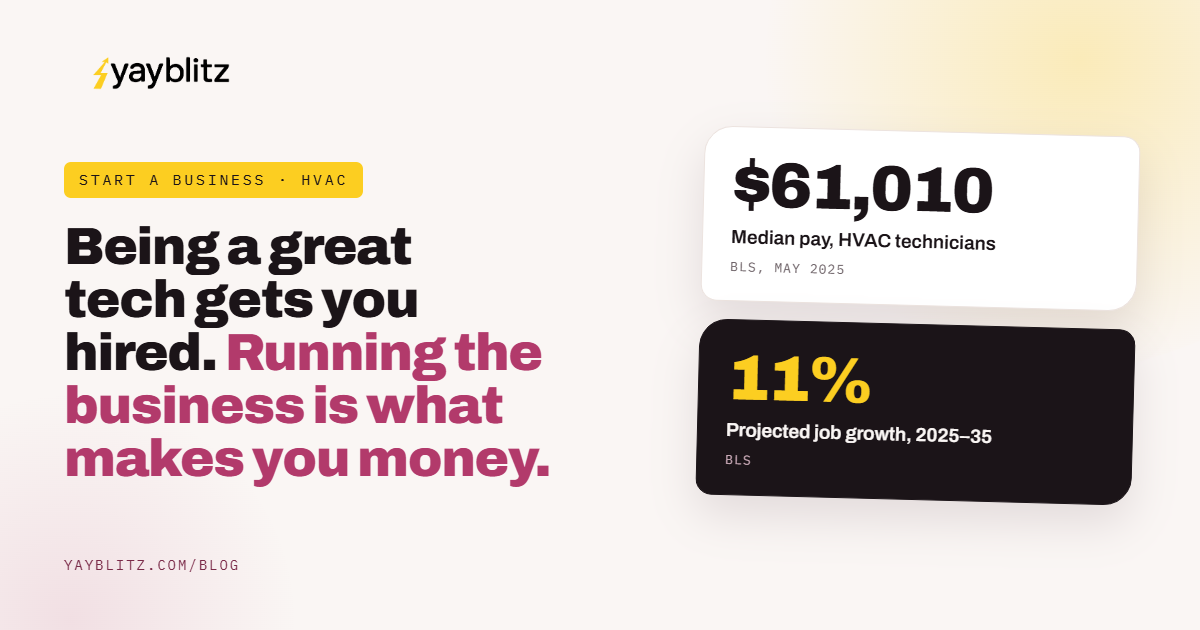
Demand is on your side. The U.S. Bureau of Labor Statistics projects HVAC technician employment to grow 11% from 2025 to 2035, much faster than the average for all jobs, as homes and businesses replace aging systems, switch to heat pumps and add better ventilation. But demand doesn’t automatically turn into profit. New HVAC companies fail when they underprice, run out of cash between seasons, or rely on one or two builders for all their work.
This guide covers how to start an HVAC business step by step: licensing and EPA certification, legal setup, insurance and bonding, tools, vans and startup costs, which services to start with, flat-rate pricing, financing, maintenance plans, your website and Google Business Profile, how to get your first customers and reviews, when to use ads, lead response, software, hiring, common mistakes and a first-90-days plan.
To start an HVAC business, first meet your state’s contractor licensing requirements, hold EPA Section 608 certification, register the business, get general liability insurance and any required bond, and set up a reliable service vehicle with the tools for the work you’ll offer first.
Then price with a flat-rate book built from your real costs, launch a fast website and a complete Google Business Profile, sell maintenance plans from day one, answer every call within minutes and grow your customer list before you buy more trucks.
Is Starting an HVAC Business Worth It in 2026?
Yes, for licensed techs who plan for cash flow, seasonality and repeat customers. Demand is strong and growing.
BLS reports a median pay of $61,010 for HVAC technicians in May 2025, with about 440,900 jobs nationwide and around 40,600 openings expected each year. For an owner, those numbers point two ways: steady customer demand, and real competition for skilled technicians when you start hiring.
The upside of ownership is control over pricing, schedule and growth, plus the chance to build a company with value you can eventually sell. The downside is risk: slow shoulder seasons, expensive equipment, warranty callbacks and the pressure of making payroll. Owners who succeed treat the business like a business from the first day, with a budget, a pricing system and a plan for repeat revenue.
Your skill gets you the first job. Your systems decide whether there’s a fifth year.
What Licenses and Certifications Do You Need?
A state or local HVAC or mechanical contractor license in most places, plus EPA Section 608 certification to handle refrigerants.
Under the Clean Air Act, technicians who maintain, service, repair or dispose of equipment that could release refrigerants must be certified under the EPA’s Section 608 program. That applies to you and every technician you hire who handles refrigerant.
Contractor licensing is set by states and sometimes cities. Many states require a mechanical or HVAC contractor license, which often means documented years of experience, a trade exam, a business and law exam, proof of insurance and sometimes a bond. Some states license at the city or county level instead. Check with your state licensing board before you advertise.
- →EPA 608: required to purchase and handle most refrigerants
- →Contractor license: state, county or city, depending on where you work
- →Business license: local registration to operate
- →Permits: many replacements and installs require a permit and inspection
- →Manufacturer training: needed to offer some extended warranties and dealer programs
The SBA’s guide to licenses and permits explains how to find federal, state and local requirements.
How Should You Set Up the Business Legally?
Choose a business structure, register your name, get an EIN and keep business money separate from day one.
Most new HVAC businesses start as a sole proprietorship or a single-member LLC. An LLC can separate business and personal liability, which matters when you work in customers’ homes and on their property. The SBA compares the options in its guide to choosing a business structure, and a local accountant can help you pick the right one for your state.
Register your business name, apply for a free Employer Identification Number from the IRS and open a business bank account. Keep every receipt and track job costs from day one. Equipment margins, labor time and callbacks vary widely by job type, and clean books are the only way to know which work actually makes money.
What Insurance Does a HVAC Business Need?
General liability at minimum, plus commercial auto, tools and equipment cover, and workers’ compensation once you hire.
HVAC work happens in attics, crawl spaces and on rooftops, with gas lines, electrical connections and expensive equipment. One mistake can cause water damage, a fire or an injury. Insurance protects you, and many builders, property managers and commercial customers won’t hire you without proof of it.
- →General liability: property damage and injuries on the job
- →Commercial auto: every work van and truck
- →Tools and equipment: inland marine coverage for tools and stock on the van
- →Workers’ compensation: required in most states once you hire
- →Contractor bond: required for licensing in some states and cities
The SBA’s guide to business insurance explains the main types. Get quotes from an agent who insures contractors, keep certificates ready to send and put “licensed and insured” on your website, truck and quotes once it’s true.
What Tools, Vehicle and Inventory Do You Need?
A reliable van set up for service calls, diagnostic and refrigerant tools, safety gear and a small stock of common parts.
Start with what you need for the calls you’ll run most often. For most new companies, that means residential service and repair. A well-organized van with the right parts on board lets you fix more problems on the first visit, which customers value and which raises revenue per call.
- →Service vehicle: van or truck with shelving and secure storage
- →Diagnostic tools: multimeter, clamp meter, digital manifold gauges, combustion analyzer
- →Refrigerant tools: recovery machine, vacuum pump, scale and tanks
- →Hand and power tools: the basics for service and minor installs
- →Common parts: capacitors, contactors, motors, igniters, filters and thermostats
- →Safety gear: PPE, ladders and fall protection for roof work
Don’t buy installation equipment until you have installation work booked. Many owners rent or partner with a supply house for larger tools at first.
How Do You Work Out Your Startup Costs?
List tools, vehicle, licensing, insurance, software, marketing and working cash, then get real local quotes for each line.
Startup costs for a HVAC business vary widely depending on whether you already own a work vehicle and tools, buy new or used, and start alone or with a crew. Rather than trusting a national average, build your own list and price every line locally.
Most supply houses offer trade accounts with payment terms once you’re established, which helps cash flow. Plan for slow months in spring and fall. The SBA guide to funding your business covers loans, lines of credit and other options if you need them.
Which HVAC Services Should You Start With?
Residential service and repair first, then replacements, maintenance plans and higher-value add-ons.
Service and repair calls are the fastest way to build a customer list. Each visit is a chance to earn trust, sell a maintenance plan and identify older systems that will need replacement. Replacement jobs bring larger tickets but need more cash, permits and installation labor.
Once you have steady service work, add heat pumps, ductless mini-splits, indoor air quality and duct work. Many new owners avoid new construction at first because builder work often has thin margins and slow payments. Commercial service can be steady, but it needs specific skills and often after-hours coverage.
How Should You Price HVAC Work?
Use flat-rate pricing built from your real costs, labor time and target profit, not hourly rates or competitors’ prices.
Flat-rate pricing means the customer approves a set price per repair before you start. It removes arguments about time, rewards efficient technicians and makes it easier to offer good, better and best options. Build each price from parts cost, average labor time, your fully loaded hourly cost, overhead and profit.
Your fully loaded hour includes wages, payroll taxes, insurance, vehicle, fuel, tools, software, office costs and unbillable time like driving and training. Most new owners underestimate this. Our guide on pricing home services walks through the full calculation.
If you price like a technician, you’ll be paid like one. Price like an owner.
Should You Offer Financing?
Yes. Replacement systems are big purchases, and financing helps homeowners choose the right system instead of the cheapest.
A full system replacement is one of the biggest repairs most homeowners make. Offering financing through a lender partner lets customers spread the cost into monthly payments, which often makes it easier to choose higher-efficiency equipment.
Present financing as an option in every replacement proposal, not just when someone objects to price. Our guide to HVAC financing marketing explains how to promote it on your website and in quotes.
How Do Maintenance Plans Help a New HVAC Business?
They create recurring revenue, fill slow seasons and keep you first in line when systems fail.
A maintenance plan, sometimes called a membership or service agreement, gives customers seasonal tune-ups plus perks like priority scheduling and repair discounts. For you, it means predictable income, scheduled work in mild months and a customer base that calls you first.
Offer a plan on every service call from day one. Even 100 members can steady cash flow in a young company. Our guide to service agreements for contractors explains how to price and sell them.
Do You Need a Website?
Yes. A fast site with service pages, service areas, real job photos, reviews, your license details and one-tap calling is enough to start.
Almost every customer checks the website before calling, even when they found you on Google Maps or through a referral. For HVAC contractors, the site has one job: make it easy to trust you and contact you. Put the phone number at the top of every page, show your license and insurance, and use real photos of your work and your team rather than stock images.
Create one page for each main service, such as AC repair, furnace repair, system replacement and maintenance plans, plus pages for the towns you serve. Add your best reviews, a short story about you and a simple quote or booking form. Our HVAC website design guide covers the pages, calls to action and trust signals that turn visitors into booked calls.
How Do You Set Up Your Google Business Profile?
Create and verify it on day one, choose the most accurate category, list every service and service area, and keep adding photos and reviews.
Your Google Business Profile decides whether you appear in the map results when someone searches “AC repair near me.” For many local service businesses, it produces more calls than the website. Set it up as a service-area business if customers don’t visit your location, and follow Google’s guidelines for representing your business so it isn’t suspended.
Pick the most accurate primary category, add every service you offer and the areas you cover, and upload real job photos every week. Reply to every review and answer questions. Our Google Business Profile guide for HVAC covers every setting, category and photo idea.
How Do You Get Your First HVAC Customers?
Start with your network, local partners and your Google profile, then add tightly targeted ads.
Many new owners land their first customers from friends, family and previous customers who liked their work. Check any non-compete or non-solicitation agreement with your previous employer before contacting their customers.
- →Your network: friends, family, neighbors and past contacts
- →Partners: realtors, home inspectors, property managers, plumbers and electricians
- →Google profile: complete, active and collecting reviews
- →Local visibility: wrapped van, yard signs at install jobs, door hangers
- →Seasonal offers: tune-up specials before summer and winter peaks
Our guide to HVAC lead generation explains which channels produce booked jobs, not just clicks.
How Do You Get Reviews Early?
Ask every happy customer the same day, send a one-tap link and reply to every review.
Reviews often decide who gets the call. BrightLocal’s 2026 survey found 68% of consumers only use businesses rated four stars or higher, and 47% won’t use a business with fewer than 20 reviews. A new HVAC business needs to close that gap quickly.
Ask in person at the end of every visit when the customer is comfortable again, then send a text with your review link within the hour. Ask them to mention the service and their town, which naturally adds useful detail. Never pay or offer discounts for reviews. Our guide to getting more HVAC reviews includes scripts and follow-up timing.
Should You Use Paid Ads When You Start?
Yes, once your profile, site and call handling are ready. Start with Local Services Ads and tightly targeted Search ads.
HVAC searches are often urgent, which makes paid ads effective. Local Services Ads show at the top of results with a Google Guaranteed badge, and you pay per lead rather than per click. Search ads let you target specific services and areas, such as “AC repair” in your best neighborhoods.
Start small, track every call and form and stop anything that doesn’t produce booked jobs. Our guides to Local Services Ads for HVAC and Google Ads for HVAC walk through setup, budgets and tracking.
How Fast Should You Answer Leads?
Within minutes. Customers often contact several companies and hire the first one that responds clearly.
A widely cited Harvard Business Review study found that firms contacting leads within an hour were about seven times more likely to qualify them than firms that waited longer. HVAC calls are often emergencies: no cooling in a heat wave or no heat in a cold snap. If you don’t answer, the customer calls the next company on the list.
Set up an instant text reply for missed calls and form submissions, block time between jobs to call back and track how long each lead waits. Our speed-to-lead guide and our guide to an AI receptionist show simple systems for small teams.
What Software Do You Need?
Field service software for scheduling, dispatch, a flat-rate pricebook, invoicing, payments and maintenance plan tracking.
Paper tickets and spreadsheets break quickly. Field service software lets you book and dispatch calls, use a pricebook on a tablet, present options, take payments on site, track maintenance plan visits and send review requests automatically.
Look for a mobile app your techs will actually use, maintenance agreement tracking, call tracking integration and simple reports for revenue per call, close rate and average ticket. Our guide to HVAC CRM explains what to look for.
When Should You Hire Your First Technician?
When you’re consistently booked out or spending your best hours on admin instead of service and sales.
Hiring too early drains cash. Hiring too late caps growth and burns you out. Track how often you turn away calls or push customers out by several days. When that happens regularly, it’s time for a second tech or an office person to answer phones.
With strong demand for skilled HVAC technicians nationwide, plan for recruiting to take time. Offer clear pay, training, a reliable vehicle and a path to advance. Our guide to HVAC technician recruiting covers where to find and how to keep good techs.
What Mistakes Do New HVAC Businesses Make?
Underpricing, skipping maintenance plans, no cash buffer, missed calls and relying on one builder or customer.
- →Underpricing: hourly rates that don’t cover the true cost of an hour
- →No maintenance plans: no recurring revenue for slow seasons
- →No cash buffer: running out of money between peaks
- →Missed calls: emergency calls go to whoever answers
- →One big customer: depending on a builder who can stop calling
- →No tracking: not knowing which marketing produces jobs
- →Doing everything yourself: no time to sell, hire or plan
What Should Your First 90 Days Look Like?
Get licensed and set up, win your first customers and reviews, then add systems and maintenance plans.
By day 90 you should know your average ticket, close rate on replacements, number of maintenance members and cost per booked job from each marketing source. Those numbers tell you where to invest next.
The 16-point HVAC startup checklist
Tick what you already have. The first unticked items are your next moves.
Licensing and legal
4 itemsOperations
4 itemsMarketing
4 itemsGrowth
4 itemsFrequently Asked Questions
How much does it cost to start an HVAC business?+
Do you need a license to start an HVAC business?+
How much do HVAC technicians make?+
Is the HVAC industry growing?+
How should a new HVAC company price its work?+
How do new HVAC companies get customers?+
Why are maintenance plans important for HVAC businesses?+
When should I hire my first HVAC technician?+
Build an HVAC Company, Not Just a Job
Get licensed, price like an owner, sell maintenance plans from the first call, answer every lead fast and track what your marketing produces. Those habits turn a skilled technician into a business owner with a company that grows.
The best time to build systems is before you need them.
Yay Blitz helps HVAC contractors businesses connect Graphic and Web Design, Paid Local Advertising, and AI Lead Management into one measurable system for getting and converting leads.
Want a second opinion? Book a Free Strategy Assessment. We’ll review your website, Google profile and lead follow-up and show you where your next customers are coming from.
 Funnel Strategy
 Graphic & Web Design
 Paid Local Ad
 Social Media Marketing