

A roof is one of the largest purchases a homeowner makes, and most people only buy one or two in their lifetime. That makes roofing a trust business. Homeowners worry about storm chasers, surprise costs and leaks after the crew leaves. The roofing companies that grow are the ones that look established, explain clearly, protect the property and stand behind their work.
Demand is steady. Roofs wear out, storms cause damage and new homes need roofs. The U.S. Bureau of Labor Statistics projects about 12,000 openings for roofers each year over the next decade. But roofing is also one of the most dangerous trades: BLS notes roofers have some of the highest injury and fatality rates of any occupation. Starting a roofing company means taking safety, insurance and cash flow seriously from the first day.
This guide covers how to start a roofing company step by step: licensing, legal setup, insurance, fall protection, crews and subcontractors, equipment and startup costs, services, estimating and pricing, insurance claim work, manufacturer certifications, your website and Google Business Profile, first jobs, reviews, ads, lead response, software, hiring, common mistakes and your first 90 days.
To start a roofing company, meet your state and local contractor licensing rules, register the business, carry general liability, auto and workers’ compensation insurance, and put a written fall protection plan in place before any crew goes on a roof.
Then build accurate estimates from measured roofs, materials, labor, disposal and overhead, launch a website and Google Business Profile with real project photos and reviews, answer leads fast and earn trust with clear contracts and warranties.
Is Starting a Roofing Company Worth It in 2026?
Yes, for owners who manage risk well. Jobs are large, demand is steady and storms create surges in work.
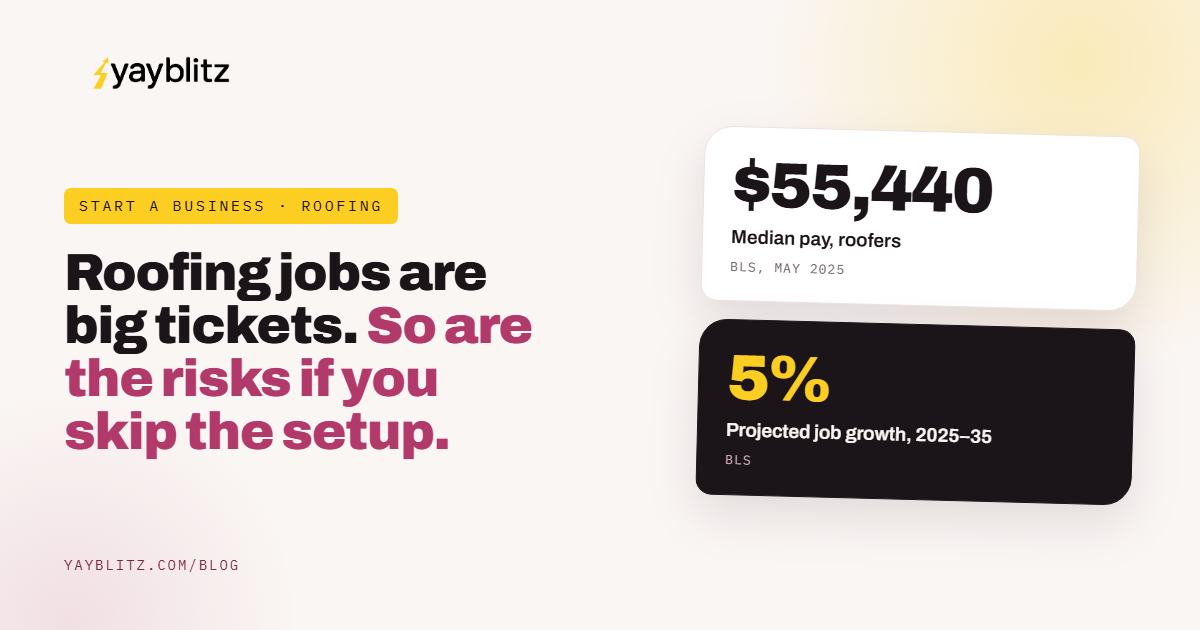
BLS reports a median pay of $55,440 for roofers in May 2025 and projects employment to grow 5% from 2025 to 2035. For owners, the opportunity is in the ticket size: a single replacement can be worth more than dozens of service calls in other trades.
The challenges are equally large. Weather delays, material price swings, labor shortages, safety risks, insurance costs and cash tied up in materials can sink a young company. Storm seasons bring a rush of work and out-of-town competitors. Owners who succeed build a local reputation that lasts beyond storm season.
Storms bring leads. Reputation brings the jobs that come after the storm chasers leave.
What Licenses Do You Need to Start a Roofing Company?
It depends on your state and city. Some require a roofing or contractor license, others only registration and a business license.
Roofing licensing varies more than most trades. Some states require a specific roofing contractor license with exams and proof of experience. Others license general or residential contractors, and some leave it to cities and counties. Many places also require permits for replacements.
Check your state contractor board and local building department before you advertise. The SBA’s guide to licenses and permits explains how to find requirements. Display your license number on your website, trucks, contracts and yard signs; homeowners and insurers often check.
How Should You Set Up the Business Legally?
Choose a business structure, register your name, get an EIN and keep business money separate from day one.
Most new roofing businesses start as a sole proprietorship or a single-member LLC. An LLC can separate business and personal liability, which matters when you work in customers’ homes and on their property. The SBA compares the options in its guide to choosing a business structure, and a local accountant can help you pick the right one for your state.
Register your business name, apply for a free Employer Identification Number from the IRS and open a business bank account. Roofing jobs tie up cash in materials and labor before you’re paid. Separate accounts and clean job costing show you exactly how much each roof earned, after materials, labor, disposal and overhead.
What Insurance Does a Roofing Business Need?
General liability at minimum, plus commercial auto, tools and equipment cover, and workers’ compensation once you hire.
Roofing insurance is often more expensive than for other trades because of the fall risk. Don’t cut corners: a single uninsured injury or leak claim can end the business. Many homeowners, property managers and insurance companies will ask for certificates before work starts. If you use subcontractors, collect their certificates and keep them current.
- →General liability: property damage, leaks and injuries to others
- →Workers’ compensation: usually required once you hire, and essential for roof work
- →Commercial auto: trucks and trailers
- →Tools and equipment: ladders, lifts and tools
- →Contractor bond: required in some states and cities
The SBA’s guide to business insurance explains the main types. Get quotes from an agent who insures contractors, keep certificates ready to send and put “licensed and insured” on your website, truck and quotes once it’s true.
How Do You Keep Roofing Crews Safe?
Write a fall protection plan, train every worker, use the right equipment and enforce it on every job.
BLS notes that roofers have one of the highest rates of injuries and fatalities of any occupation, and most employers require OSHA-aligned safety certification. OSHA’s fall prevention campaign focuses on three steps: plan ahead, provide the right equipment and train everyone to use it safely.
- →Plan: assess each roof for pitch, edges, skylights and power lines
- →Equip: harnesses, anchors, guardrails or safety nets as required
- →Train: teach every worker, including subcontractors, and document it
- →Enforce: stop work when safety rules aren’t followed
- →Ladders: secure, inspected and correctly placed
A strong safety record also lowers insurance costs over time and helps you win commercial and property management work.
Should You Use Your Own Crews or Subcontractors?
Many new roofing companies start with trusted subcontract crews, then hire their own as volume grows.
Subcontract crews let you take jobs without carrying full payroll, which helps cash flow early. The trade-offs are less control over quality, scheduling and safety, plus legal risk if workers are misclassified. Your own crews cost more to carry but give you control and a consistent standard.
Whichever you choose, write clear scopes, require proof of insurance, check quality on every job and keep a production manager or yourself on site for key stages. Your name is on the yard sign, not the crew’s.
What Equipment and Vehicles Do You Need?
A work truck, trailer or dump trailer, ladders, safety gear, roofing tools and, later, lifts and conveyors.
- →Truck and trailer: for crews, tools and materials
- →Dump trailer or dumpsters: for tear-off debris
- →Ladders and lifts: rated for roof work
- →Safety gear: harnesses, anchors, ropes, guardrails
- →Roofing tools: nail guns, compressors, cutters, pry bars and magnets
- →Measuring tools: drone or satellite measurements and pitch gauges
Many material suppliers deliver directly to the roof, which saves labor. Rent expensive equipment until you have steady volume.
How Do You Work Out Your Startup Costs?
List tools, vehicle, licensing, insurance, software, marketing and working cash, then get real local quotes for each line.
Startup costs for a roofing business vary widely depending on whether you already own a work vehicle and tools, buy new or used, and start alone or with a crew. Rather than trusting a national average, build your own list and price every line locally.
Set up supplier accounts with payment terms and agree deposit and progress payment terms with customers. Material costs can be the largest line on every job. The SBA guide to funding your business covers loans, lines of credit and other options if you need them.
Which Roofing Services Should You Offer First?
Residential repairs, inspections and replacements in one or two roofing types, then expand.
Repairs and inspections build relationships and lead to replacements. Focus on the roofing types most common in your area, often asphalt shingles, and get very good at them before adding metal, tile, flat or commercial roofing.
Gutters, skylights, ventilation and attic insulation are natural add-ons. Commercial roofing can be profitable but often needs different materials, equipment and crews.
How Do You Estimate and Price Roofing Jobs?
Measure accurately, price materials, labor, disposal, permits and overhead, then add profit, and present options.
Accurate measurements are the foundation of profitable roofing. Use satellite or drone measurement tools and check them on site. Account for pitch, layers to remove, decking repairs, flashing, ventilation, access and disposal. Missing any of these can wipe out profit.
Present good, better and best options, such as different shingle lines or warranty levels. Write clear contracts that list materials, scope, timeline, payment schedule and how unexpected issues like rotten decking are handled. Our guide on pricing home services explains how to build a price from your real costs.
A cheap estimate that misses decking, flashing or disposal isn’t competitive. It’s a loss.
Should You Do Insurance Claim and Storm Work?
It can be a large share of roofing work, but learn your state’s rules and protect your reputation.
Hail and wind storms create sudden demand, and many replacements are paid for through homeowners insurance. Helping homeowners document damage and work with their insurance company is part of the job in storm-prone areas.
Be careful. Many states restrict what contractors can do in the claims process, such as negotiating on a homeowner’s behalf, and some have rules about waiving deductibles. Check your state’s laws, be transparent with homeowners and avoid high-pressure tactics. Your reputation will last longer than any storm season.
Keep detailed photo records of damage before, during and after work, and give homeowners clear written explanations of what was found and replaced. That documentation protects you if questions come up later and makes it easier for customers to recommend you to neighbors who had the same storm.
Do Manufacturer Certifications Matter?
Yes. They can let you offer stronger warranties and add credibility with homeowners.
Major shingle manufacturers run contractor certification programs. Certified contractors can often offer extended warranties that cover both materials and workmanship, which is a strong selling point. Requirements usually include licensing, insurance, training and time in business.
Once certified, mention it on your website, Google profile and proposals.
Do You Need a Website?
Yes. A fast site with service pages, service areas, real job photos, reviews, your license details and one-tap calling is enough to start.
Almost every customer checks the website before calling, even when they found you on Google Maps or through a referral. For roofers, the site has one job: make it easy to trust you and contact you. Put the phone number at the top of every page, show your license and insurance, and use real photos of your work and your team rather than stock images.
Create one page for each main service, such as roof repair, roof replacement, storm damage, inspections and gutters, plus pages for the towns you serve. Add your best reviews, a short story about you and a simple quote or booking form. Our roofing SEO guide explains how to make those pages rank in local search.
How Do You Set Up Your Google Business Profile?
Create and verify it on day one, choose the most accurate category, list every service and service area, and keep adding photos and reviews.
Your Google Business Profile decides whether you appear in the map results when someone searches “roofer near me.” For many local service businesses, it produces more calls than the website. Set it up as a service-area business if customers don’t visit your location, and follow Google’s guidelines for representing your business so it isn’t suspended.
Pick the most accurate primary category, add every service you offer and the areas you cover, and upload real job photos every week. Reply to every review and answer questions. Our Google Business Profile checklist covers every setting, and our roofing marketing guide shows how to use it alongside other channels.
How Do You Get Your First Roofing Jobs?
Your network, local partners, yard signs, neighborhood marketing and a strong Google profile.
- →Your network: friends, family and past customers who trust your work
- →Partners: realtors, home inspectors, insurance agents and property managers
- →Yard signs: on every job, with permission
- →Neighbor marketing: letters or door hangers to homes near each job
- →Repairs and inspections: small jobs that lead to replacements
Track where every lead comes from and what it produces. Roofing leads are expensive, so knowing your cost per signed job matters.
How Do You Get Reviews Early?
Ask every happy customer the same day, send a one-tap link and reply to every review.
Reviews often decide who gets the call. BrightLocal’s 2026 survey found 68% of consumers only use businesses rated four stars or higher, and 47% won’t use a business with fewer than 20 reviews. A new roofing business needs to close that gap quickly.
Ask after final cleanup and inspection, when the homeowner sees the finished roof. Share photos of the job with your request. Ask them to mention the service and their town, which naturally adds useful detail. Never pay or offer discounts for reviews. Our guide on how to get more Google reviews includes scripts.
Should You Use Paid Ads When You Start?
Yes, carefully. Roofing clicks are expensive, so start with tight targeting and strong tracking.
Because roofing jobs are valuable, competition in paid search is fierce. Start with Local Services Ads and tightly targeted Search ads for repair and replacement in your best areas, with negative keywords for jobs, DIY and materials. Track calls and forms to signed contracts, not just leads.
Our guide to Google Ads for roofers explains campaign setup and budgeting.
How Fast Should You Answer Leads?
Within minutes. Customers often contact several companies and hire the first one that responds clearly.
A widely cited Harvard Business Review study found that firms contacting leads within an hour were about seven times more likely to qualify them than firms that waited longer. Homeowners often get several roofing quotes. Responding first and booking an inspection quickly puts you ahead before competitors call back.
Set up an instant text reply for missed calls and form submissions, block time between jobs to call back and track how long each lead waits. Our speed-to-lead guide and our guide to an AI receptionist show simple systems for small teams.
What Software Do You Need?
A roofing CRM for leads, estimates, measurements, photos, production and follow-up.
Roofing sales cycles involve inspections, estimates, insurance and production schedules. A CRM keeps track of every lead and job, stores photos and measurements, sends proposals and follows up automatically.
Our guide to roofing CRM explains which features matter most.
What Mistakes Do New Roofing Companies Make?
Weak safety, thin insurance, bad estimates, no cash buffer and overreliance on storm work.
- →Weak safety: injuries, fines and higher insurance costs
- →Thin insurance: one claim can end the business
- →Inaccurate estimates: missing decking, flashing or disposal
- →No cash buffer: materials and labor due before payment
- →Storm-only business: nothing to do when the storm season ends
- →Unclear contracts: disputes over scope and payment
What Should Your First 90 Days Look Like?
Set up legally and safely, win first jobs from your network and partners, then add systems and marketing.
By day 90, know your average job size, close rate, cost per signed job and gross margin per roof.
The 16-point roofing startup checklist
Tick what you already have. The first unticked items are your next moves.
Licensing and legal
4 itemsSafety and operations
4 itemsMarketing
4 itemsGrowth
4 itemsFrequently Asked Questions
How much does it cost to start a roofing company?+
Do you need a license to start a roofing company?+
What insurance does a roofing company need?+
How much do roofers make?+
How do new roofing companies get customers?+
How should I price roofing jobs?+
Is roofing a dangerous business?+
Should a new roofing company do storm work?+
Build a Roofing Company Homeowners Trust
Get licensed and insured, keep crews safe, estimate accurately, explain clearly and stand behind your work. Those habits build a reputation that keeps a roofing company busy long after the storm chasers have moved on.
Every roof you finish is a sign in the yard for the next one.
Yay Blitz helps roofers businesses connect Graphic and Web Design, Paid Local Advertising, and AI Lead Management into one measurable system for getting and converting leads.
Want a second opinion? Book a Free Strategy Assessment. We’ll review your website, Google profile and lead follow-up and show you where your next customers are coming from.
 Funnel Strategy
 Graphic & Web Design
 Paid Local Ad
 Social Media Marketing