

Junk removal is one of the simplest service businesses to understand. Customers have things they don’t want, and you haul them away. Startup costs are lower than most trades, you don’t need a trade license in most places and demand comes from almost everyone: homeowners, renters, landlords, realtors, contractors, estate executors and businesses.
Simple doesn’t mean easy. Disposal fees can quietly eat your profit, heavy items cause injuries, and customers often call several companies and book whoever answers first. The owners who build real junk removal businesses know exactly what each load costs to dump, price by volume with confidence, donate and recycle where they can and answer every call quickly.
This guide covers how to start a junk removal business step by step: legal setup, licensing, insurance, choosing a truck or trailer, startup costs, disposal and recycling, which services to offer, pricing by volume, safety, branding, your website and Google Business Profile, first customers, reviews, ads, lead response, software, partner and commercial work, hiring, common mistakes and your first 90 days.
To start a junk removal business, register the business, check local hauling and business license rules, carry general liability and commercial auto insurance, choose a dump truck, box truck or dump trailer sized for typical loads, and map your local landfills, transfer stations, donation centers and recyclers.
Then price by truck volume from your real disposal, labor, fuel and overhead costs, build a website and Google Business Profile with clear pricing and real photos, answer leads within minutes, ask every customer for a review and build partnerships with realtors, property managers and contractors.
Is a Junk Removal Business Worth Starting in 2026?
Yes. Startup costs are modest, demand is broad and jobs are quick, if you control disposal costs and price correctly.
Junk removal benefits from life events that never stop: moves, renovations, downsizing, estate cleanouts, evictions and spring cleaning. Many jobs are completed in an hour or two and paid on the spot, which helps cash flow compared with trades that wait weeks for payment.
The main risks are thin margins if you underprice, rising disposal fees, truck breakdowns and physical strain. Owners who track cost per load, keep their truck in good shape and build repeat partner relationships do best.
Every load has a cost before it earns a cent. Know your dump fees cold.
Do You Need a License to Start a Junk Removal Business?
Usually a general business license. Some cities require hauling or waste permits, and certain items have special disposal rules.
Most places don’t require a special trade license for junk removal, but you’ll typically need a business license, and some cities or counties require a waste hauler permit or registration. If you operate a commercial vehicle over 10,001 pounds across state lines, the FMCSA explains when you need a USDOT number, and some states require one for intrastate work too.
Certain items, such as electronics, tires, paint, chemicals, refrigerants in appliances and mattresses, have specific disposal rules that vary by state and city. Check with your local solid waste department and the SBA’s guide to licenses and permits.
How Should You Set Up the Business Legally?
Choose a business structure, register your name, get an EIN and keep business money separate from day one.
Most new junk removal businesses start as a sole proprietorship or a single-member LLC. An LLC can separate business and personal liability, which matters when you work in customers’ homes and on their property. The SBA compares the options in its guide to choosing a business structure, and a local accountant can help you pick the right one for your state.
Register your business name, apply for a free Employer Identification Number from the IRS and open a business bank account. Track every load’s disposal fee, fuel, labor and revenue from day one. It’s the only way to know if your pricing works.
What Insurance Does a Junk Removal Business Need?
General liability at minimum, plus commercial auto, tools and equipment cover, and workers’ compensation once you hire.
Moving heavy furniture and appliances through tight spaces can damage walls, floors and doorways, and loaded trucks carry more risk on the road. Property managers and commercial customers will often ask for proof of insurance.
- →General liability: damage to customers’ homes, walls, floors and property
- →Commercial auto: your truck or truck and trailer
- →Workers’ compensation: usually required once you hire
- →Tools and equipment: dollies, straps and tools
The SBA’s guide to business insurance explains the main types. Get quotes from an agent who insures contractors, keep certificates ready to send and put “licensed and insured” on your website, truck and quotes once it’s true.
Should You Use a Truck or a Trailer?
A dump truck or box truck with a dump body is most efficient, but a dump trailer and pickup is a lower-cost way to start.
Your vehicle defines how much you can haul per trip and how quickly you can unload. A dump truck or box truck with a dump body lets you unload quickly at the landfill. A dump trailer behind a pickup is a cheaper way to start and can be dropped at a customer’s location for larger cleanouts.
Whatever you choose, keep it well maintained. A broken-down truck means cancelled jobs and lost reviews.
How Do You Work Out Your Startup Costs?
List tools, vehicle, licensing, insurance, software, marketing and working cash, then get real local quotes for each line.
Startup costs for a junk removal business vary widely depending on whether you already own a work vehicle and tools, buy new or used, and start alone or with a crew. Rather than trusting a national average, build your own list and price every line locally.
Your truck is your biggest investment and best advertisement. A clean wrap with your phone number and website works every day you drive. The SBA guide to funding your business covers loans, lines of credit and other options if you need them.
How Do You Handle Disposal, Donation and Recycling?
Map every local landfill, transfer station, donation center and recycler, and sort loads to cut disposal fees.
Disposal is often your largest variable cost. Call local landfills and transfer stations to learn their fees, minimums, hours and accepted items. Find donation centers and resale shops that accept furniture and household goods, and recyclers for metal, cardboard and electronics. The EPA explains options for electronics donation and recycling.
Sorting loads takes time but can lower disposal fees and sometimes earn money from scrap metal. Many customers also prefer companies that donate and recycle, so tell them where their items go. Track disposal costs per load and update your prices when fees change.
Which Junk Removal Services Should You Offer?
Start with household junk and furniture, then add cleanouts, construction debris and specialty items.
Single items like couches, mattresses and appliances, plus partial and full-truck household loads, are the core of most junk removal businesses. Garage, attic, basement and estate cleanouts are larger jobs that often come through realtors and families. Construction and renovation debris, yard waste, hot tubs and light demolition can add value but may need more equipment and different disposal sites.
Be clear about what you don’t take, such as hazardous chemicals or asbestos, and list it on your website.
How Should You Price Junk Removal?
Price by truck volume, with minimums and surcharges for heavy or special items, based on real disposal, labor and overhead costs.
Most junk removal companies price by how much of the truck a load fills, such as a quarter, half, three-quarters or a full load, with a minimum charge for single items. Build each tier from your disposal cost per load, labor time, fuel, truck costs, overhead and profit.
Add surcharges for heavy materials like concrete or dirt, items with special disposal fees like mattresses or tires, and difficult access like stairs or long carries. Offer free on-site estimates or price ranges from photos to speed up booking. Our guide on pricing home services explains the method.
If you don’t know what your dump fee is per load, you don’t know your profit.
How Do You Keep Your Crew Safe?
Use proper lifting, the right equipment, gloves and eye protection, and never handle hazardous materials you’re not trained for.
Back injuries, cuts and crushed fingers are common in junk removal. Train every worker on safe lifting and team lifts, use dollies and straps and wear gloves, boots and eye protection. Load trucks evenly and secure loads with tarps and straps.
Inspect items for hazards like broken glass, sharp edges, chemicals and pests before handling. Turn down hazardous materials unless you’re licensed and trained to handle them.
How Do You Choose a Name and Brand?
Choose a clear, friendly name, a bold truck wrap and consistent branding everywhere.
Your truck is a moving billboard, so a simple name, big phone number and website on the wrap get you seen. Uniforms and a clean truck show professionalism, which matters when customers are letting you into their homes.
Use the same name, phone and service area on your website, Google profile and directories.
Do You Need a Website?
Yes. A fast site with service pages, service areas, real job photos, reviews, your license details and one-tap calling is enough to start.
Almost every customer checks the website before calling, even when they found you on Google Maps or through a referral. For junk removal companies, the site has one job: make it easy to trust you and contact you. Put the phone number at the top of every page, show your license and insurance, and use real photos of your work and your team rather than stock images.
Create one page for each main service, such as furniture removal, appliance removal, garage and estate cleanouts, construction debris and hot tub removal, plus pages for the towns you serve. Add your best reviews, a short story about you and a simple quote or booking form. Show your volume pricing tiers clearly and let customers upload photos for a fast quote. Our home service website guide covers the essentials.
How Do You Set Up Your Google Business Profile?
Create and verify it on day one, choose the most accurate category, list every service and service area, and keep adding photos and reviews.
Your Google Business Profile decides whether you appear in the map results when someone searches “junk removal near me.” For many local service businesses, it produces more calls than the website. Set it up as a service-area business if customers don’t visit your location, and follow Google’s guidelines for representing your business so it isn’t suspended.
Pick the most accurate primary category, add every service you offer and the areas you cover, and upload real job photos every week. Reply to every review and answer questions. Our Google Business Profile checklist covers every setting.
How Do You Get Your First Junk Removal Customers?
Realtors, property managers, contractors, neighbors and a strong Google profile.
- →Realtors: cleanouts before listing and after sales
- →Property managers: eviction and move-out cleanouts
- →Contractors and remodelers: debris removal
- →Estate professionals: attorneys, estate sale companies and senior move managers
- →Neighbors: door hangers around each job
- →Community groups: local Facebook groups and Nextdoor
Partners send repeat work, so treat their clients well and make booking easy.
How Do You Get Reviews Early?
Ask every happy customer the same day, send a one-tap link and reply to every review.
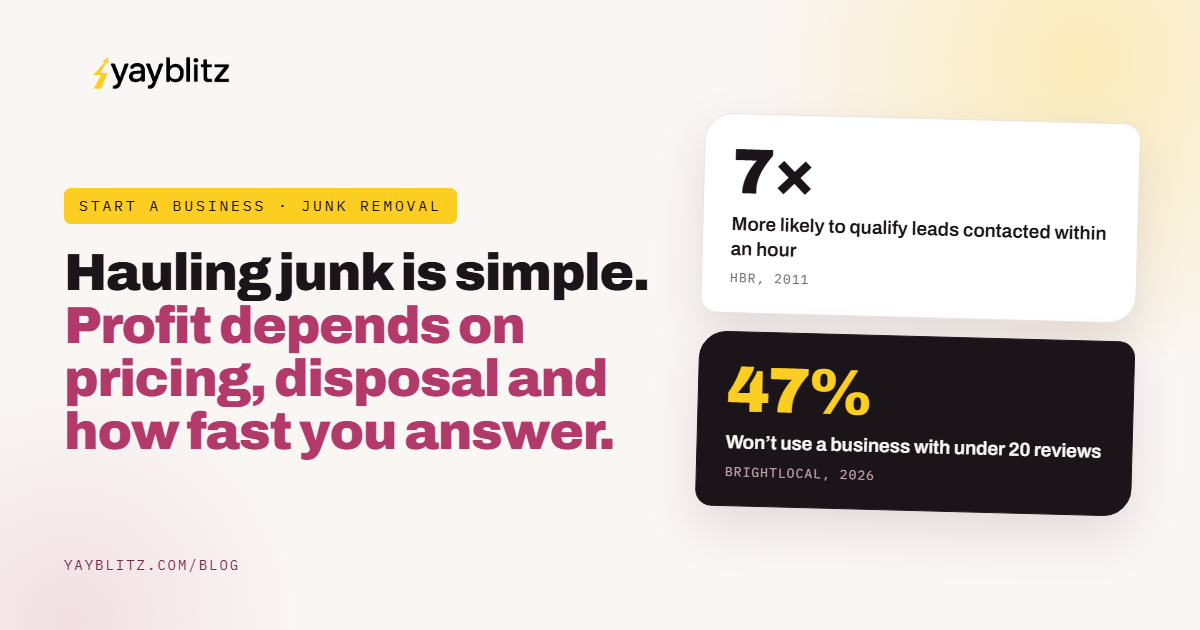
Reviews often decide who gets the call. BrightLocal’s 2026 survey found 68% of consumers only use businesses rated four stars or higher, and 47% won’t use a business with fewer than 20 reviews. A new junk removal business needs to close that gap quickly.
Ask when the space is clear and the customer is relieved, and text a review link with a photo of the empty room. Ask them to mention the service and their town, which naturally adds useful detail. Never pay or offer discounts for reviews. Our guide on how to get more Google reviews includes scripts.
Should You Use Paid Ads When You Start?
Yes, once your profile and website are ready. Junk removal searches are high intent and local.
People searching “junk removal near me” usually want help soon. Local Services Ads and tightly targeted Search ads can bring calls quickly. Block searches for dumpsters, jobs and free pickup if you don’t offer them, and track calls to booked jobs.
Our guide to Local Services Ads vs Google Ads explains which to start with.
How Fast Should You Answer Leads?
Within minutes. Customers often contact several companies and hire the first one that responds clearly.
A widely cited Harvard Business Review study found that firms contacting leads within an hour were about seven times more likely to qualify them than firms that waited longer. Junk removal customers often book the first company that gives a clear price and an arrival window, sometimes for the same day.
Set up an instant text reply for missed calls and form submissions, block time between jobs to call back and track how long each lead waits. Our speed-to-lead guide and our guide to an AI receptionist show simple systems for small teams.
What Software Do You Need?
A CRM or field service app for booking, scheduling, photo quotes, payments and follow-up.
Software helps you capture leads, send quotes from photos, schedule jobs and routes, collect payment on site and send review requests automatically. It also helps track disposal costs and revenue per load.
Our guide to junk removal CRM explains what to look for.
When Should You Hire Help?
Many jobs need two people from the start. Hire a reliable helper early and add a second truck when demand supports it.
Heavy items and larger loads usually need two people, so many owners hire a helper from day one. Look for reliability, customer service skills and safe lifting habits. Check workers’ compensation and classification rules in your state.
When you’re regularly turning down same-day jobs or booking several days out, consider a second truck and crew.
What Mistakes Do New Junk Removal Businesses Make?
Underpricing, ignoring disposal costs, poor truck maintenance, missed calls and no partner relationships.
- →Underpricing: tiers that don’t cover disposal and labor
- →Ignoring disposal fees: not tracking cost per load
- →Poor maintenance: breakdowns and cancelled jobs
- →Missed calls: same-day jobs go to whoever answers
- →No partners: relying only on one-time customers
- →Taking hazardous items: fines and safety risks
What Should Your First 90 Days Look Like?
Set up legally and map disposal sites first, win first customers next, then add partners and systems.
By day 90, know your average job size, disposal cost per load and best lead sources.
The 16-point junk removal startup checklist
Tick what you already have. The first unticked items are your next moves.
Setup
4 itemsOperations
4 itemsMarketing
4 itemsGrowth
4 itemsFrequently Asked Questions
How much does it cost to start a junk removal business?+
Do you need a license to start a junk removal business?+
How should I price junk removal?+
What truck is best for junk removal?+
How do junk removal businesses get customers?+
Is junk removal profitable?+
What items can’t junk removal companies take?+
How can I lower disposal costs?+
Build a Junk Removal Business That Clears a Profit
Know your disposal costs, price by volume, keep your truck running, answer fast, donate and recycle, and build partner relationships. Those habits turn a truck into a business.
Answer first, quote clearly, haul it today. That’s the whole pitch.
Yay Blitz helps junk removal companies businesses connect Graphic and Web Design, Paid Local Advertising, and AI Lead Management into one measurable system for getting and converting leads.
Want a second opinion? Book a Free Strategy Assessment. We’ll review your website, Google profile and lead follow-up and show you where your next customers are coming from.
 Funnel Strategy
 Graphic & Web Design
 Paid Local Ad
 Social Media Marketing