

Almost every homeowner, landlord and small business has a list of small repairs that never get done. Most contractors don’t want small jobs, and homeowners don’t have the time, tools or skills. That gap is the handyman business. It’s one of the lowest-cost home service businesses to start, and good handymen are often booked weeks out.
The catch is that “handyman” isn’t a license. Many states limit what unlicensed workers can do, usually by project value or type of work. California, for example, raised its handyperson exemption to $1,000 in 2025, but only when no building permit is needed and no workers are hired. Electrical, plumbing and HVAC work generally require licensed trades. Knowing your limits protects customers and your business.
This guide covers how to start a handyman business step by step: licensing limits, legal setup, insurance, tools and vehicle, startup costs, which jobs to take and refuse, hourly versus flat-rate pricing, minimums and trip charges, branding, your website and Google Business Profile, first customers, reviews, ads, lead response, software, repeat customers, hiring, common mistakes and your first 90 days.
To start a handyman business, learn your state and local licensing limits, register the business, carry general liability insurance, and build a reliable kit of tools for the repairs you’ll do most. Refer licensed trade work like electrical panels, plumbing and HVAC to licensed contractors.
Then price with clear minimums and flat rates for common jobs, launch a simple website and Google Business Profile with real photos, answer leads quickly, ask every customer for a review and turn one-time jobs into repeat customers with home maintenance visits.
Is a Handyman Business Worth Starting in 2026?
Yes. Startup costs are low, demand is broad and loyal customers call again and again.
Handyman work comes from homeowners, older adults, busy families, landlords, property managers, realtors and small businesses. Many jobs are too small for contractors but too difficult or time-consuming for the customer, which leaves room for a reliable handyman to charge fair prices.
The challenges are low job values, lots of driving and the temptation to take work beyond your license or skills. Owners who succeed bundle jobs into bigger visits, set minimums, stay within legal limits and build repeat customers who trust them with their whole list.
One small job is a visit. A customer who hands you their whole list is a business.
Do You Need a License to Start a Handyman Business?
It depends on your state. Many allow small jobs without a contractor license, but set limits on project value, permits and trade work.
Licensing rules vary widely. Some states have no handyman license and only require a business license. Others require a contractor license above a dollar threshold. In California, the Contractors State License Board allows unlicensed work only on projects under $1,000 in total labor and materials, when no permit is needed and no workers are hired. Other states set different limits.
Nearly everywhere, work involving electrical systems, plumbing, gas or HVAC requires licensed tradespeople, and anything that needs a building permit usually requires a licensed contractor. Check with your state contractor board and city, write down your limits and stick to them. Some handymen later get a contractor license to take larger jobs.
How Should You Set Up the Business Legally?
Choose a business structure, register your name, get an EIN and keep business money separate from day one.
Most new handyman businesses start as a sole proprietorship or a single-member LLC. An LLC can separate business and personal liability, which matters when you work in customers’ homes and on their property. The SBA compares the options in its guide to choosing a business structure, and a local accountant can help you pick the right one for your state.
Register your business name, apply for a free Employer Identification Number from the IRS and open a business bank account. Track every job’s time, materials and drive time. It shows which jobs are worth taking and helps you set your minimums.
What Insurance Does a Handyman Business Need?
General liability at minimum, plus commercial auto, tools and equipment cover, and workers’ compensation once you hire.
Handyman work happens inside people’s homes. A slipped drill, a leaky fixture or a dropped TV can lead to a claim. General liability insurance protects you and reassures customers, and property managers often require it.
- →General liability: damage to customers’ property and injuries to others
- →Commercial auto: vehicles used for work
- →Tools and equipment: coverage for your tool kit
- →Workers’ compensation: usually required once you hire
The SBA’s guide to business insurance explains the main types. Get quotes from an agent who insures contractors, keep certificates ready to send and put “licensed and insured” on your website, truck and quotes once it’s true.
What Tools and Vehicle Do You Need?
A reliable vehicle, a well-organized core tool kit and common supplies, then add specialty tools as jobs require.
- →Vehicle: truck or van with organized storage
- →Power tools: drill, impact driver, oscillating tool, circular saw, jigsaw
- →Hand tools: levels, measuring tools, pry bars, hammers, screwdrivers, wrenches
- →Drywall and paint: knives, sanders, patching materials, brushes
- →Ladders: step and extension ladders
- →Supplies: fasteners, anchors, caulk, adhesives, shims
- →Protection: drop cloths, shoe covers and cleanup supplies
Organize your vehicle so you can find anything quickly. Clean shoe covers and drop cloths make a strong first impression.
How Do You Work Out Your Startup Costs?
List tools, vehicle, licensing, insurance, software, marketing and working cash, then get real local quotes for each line.
Startup costs for a handyman business vary widely depending on whether you already own a work vehicle and tools, buy new or used, and start alone or with a crew. Rather than trusting a national average, build your own list and price every line locally.
Many handymen start with tools they already own, but budget to replace worn tools with professional-grade versions. The SBA guide to funding your business covers loans, lines of credit and other options if you need them.
Which Jobs Should You Take and Refuse?
Take small repairs, installs and maintenance you can do well and legally. Refer licensed trade work and large projects.
Good handyman jobs include drywall repair, doors and trim, caulking, small carpentry, fixture swaps where allowed, furniture assembly, TV and shelf mounting, gutter cleaning, minor painting, weatherstripping and rental turnover repairs.
Refer out electrical panel and circuit work, plumbing beyond simple fixture swaps where allowed, HVAC, gas, roofing and structural work, and anything that needs a permit unless you’re licensed for it. Building referral relationships with licensed trades often leads to referrals back to you.
How Should You Price Handyman Work?
Use a minimum charge, flat rates for common jobs and hourly rates for unclear jobs, all based on your real costs.
Small jobs lose money if you don’t account for drive time, setup, supply runs and cleanup. Set a minimum visit charge that covers at least the first hour or two. For common jobs like mounting a TV or replacing a door, use flat rates so customers know the price upfront.
For unclear or larger jobs, use an hourly rate plus materials with a written estimate. Build every rate from your fully loaded hourly cost, including vehicle, insurance, tools, overhead, unbillable time and profit. Our guide on pricing home services explains the method.
Your minimum charge isn’t greedy. It’s what makes small jobs possible.
How Can You Make Each Visit More Valuable?
Encourage customers to bundle tasks into one visit and offer half-day and full-day bookings.
Driving across town for one 20-minute job rarely pays. Ask customers to send their full list, offer half-day and full-day rates and suggest related fixes you notice while you’re there.
Group jobs by area on the same day to cut drive time. Bundling makes each visit more profitable and more useful for the customer.
How Do You Communicate Like a Professional?
Confirm every booking in writing, arrive on time, explain the work and leave a written summary.
Communication is where many handymen lose customers. Confirm each visit by text the day before with your arrival window and what you’ll work on. If you’re running late, say so before the window ends. On arrival, walk through the list with the customer and agree on priorities if time is short.
Before you leave, show what you fixed, explain anything you noticed that may need attention later and send a written summary with photos and the invoice. Customers who feel informed trust you with more of their home, and they’re far more likely to leave a review and refer friends.
Keep your notes from each visit. The next time the customer calls, you’ll already know their home, which saves time for both of you.
How Do You Choose a Name and Brand?
Pick a clear, friendly name, use clean branding and present yourself professionally.
Customers are letting you into their homes, often while they’re there alone. A professional name, logo, uniform, clean vehicle and clear communication build trust before you pick up a tool.
Keep your name, phone number and service area consistent across your website, Google profile, invoices and directories.
Do You Need a Website?
Yes. A fast site with service pages, service areas, real job photos, reviews, your license details and one-tap calling is enough to start.
Almost every customer checks the website before calling, even when they found you on Google Maps or through a referral. For handyman, the site has one job: make it easy to trust you and contact you. Put the phone number at the top of every page, show your license and insurance, and use real photos of your work and your team rather than stock images.
Create one page for each main service, such as drywall repair, door and trim repair, fixture installs, furniture assembly, TV mounting and small carpentry, plus pages for the towns you serve. Add your best reviews, a short story about you and a simple quote or booking form. List the jobs you do and don’t do, your minimum charge and how booking works. Our home service website guide covers the essentials.
How Do You Set Up Your Google Business Profile?
Create and verify it on day one, choose the most accurate category, list every service and service area, and keep adding photos and reviews.
Your Google Business Profile decides whether you appear in the map results when someone searches “handyman near me.” For many local service businesses, it produces more calls than the website. Set it up as a service-area business if customers don’t visit your location, and follow Google’s guidelines for representing your business so it isn’t suspended.
Pick the most accurate primary category, add every service you offer and the areas you cover, and upload real job photos every week. Reply to every review and answer questions. Our Google Business Profile checklist covers every setting.
How Do You Get Your First Handyman Customers?
Neighbors, realtors, property managers, older adults’ networks and a strong Google profile.
- →Neighbors and friends: your first reviews and referrals
- →Realtors: pre-listing and inspection repairs
- →Property managers: turnover repairs and maintenance
- →Senior communities: trusted, recurring small repairs
- →Licensed trades: referrals for work they don’t want
- →Local groups: Nextdoor and neighborhood Facebook groups
Our guide to local SEO for new businesses explains how to get found from day one.
How Do You Get Reviews Early?
Ask every happy customer the same day, send a one-tap link and reply to every review.
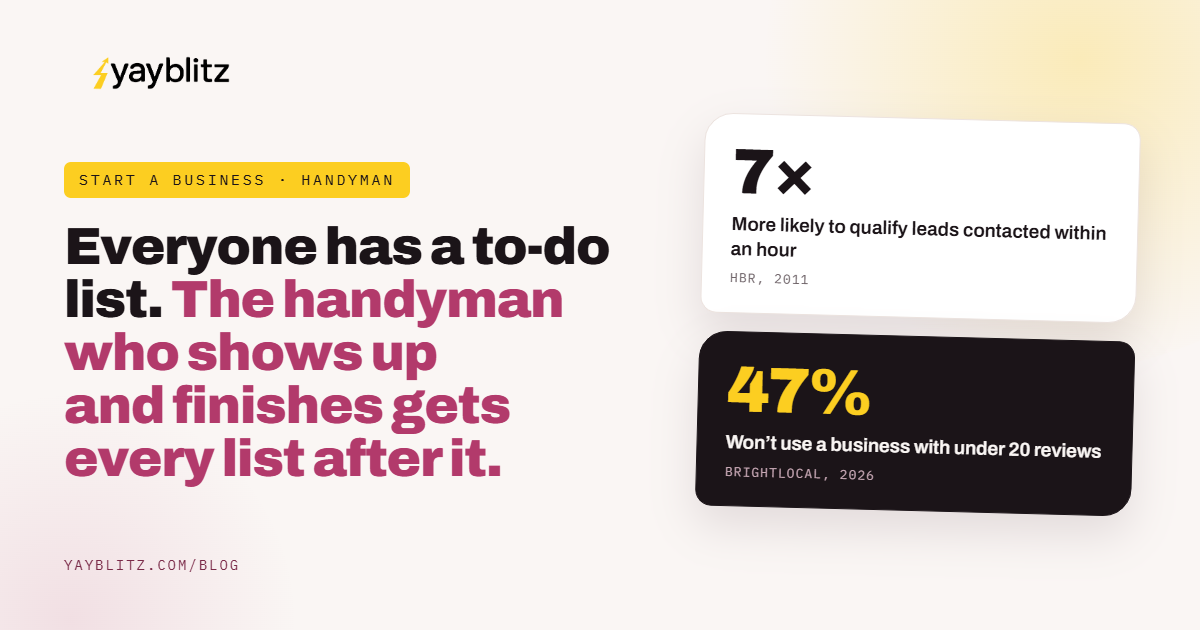
Reviews often decide who gets the call. BrightLocal’s 2026 survey found 68% of consumers only use businesses rated four stars or higher, and 47% won’t use a business with fewer than 20 reviews. A new handyman business needs to close that gap quickly.
Ask at the end of every visit, once the customer has seen the finished work, and text a review link. Ask them to mention the service and their town, which naturally adds useful detail. Never pay or offer discounts for reviews. Our guide on how to get more Google reviews includes scripts.
Should You Use Paid Ads When You Start?
Carefully. Many handyman jobs are small, so make sure your pricing covers the cost of each lead.
Because handyman jobs are often smaller, ads need to be tightly targeted to be profitable. Focus on searches for specific services you do well and areas you want to work, and track calls to booked jobs.
Many handyman businesses grow mostly through Google Business Profile, reviews and referrals. Our guide to local SEO vs LSA vs Google Ads explains how to split a small budget.
How Fast Should You Answer Leads?
Within minutes. Customers often contact several companies and hire the first one that responds clearly.
A widely cited Harvard Business Review study found that firms contacting leads within an hour were about seven times more likely to qualify them than firms that waited longer. Customers with a to-do list often contact several handymen and book the first who responds with a clear next step.
Set up an instant text reply for missed calls and form submissions, block time between jobs to call back and track how long each lead waits. Our speed-to-lead guide and our guide to an AI receptionist show simple systems for small teams.
What Software Do You Need?
A simple CRM or field service app for booking, quotes, scheduling, invoicing, payments and follow-up.
Software helps you keep track of customers and their lists, send quotes, schedule visits efficiently, take payments and send review requests and reminders.
Our guide to handyman CRM explains what to look for.
How Do You Build Repeat Customers?
Keep a record of each home, offer seasonal maintenance visits and stay in touch.
A handyman who knows a customer’s home becomes the first call for every small job. Keep notes and photos of each property, offer spring and fall maintenance visits and send reminders.
Our guide to customer retention for home services shows how to set up simple reminders.
When Should You Hire Help?
When you’re booked weeks out and turning down profitable work, and only if your licensing allows it.
In some states, hiring workers changes your licensing requirements, as in California, where the handyperson exemption doesn’t apply if workers are hired. Check before you hire.
Many handymen grow by raising prices, focusing on better-paying jobs, getting a contractor license or adding a second technician.
What Mistakes Do New Handyman Businesses Make?
Working beyond legal limits, underpricing small jobs, no minimums, too much driving and no follow-up.
- →Beyond legal limits: fines and liability for unlicensed work
- →No minimum charge: small jobs that lose money
- →Too much driving: scattered single-task visits
- →Taking trade work: electrical, plumbing or HVAC without a license
- →No reviews: invisible on Google Maps
- →No follow-up: missing repeat work
What Should Your First 90 Days Look Like?
Learn your limits and set up first, win your first customers next, then build repeat work and systems.
By day 90, know your average visit value, drive time per job and best customer sources.
The 16-point handyman startup checklist
Tick what you already have. The first unticked items are your next moves.
Setup
4 itemsOperations
4 itemsMarketing
4 itemsGrowth
4 itemsFrequently Asked Questions
How much does it cost to start a handyman business?+
Do you need a license to be a handyman?+
What is the handyman limit in California?+
What jobs can a handyman do?+
How should I price handyman work?+
How do handymen get customers?+
Is a handyman business profitable?+
Should a handyman get a contractor license?+
Build a Handyman Business Customers Trust With Their Whole List
Know your legal limits, price small jobs properly, bundle visits, show up on time and stay in touch. That’s how a handyman becomes the first call for every repair.
Reliable beats cheap. Every time.
Yay Blitz helps handyman businesses connect Graphic and Web Design, Paid Local Advertising, and AI Lead Management into one measurable system for getting and converting leads.
Want a second opinion? Book a Free Strategy Assessment. We’ll review your website, Google profile and lead follow-up and show you where your next customers are coming from.
 Funnel Strategy
 Graphic & Web Design
 Paid Local Ad
 Social Media Marketing