

Garage doors are the largest moving object in most homes, and when one stops working, the homeowner’s car is often trapped inside. That urgency makes garage door repair one of the most profitable service niches in home services: calls are frequent, decisions are fast and a good technician can complete several calls a day. Add new doors and openers, and a small company can build a strong mix of quick repairs and higher-ticket installs.
It’s also a trade with real safety and trust issues. Torsion and extension springs store a lot of energy and can cause serious injuries when handled incorrectly. Federal rules in 16 CFR Part 1211 require entrapment protection on automatic residential garage door openers. And the industry has a reputation problem: homeowners are wary of companies that quote low on the phone and upsell aggressively at the door. Honest, clear pricing is a competitive advantage.
This guide is written for the founder deciding whether to start, the operator who has to run profitable service trucks, and the investor or buyer evaluating a garage door company. It covers licensing, safety, insurance, tools and inventory, services, pricing, door and opener sales, maintenance plans, unit economics, KPIs, marketing, hiring, software, what makes a garage door company valuable and a first-90-days plan.
To start a garage door business, register the business, check state and local contractor licensing rules, carry general liability and workers’ compensation, train thoroughly on spring and opener safety, and stock a service van with common springs, cables, rollers and opener parts.
Then build a clear flat-rate pricebook from your real costs, offer good, better and best options without pressure, sell tune-up plans, answer every call within minutes, launch a website and Google profile with real reviews, and track revenue per call, close rate on doors and repeat customers every week.
Is Starting a Garage Door Business Worth It in 2026?
Yes. Service calls are frequent and urgent, startup costs are moderate and door sales add high-ticket revenue.
Springs break, cables fray, openers fail and cars back into doors. Every home with an attached garage is a potential customer, and many calls are urgent. A well-stocked truck lets one technician complete several profitable calls a day, and installs of new doors and openers add bigger tickets.
The challenges are safety, competition from national lead-generation networks, price-shopping customers, technician hiring and managing inventory. Owners who build trust with clear pricing and quality work earn repeat customers and referrals.
Customers expect to be upsold. Surprise them with a fair price and an honest explanation.
Do You Need a License to Start a Garage Door Business?
It depends on your state and city. Some require a contractor or specialty license, some only a business license.
Licensing varies widely. Some states require a contractor or home improvement license for garage door installation, especially above a dollar threshold. Others require only a business license. Electrical work beyond plugging in an opener may require a licensed electrician in some areas, and some cities require permits for new door installations.
Check your state contractor board and city building department, and the SBA’s guide to licenses and permits. Display your license and insurance on your website, truck and invoices.
How Do You Handle Spring and Opener Safety?
Train every technician on spring tension and correct tools, never cut corners, and make sure every opener you install or service has working safety reversal.
Torsion springs store enough energy to cause serious injuries if released incorrectly. Use proper winding bars, never improvise tools, unwind before removing, secure doors before working on them and never let untrained workers handle springs. Train new technicians by pairing them with experienced techs until they demonstrate safe practice.
Federal rules in 16 CFR Part 1211 set entrapment protection requirements for automatic residential garage door openers manufactured since 1993, including reversal when the door meets an obstruction. On every service call, test the photo eyes and reversal function, explain the results to the customer and recommend replacement when older openers lack modern safety features. The U.S. Consumer Product Safety Commission offers consumer guidance you can share.
How Should You Set Up the Business Legally?
Choose a business structure, register your name, get an EIN and keep business money separate from day one.
Most new garage door businesses start as a sole proprietorship or a single-member LLC. An LLC can separate business and personal liability, which matters when you work in customers’ homes and on their property. The SBA compares the options in its guide to choosing a business structure, and a local accountant can help you pick the right one for your state.
Register your business name, apply for a free Employer Identification Number from the IRS and open a business bank account. Track repair and installation revenue separately. They have different margins, cash needs and sales processes.
What Insurance Does a Garage Door Business Need?
General liability at minimum, plus commercial auto, tools and equipment cover, and workers’ compensation once you hire.
Spring failures, falling doors and opener malfunctions can cause serious injuries and property damage. Confirm your policy covers garage door work and that limits are adequate. Builders and commercial customers will ask for certificates.
- →General liability: property damage and injuries, including door and spring failures
- →Workers’ compensation: required in most states once you hire
- →Commercial auto: service vans
- →Tools and inventory: parts and tools on every truck
- →Contractor bond: required in some states and cities
The SBA’s guide to business insurance explains the main types. Get quotes from an agent who insures contractors, keep certificates ready to send and put “licensed and insured” on your website, truck and quotes once it’s true.
What Tools and Inventory Do You Need?
A service van with winding bars, hand and power tools, ladders and a stock of the most common springs, cables, rollers and opener parts.
- →Service van: shelving, spring racks and secure storage
- →Spring tools: proper winding bars, clamps and gauges
- →Hand and power tools: drills, impact drivers, sockets, levels, cutters
- →Ladders: for opener and track work
- →Springs: common torsion and extension sizes in your market
- →Parts: cables, rollers, drums, bearings, hinges, weather seals
- →Opener parts: logic boards, gears, sensors, remotes and keypads
First-visit fixes are the key to profitability. Track which springs and parts you use most and keep them stocked.
How Do You Work Out Your Startup Costs?
List tools, vehicle, licensing, insurance, software, marketing and working cash, then get real local quotes for each line.
Startup costs for a garage door business vary widely depending on whether you already own a work vehicle and tools, buy new or used, and start alone or with a crew. Rather than trusting a national average, build your own list and price every line locally.
New doors are usually ordered from a manufacturer or distributor. A deposit at signing helps cover the cost. The SBA guide to funding your business covers loans, lines of credit and other options if you need them.
Which Garage Door Services Should You Offer?
Spring and opener repairs first, then new openers, new doors, tune-up plans and commercial doors.
How Should You Price Garage Door Work?
Use a clear flat-rate pricebook built from parts, labor time, your fully loaded hourly cost and profit, and present honest options.
Flat-rate pricing lets customers approve a clear price before work begins. Build every price from parts cost, average labor time, your fully loaded hourly cost, overhead and profit. Offer good, better and best options, such as standard springs, high-cycle springs or springs plus a full tune-up.
Be honest about what’s needed and what’s optional. Many homeowners are wary of garage door companies after bad experiences. Explain each option, leave the decision to them and never pressure. Our guide on pricing home services explains how to calculate your true hourly cost.
Honest options sell more than pressure. And they get you reviews.
How Do You Sell New Doors and Openers?
Measure carefully, show options with photos or a simple showroom, quote clearly and follow up.
New doors are a design decision as much as a repair. Bring a catalog or tablet with photos, show how different styles look on similar homes and explain insulation, windows and warranty options. Measure carefully and confirm headroom, side room and backroom before ordering.
Collect a deposit when the customer signs, order promptly and keep them updated on delivery. Follow up on every unsold door quote; many customers take time to decide.
Should You Offer Tune-Up or Maintenance Plans?
Yes. Plans create recurring revenue, fill slow weeks and keep you first in line for repairs and replacements.
An annual tune-up plan might include lubrication, balance and safety tests, hardware tightening and priority scheduling. It keeps customers in touch with you and catches problems before they become emergencies.
Our guide to service agreements for contractors explains pricing and selling plans.
What Do the Unit Economics of a Garage Door Truck Look Like?
Revenue per technician-day minus labor, parts, vehicle and fuel. Track it every week.
Calls per day and first-visit completion drive profitability. Every return trip for a missing part costs a call.
Which KPIs Should a Garage Door Owner Track?
Calls per tech-day, average ticket, first-visit completion, door close rate, tune-up members, reviews and cost per booked call.
Do You Need a Website?
Yes. A fast site with service pages, service areas, real job photos, reviews, your license details and one-tap calling is enough to start.
Almost every customer checks the website before calling, even when they found you on Google Maps or through a referral. For garage door companies, the site has one job: make it easy to trust you and contact you. Put the phone number at the top of every page, show your license and insurance, and use real photos of your work and your team rather than stock images.
Create one page for each main service, such as spring replacement, opener repair and installation, new doors, cables and rollers, tune-up plans and commercial doors, plus pages for the towns you serve. Add your best reviews, a short story about you and a simple quote or booking form. Our garage door SEO guide explains how to rank those pages.
How Do You Set Up Your Google Business Profile?
Create and verify it on day one, choose the most accurate category, list every service and service area, and keep adding photos and reviews.
Your Google Business Profile decides whether you appear in the map results when someone searches “garage door repair near me.” For many local service businesses, it produces more calls than the website. Set it up as a service-area business if customers don’t visit your location, and follow Google’s guidelines for representing your business so it isn’t suspended.
Pick the most accurate primary category, add every service you offer and the areas you cover, and upload real job photos every week. Reply to every review and answer questions. Our Google Business Profile checklist covers every setting.
How Do You Get Your First Garage Door Customers?
Your network, realtors, home inspectors, builders, property managers and a strong Google profile.
- →Your network: friends, neighbors and past customers
- →Home inspectors: garage door safety issues found during inspections
- →Realtors: pre-sale repairs and new homeowners
- →Builders and remodelers: new doors for projects
- →Property managers: repairs across rental properties
- →Google profile: most garage door searches are local and urgent
Our garage door company marketing guide and our guide to Google Ads for garage door companies cover the next steps.
How Do You Get Reviews Early?
Ask every happy customer the same day, send a one-tap link and reply to every review.
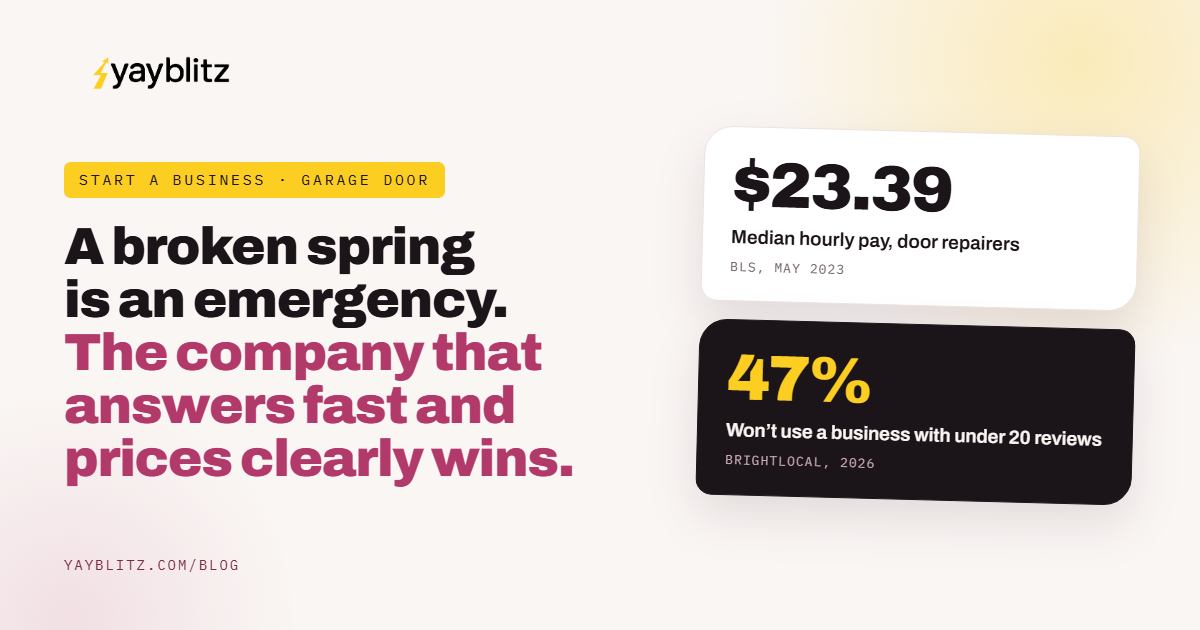
Reviews often decide who gets the call. BrightLocal’s 2026 survey found 68% of consumers only use businesses rated four stars or higher, and 47% won’t use a business with fewer than 20 reviews. A new garage door business needs to close that gap quickly.
Ask right after the door is working again, when the customer is relieved, and text the review link before you leave. Ask them to mention the service and their town, which naturally adds useful detail. Never pay or offer discounts for reviews. Our guide on how to get more Google reviews includes scripts.
How Fast Should You Answer Leads?
Within minutes. Customers often contact several companies and hire the first one that responds clearly.
A widely cited Harvard Business Review study found that firms contacting leads within an hour were about seven times more likely to qualify them than firms that waited longer. A homeowner with a car trapped in the garage won’t wait for a callback. The first company that answers with a clear arrival time usually gets the job.
Set up an instant text reply for missed calls and form submissions, block time between jobs to call back and track how long each lead waits. Our speed-to-lead guide and our guide to an AI receptionist show simple systems for small teams.
What Software Do You Need?
Field service software with dispatch, a pricebook, inventory, payments, tune-up plan tracking and follow-up.
Software helps you book and dispatch calls, present options on a tablet, track truck inventory, take payment on site, manage tune-up plans and follow up on door quotes. It also gives you calls per day and average ticket by technician.
When Should You Hire Your First Technician?
When you’re regularly turning down calls or booking customers more than a day out.
Hire for reliability, mechanical aptitude and customer communication, then train thoroughly on safety. Ride along until the technician consistently completes calls safely and presents options honestly.
A second truck doubles your capacity for urgent calls, which is where much of the revenue in garage doors comes from.
What Makes a Garage Door Company Valuable?
Consistent profit, a strong review base, tune-up members, trained technicians, documented pricing and owner independence.
- →Profitability: steady margins on service and installs
- →Reputation: a large, positive review base
- →Recurring revenue: tune-up plan members
- →People: trained technicians and an office manager
- →Systems: documented pricebook and processes
- →Records: clean books, inventory and customer lists
What Mistakes Do New Garage Door Businesses Make?
Unsafe spring work, low phone quotes followed by upsells, poor inventory, missed calls and no follow-up on door quotes.
- →Unsafe spring work: injuries and liability
- →Bait-and-switch pricing: bad reviews and lost trust
- →Poor inventory: return trips and lost calls
- →Missed calls: urgent jobs go to whoever answers
- →No door follow-up: high-ticket sales left behind
- →Relying on lead networks: high cost per call and no brand
What Should Your First 90 Days Look Like?
Set up legally and safely, stock your truck, build your pricebook, then win first customers and add systems.
By day 90, know your calls per day, average ticket, first-visit completion and cost per booked call.
The 16-point garage door startup checklist
Tick what you already have. The first unticked items are your next moves.
Legal and safety
4 itemsOperations
4 itemsMarketing
4 itemsValue building
4 itemsFrequently Asked Questions
Do you need a license to start a garage door business?+
How much do garage door technicians make?+
Are garage door springs dangerous?+
What safety rules apply to garage door openers?+
How should I price garage door repairs?+
How do garage door companies get customers?+
Should a garage door company offer maintenance plans?+
What makes a garage door company valuable?+
Build the Garage Door Company People Trust
Work safely, price clearly, explain honestly, stock your truck, answer fast and follow up on every door quote. In an industry where customers expect pressure, being fair and reliable is the strongest brand you can build.
Fixed today, priced fairly, explained clearly.
Yay Blitz helps garage door companies businesses connect Graphic and Web Design, Paid Local Advertising, and AI Lead Management into one measurable system for getting and converting leads.
Want a second opinion? Book a Free Strategy Assessment. We’ll review your website, Google profile and lead follow-up and show you where your next customers are coming from.
 Funnel Strategy
 Graphic & Web Design
 Paid Local Ad
 Social Media Marketing