

Most HVAC owners we talk to don’t have a lead problem in July. They have a capacity problem in July and a lead problem in April. Calls pour in during the first heat wave, the phones ring through lunch, and booked jobs slip to competitors who answered faster. Then the shoulder season arrives and the board goes quiet.
More marketing rarely fixes that on its own. If calls go to voicemail at 7 PM, replacement estimates go cold, and maintenance members aren’t renewed, every new dollar of advertising leaks out through the same holes.
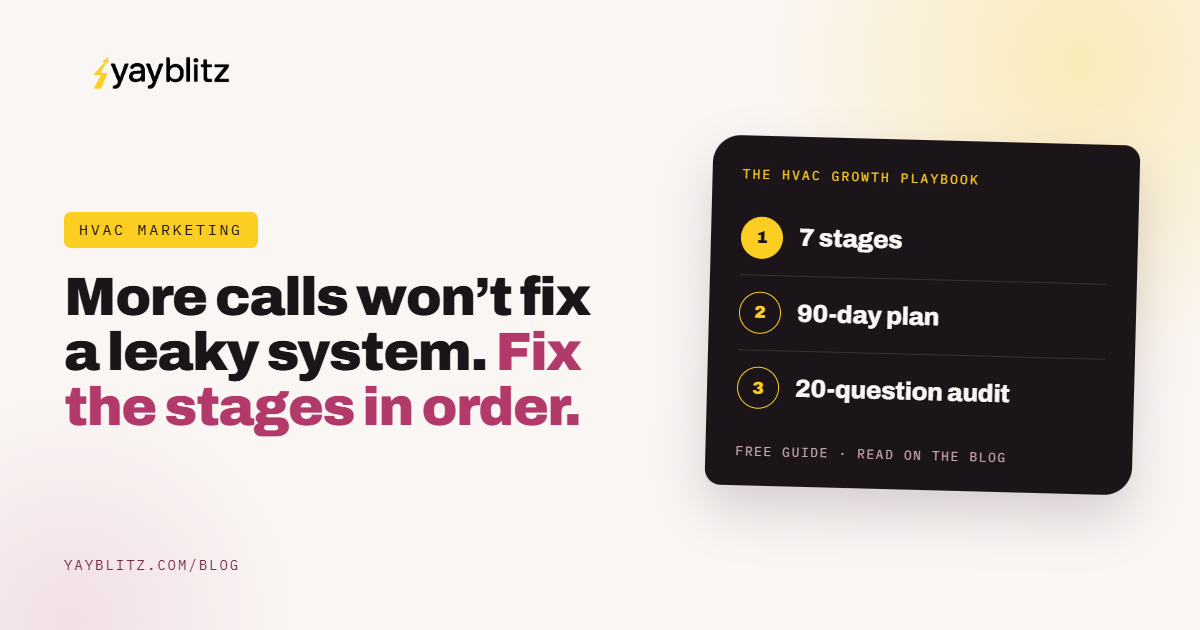
This playbook lays out the seven stages of a residential HVAC growth system in the order they should be built. It explains what each stage needs, how to measure it, and where our deeper guides fit. Use it as a map: find your weakest stage, fix it, then move to the next.
What Makes HVAC Growth Different?
Urgency, seasonality, and two very different sales. HVAC mixes emergency repairs that must be answered in minutes with high-ticket replacements that take days to decide, plus recurring maintenance that drives long-term profit.
Source: IBISWorld and BLS via Sequoia Geo; BrightLocal 2026.
Three forces shape almost every decision an HVAC owner makes about marketing:
That’s why HVAC marketing can’t be judged only by leads. A campaign that doubles calls during a week your team can’t answer them makes the business look worse online, not better. Our original HVAC lead generation guide covers the demand side; this playbook connects it to everything after the call.
What Are the Seven Stages?
Foundation, visibility, capacity, response, sales, memberships, and measurement. Each stage depends on the ones before it.
Owners often skip to stage 2 and buy more visibility. The sections below explain each stage and how to tell whether it’s holding you back.
Stage 1: What Belongs in the Foundation?
A complete Google Business Profile, a fast mobile website with click-to-call and online booking, a steady flow of recent reviews, and a clear brand on trucks and uniforms.
The foundation multiplies everything else. A homeowner who sees your ad, then a profile with 400 recent reviews and a site that loads fast and books online, calls you. The same ad pointing to a weak profile wastes the click. BrightLocal reports that 72% of consumers look at three or fewer businesses before deciding.
Stage 2: How Do You Build Visibility?
Combine local SEO and the map pack for steady demand, Local Services Ads for pay-per-lead calls, and Google Ads for control and scale. Most HVAC companies need all three, weighted by season.
Shoulder season is for building
Spring and fall are when SEO pages, profile work, and reviews should get the most attention, because they compound into the peak. Paid channels can then scale up quickly when demand arrives.
Search and AI answers
More homeowners now ask AI assistants which HVAC company to call or whether a repair is worth it. BrightLocal reports that 45% of consumers use ChatGPT or other AI tools for local recommendations. Pages that answer specific questions, such as repair vs. replace, typical costs, and what happens on a maintenance visit, with real numbers and named people, are the ones most likely to be quoted. For the trade-offs between channels, see local SEO vs. paid ads.
Stage 3: Why Does Capacity Come Before More Leads?
Because HVAC demand arrives in spikes. If you can’t answer, dispatch, and complete the work in a heat wave, extra leads become missed calls, bad reviews, and wasted ad spend.
A simple test: look at last summer’s busiest week. How many calls went unanswered? How long did booked customers wait? If the answers are uncomfortable, put capacity ahead of new campaigns. In many shops the cheapest growth comes from answering the calls already coming in.
Stage 4: How Do You Turn Calls Into Booked Jobs?
Answer fast, book on the first call, confirm by text, and measure booking rate by source and by person. Booking rate is the single most useful number between marketing and revenue.
The example uses illustrative numbers. Exclude existing customers checking on appointments, vendors, and spam from the denominator, or the rate looks worse than it is.
Call recordings show why calls don’t book: price shock, no availability, or an unclear next step. Review a handful each week. Our AI lead management guide covers how automation can help.
Stage 5: How Do You Sell More Replacements?
Spot replacement opportunities on repair calls, present clear options, offer financing, follow up for weeks, and be honest about incentives. Since January 2026, the federal 25C heat pump credit no longer applies to new installations.
Incentives after 2025
The IRS confirms that the Section 25C energy efficient home improvement credit is not allowed for property placed in service after December 31, 2025. Homeowners who installed in 2025 may still claim it on their 2025 return, but new 2026 and 2027 installs don’t qualify. Any marketing that still promises a federal heat pump credit is out of date.
Utility rebates and some state programs continue, and vary by area. Check them locally, name them specifically, and avoid blanket promises. Financing, efficiency savings, comfort, and warranty are now the main levers for replacement offers.
Stage 6: How Do Memberships and Retention Drive Growth?
Maintenance memberships bring customers back twice a year, smooth the seasons, create replacement opportunities, and generate reviews and referrals. Track members, renewals, and revenue per member.
Our service agreements guide covers how to price, sell, and renew plans. In a seasonal business, a strong membership base is one of the best ways to keep technicians busy in April and October.
Stage 7: What Should You Measure?
Cost per booked job and cost per sale by source, booking rate, replacement close rate, average ticket, members, and renewal rate. Review monthly, decide quarterly.
A worked example
Here’s how the stages connect, using illustrative numbers for one summer month. A company receives 400 calls. After removing existing customers, vendors, and spam, 260 are qualified new-customer calls. At a 65% booking rate, that’s 169 booked jobs. Techs flag 40 systems as replacement candidates, and the comfort advisor closes 12 of them.
Now change one number at a time. Raise the booking rate to 75% and the same calls book 26 more jobs, which at the same flag and close rates means about two more replacements. Add a 30-day follow-up sequence that lifts the close rate to 38%, and three more replacements close. Neither change required a single new lead.
Start with call tracking so every call and form has a source, then report by month and channel. Our HVAC cost per lead guide covers lead costs; cost per booked job is the next step down the funnel.
What Do Homeowners Need to Hear at Each Moment?
Different situations need different messages. An emergency caller needs speed and a time; a replacement shopper needs options and proof; a maintenance prospect needs value; a new homeowner needs a trusted name.
Matching the message to the moment is also how a content library grows organic traffic steadily. Each row is a set of searches homeowners make, and each deserves a page that answers it directly. A replacement page that explains repair-versus-replace honestly, with real price ranges and system-age guidance, can rank and be quoted for months. A membership page that lists exactly what’s checked on a tune-up answers a question AI assistants are asked constantly.
Keep claims specific and supportable. Avoid promising exact energy savings or health outcomes, and avoid any mention of the federal 25C credit for new installs. Our HVAC landing page guide shows how to build pages for each situation, and our HVAC SEO guide covers how they rank.
How Should Seasonality Shape the Plan?
Build in the shoulder seasons and capture in the peaks. Use spring and fall for SEO, reviews, memberships, and training; use summer and winter peaks for paid scale and full capacity.
Climate changes the shape. A Phoenix or Dallas contractor sees a much longer cooling season than one in Minneapolis, where heating dominates. Set budgets and staffing from your own call volume by month, not a national average.
How Should the Budget Be Split?
Fund proven channels first, protect the foundation, test one new channel at a time, and keep a reserve for weather spikes. Judge each channel by cost per booked job.
These shares are examples, not benchmarks. The right split depends on market, season, and capacity. Track spend against booked jobs so the mix follows results. For channel structure, see PPC for contractors.
Who Needs to Be Trained for Growth?
Customer service reps, technicians, and comfort advisors. Marketing brings the call; these three roles decide whether it becomes a booked job, a replacement, and a member.
Training doesn’t need to be elaborate. A weekly 30-minute session that reviews three recorded calls and one lost replacement estimate will improve booking and close rates over a season. Pair it with a simple scorecard for each role so people can see their own numbers.
Hiring follows the same logic. The BLS projects 8% job growth for HVAC mechanics and installers from 2024 to 2034, so technicians will stay hard to find. Many companies grow faster by improving booking rate and memberships, which make better use of the technicians they already have, than by trying to add trucks in a tight labor market. For response tools, see AI receptionist for service businesses.
Where Does AI Fit in an HVAC Business?
Where it removes repetitive work: answering after-hours calls, instant replies to forms, appointment reminders, estimate follow-up, review responses, and call summaries. Keep people in charge of diagnosis, pricing, and promises.
Start with one workflow, measure booked jobs before and after, and expand. Our CRM automation and AI guide and AI lead CRM guide cover the setup.
What Do HVAC Companies Look Like at Each Size?
Small shops win with a strong profile, fast answers, and memberships. Growing shops add call tracking, a booking team, and replacement sales. Established shops add routing, dashboards, and multiple channels.
Owner-operator to 5 trucks
The owner often answers the phone, runs calls, and sells. Focus on the Google profile, reviews after every job, click-to-call and online booking, after-hours coverage, and a simple membership plan.
6 to 20 trucks
A dispatcher or CSR team appears, and leaks shift to the phones and the replacement process. Add call tracking, booking-rate reporting, call scripts, a replacement follow-up sequence, and Google Ads alongside LSA.
20+ trucks or multiple locations
Small inefficiencies multiply. Add lead routing by area, monthly cost-per-booked-job dashboards, membership renewal automation, and separate campaigns by location and service.
What Are the Most Common Mistakes?
Buying leads before fixing the phones, judging by cost per lead, pausing SEO in peak season, selling replacements on one visit with no follow-up, promising expired incentives, and ignoring memberships.
Each of these is fixable within a season. The stage audit below shows which ones apply to you.
What’s the 90-Day Plan?
Days 1–30 fix the foundation and phones, days 31–60 tighten booking and replacement follow-up, days 61–90 build memberships and measurement. Then move to the weakest remaining stage.
Give each block one owner, even in a small company. Someone owns the profile and reviews, someone the phones and booking, someone replacement follow-up, and someone the numbers.
Where Do All Our HVAC Guides Fit?
Every guide maps to a stage. Use this table as the index to the full HVAC library.
Start with our guide to choosing an HVAC marketing agency. We’re adding HVAC guides on budgets, after-hours dispatch, replacement sales, booking rate, seasonality, and heat pump marketing. Each will be linked here as it’s published.
Twenty questions to find your weakest stage
Answer yes or no. The stage with the most no answers is where to start.
Foundation
5 itemsCapacity and response
5 itemsSales and memberships
5 itemsMeasurement
5 itemsFix the stage with the most no answers before adding marketing spend. That's fixable.
Frequently Asked Questions About HVAC Contractor Growth
What is the best way for an HVAC company to grow?+
What should an HVAC company measure?+
What is a good booking rate for HVAC calls?+
Is the federal heat pump tax credit still available?+
How should HVAC companies handle seasonality?+
Do HVAC companies need both LSA and Google Ads?+
How can AI help an HVAC company?+
Where should a small HVAC company start?+
Fix the Leak Before You Turn Up the Water.
The HVAC companies that grow steadily aren’t the ones with the biggest ad budgets. They answer every call, book on the first conversation, follow up on every replacement estimate, keep their members, and measure what each channel really delivers.
Build the foundation. Answer every call. Keep every member.
For related guides, see HVAC lead generation, HVAC cost per lead, and service agreements.
Yay Blitz helps HVAC companies connect Graphic and Web Design, Paid Local Advertising, and AI Lead Management into one measurable system for getting and converting leads.
If you’re not sure which stage is holding you back, start with a Free Strategy Assessment. We’ll run the stage audit on your business and show where to start.
 Funnel Strategy
 Graphic & Web Design
 Paid Local Ad
 Social Media Marketing