

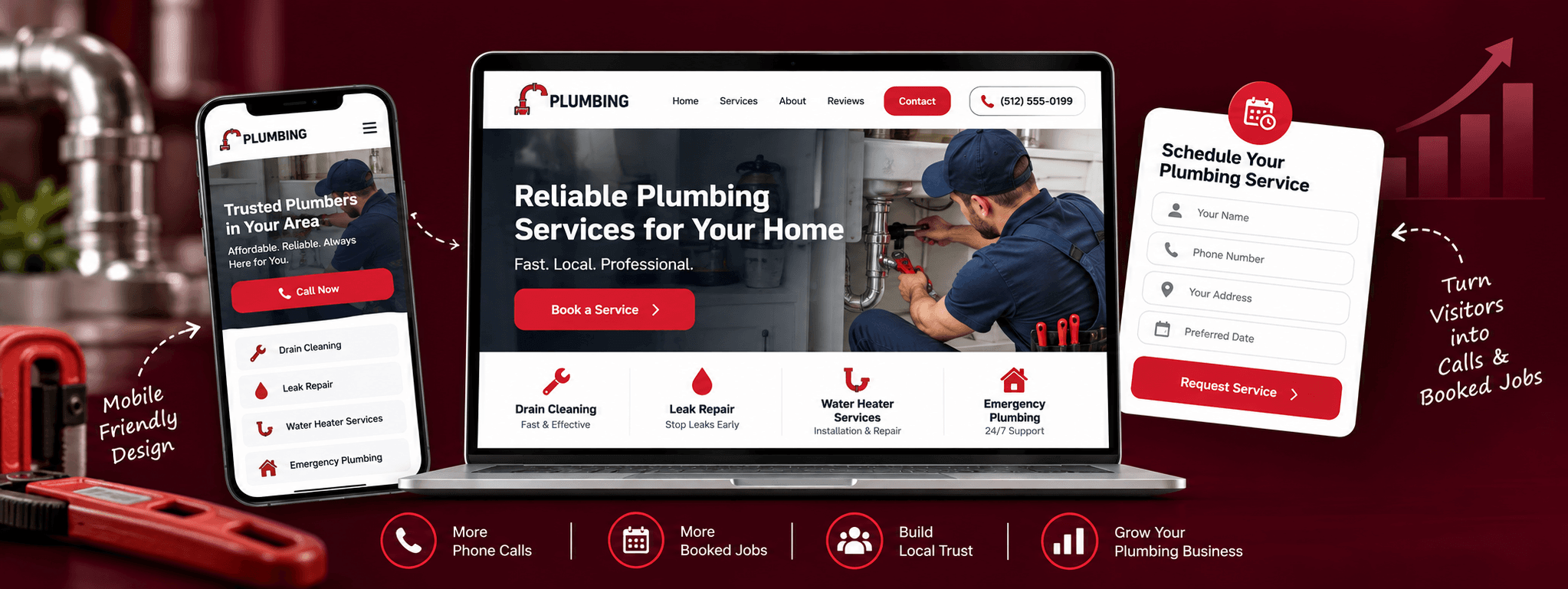
A plumbing company can have a clean logo, modern colors, professional photography, and a website that looks impressive on a desktop monitor, yet still lose the customer standing in a wet kitchen with a phone in one hand. The reason is simple. Plumbing website design is not only about appearance. It has to help a local homeowner understand whether you solve the problem, whether you serve the area, whether you look trustworthy, and what to do next.
That decision can happen quickly for emergency work and much more slowly for planned projects. Someone with a burst pipe may want a phone number immediately. Someone considering repiping, a new water heater, or a larger plumbing project may compare several companies, read reviews, study financing, and look for proof before requesting an estimate.
A strong plumbing company website has to serve both behaviors without becoming confusing. It should support local SEO, give paid traffic a relevant destination, reduce hesitation, and make it easy to measure which pages and campaigns actually produce booked jobs.
What Plumbing Website Design Actually Needs to Accomplish
The website has four practical jobs, and a beautiful site that fails them is not a strong plumbing website.
The visitor immediately understands what the company does and whether the service matches the problem.
Real reviews, technicians, vehicles, licenses, and warranties reduce the uncertainty of inviting someone into the home.
Urgent customers call without searching menus. Planned customers have a clear estimate path.
Calls, forms, booked appointments, and revenue trace back to the pages and sources that generated them.
The Homepage Should Explain the Business in Seconds
The homepage is not the place to make the customer decode what the company does. The headline should communicate the business rather than use vague language such as "Quality You Can Trust" without context. A stronger approach names the category, service area, or core value clearly enough that a homeowner can understand it without scrolling.
The homepage should then guide visitors into the major service pages instead of attempting to explain every service in one long page.
Every Important Plumbing Service Needs a Clear Destination
A plumbing website becomes much easier to use when important services have distinct pages: emergency plumbing, drain cleaning, sewer line repair, water heater repair, water heater replacement, leak detection, repiping, and commercial plumbing. The exact architecture should follow the real services and search demand of the business.
A good service page should answer the customer's buying questions, not simply repeat the keyword ten times. Google recommends helpful, reliable, people first content rather than pages created mainly to manipulate rankings. The service page should be genuinely useful even if the visitor arrived directly and never saw a search result.
One intent, one page, no competing URLs
"Plumber Fort Worth," "Fort Worth plumber," and "plumbing company Fort Worth" often represent the same broad intent. Creating separate near duplicate pages for each variation can make the site confusing and create competition between your own URLs. Website architecture and keyword ownership should be planned together, not built by separate teams after the site is already live.
Mobile Is the Primary Conversion Environment
A plumbing website should be designed from the phone outward, not as a desktop page that happens to shrink. On mobile, the phone number should be easy to see and tap. Navigation should be simple. Forms should be short. Important information should not be hidden behind animations or popups.
Google's current page experience guidance recommends pages that display well on mobile devices, provide good Core Web Vitals, use secure connections, and avoid intrusive experiences. For plumbing companies, these are not only technical SEO considerations. If the customer cannot interact with the page easily while dealing with an urgent problem, the site may lose the job before the business ever receives the lead.
Largest Contentful Paint, per Google's Core Web Vitals guidance.
Interaction to Next Paint, under this threshold for a good experience.
Cumulative Layout Shift, so buttons do not move while someone tries to call.
Those numbers should not become an excuse to chase a perfect technical score while ignoring the customer. Compress large images, use modern formats, remove unnecessary scripts, and pay particular attention to the homepage and high traffic service pages.
Reviews Should Support the Decision, Not Decorate the Footer
Reviews are most useful when they appear close to the moment of hesitation. A customer on a sewer line page may respond better to proof related to major plumbing work than a generic testimonial about friendly service. Do not manufacture testimonials or write reviews on behalf of customers.
The website should also connect naturally with Google Business Profile. Google states that local results are mainly influenced by relevance, distance, and prominence, and that reviews and links can contribute to prominence. The website and Business Profile should tell a consistent story about services, location, and business identity.
Service Areas Need to Be Clear Without Pretending Geography Does Not Matter
Many plumbing companies serve a large metro, but that does not mean the website should list fifty cities in every paragraph. A dedicated location page can make sense when the company genuinely serves the market and the page contains meaningful local information, not a copy of another city page with the place name changed.
The site also cannot force Google Maps visibility in every city. Distance remains part of local ranking. Website location strategy should follow both search opportunity and job economics. A faraway sewer project may be worth pursuing. A small repair forty miles away may not.
Measure the Website Through Booked Jobs
Website analytics should go beyond page views. A page with high traffic and no calls has a different problem from a page with low traffic and a strong conversion rate. A website rebuild should not be judged only by how different the design looks. It should be judged by whether the customer journey improves.
Vague homepage messaging and every service crammed into one generic page.
Copying the same city page across many locations, hiding reviews deep in the site.
Heavy video and scripts that slow important pages, effects that interfere with reading or calling.
No call or form tracking by source, redesign judged by aesthetics rather than booked jobs.
Twenty five questions for the site you have today
Structure & trust
13 itemsTechnical & measurement
12 itemsFrequently Asked Questions
What should a plumbing website include?+
Should a plumber have a separate page for every service?+
How important is mobile design for plumbers?+
How fast should a plumbing website load?+
Do plumber websites need city pages?+
Does website design affect plumber SEO?+
Build the Website Around the Customer Journey
The best plumbing website is not necessarily the one with the most animation, the longest homepage, or the newest design trend. It is the site that makes a local customer feel confident enough to take the next step.
For urgent work, that means speed, availability, trust, and a visible call path. For planned work, it means deeper service information, proof, process, financing where relevant, and an easy way to request the next conversation. Then the site has to support the rest of the acquisition system: organic visitors need useful service architecture, paid visitors need message match, and the front office needs reliable lead routing and follow up.
Yay Blitz helps local service companies connect Graphic and Web Design, Local SEO vs Paid Ads, paid local advertising, conversion tracking, and lead handling so the website becomes part of a measurable growth system rather than a digital brochure. Start with a free strategy assessment if you want to identify where your plumbing website is losing visibility, calls, or booked jobs.
 Funnel Strategy
 Graphic & Web Design
 Paid Local Ad
 Marketing Strategy