

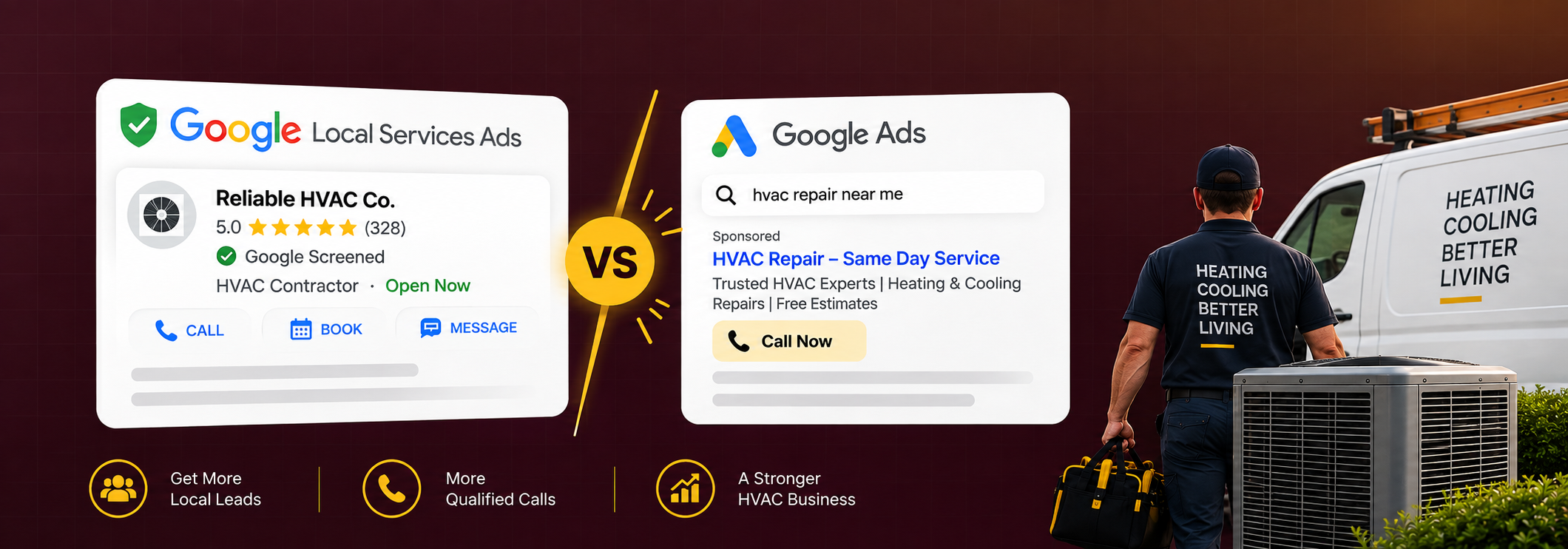
An HVAC owner hears that another contractor is getting service calls from Google Local Services Ads at a lower cost than Search Ads, so the obvious question is whether more budget should move into LSA. That comparison sounds simple, but the two channels create different customer journeys and depend on different strengths.
Local Services Ads lean heavily on reviews, verification, responsiveness, profile quality, and local operating capacity. Search Ads give the advertiser far more control over keywords, messaging, offers, and landing pages.
The decision matters even more in 2026 because Google has started moving Local Services Ads into Google Ads as Performance Max campaigns with pay per lead goals. The core local lead model remains, but management is changing and historical campaign reporting does not automatically carry over. The right question is not whether LSA is better than Google Ads. It is which channel fits the service you want to grow, your local market, your lead economics, and your ability to convert the demand you buy.
What Are Google Local Services Ads for HVAC?
Google Local Services Ads connect local customers directly with eligible service providers. Instead of paying for a normal website click, the advertiser pays for valid leads such as calls, messages, or supported bookings that relate to the services being promoted.
That creates a different path from Search Ads. A Search campaign usually moves the homeowner from the search result to an ad and then to a website or landing page. Local Services Ads place much more weight on the provider profile itself, including reviews, verification, services, photos, business information, and responsiveness. For an HVAC contractor, the customer can begin comparing local providers before visiting the full website.
Why That Baseline Matters
Suppose a Fort Worth HVAC company historically pays $68 per LSA lead and books 46 percent of them. After migration, the new campaign reports a $61 CPL, which looks better. But the booking rate has fallen.
The lead got 10 percent cheaper and the booked job got 33 percent more expensive. Without the old booking data, the owner celebrates a lower CPL while acquiring customers less efficiently. Google says advertisers receive advance notice before migration, so use that window to build a simple before and after benchmark rather than relying on memory later.
Google Guaranteed Is Now Google Verified
Another outdated piece of HVAC marketing advice is the assumption that Local Services Ads still revolve around the Google Guaranteed badge. Google introduced Google Verified as the unified Local Services badge for eligible advertisers that complete the required screening and verification process, and the old Google Guarantee money back program was discontinued.
Verification still matters, but the terminology and consumer promise have changed. Existing eligible advertisers that already completed the required checks move into the Google Verified framework without rebuilding their advertising simply because the badge name changed. If an agency or article still presents Google Guaranteed as the current 2026 program, its Local Services guidance may be out of date.
Still matters, but it is one input rather than the whole contest.
Average response time and answered calls sit inside the ranking signals.
Used by Google to rank you and by homeowners to choose you.
Service relevance, search context, real photos, and completed verification checks.
Google lists responsiveness, customer search context, relevance to the requested service, ratings, review count, average response time, high quality images, completed verification checks, and other profile information among the signals that can influence ranking. LSA optimization is therefore partly an advertising problem and partly an operating problem. A contractor can increase budget, but if calls regularly go unanswered, reviews are weak, or the profile looks thin, additional spend may not solve the real issue.
Reviews and Real Business Proof Matter
Reviews matter in Local Services Ads for both ranking and conversion. Google says star ratings and review count affect how providers are ranked, while homeowners use those same signals to decide which contractor feels safer to contact.
Imagine three HVAC businesses appearing for the same AC repair search in Fort Worth. One has strong reviews, complete business information, and real photos of technicians and vehicles. Another has fewer reviews and a thin profile. The customer may form a preference before either website becomes part of the decision.
Google also encourages providers to upload high quality photos and reports that businesses successfully uploading at least one photo could potentially receive an average of 16 percent more leads than providers without photos. Treat that as a platform observation, not a guaranteed HVAC result, but it reinforces the value of a complete profile.
What Does an HVAC Local Services Lead Cost in 2026?
Current benchmarks suggest LSA can produce competitive HVAC lead costs, but the numbers vary by market. A September 2026 dataset from 99 Calls reports an average HVAC contractor cost per charged lead of $61.29, a median of $64.76, and a typical range of roughly $44 to $102.
The sample is small, based on five client campaigns over the previous 12 months, so the figures are directional rather than a national target. A Dallas Fort Worth HVAC company and a contractor serving a smaller suburban market can see very different results because competition, reviews, demand, service mix, and local bidding conditions are different.
Cost per charged HVAC lead in the September 2026 dataset.
Small sample of five campaigns over 12 months. Directional only.
Competition, reviews, demand, and service mix move you inside this band.
The more important question is what happens after the lead arrives. A $61 lead that never books is not more valuable than a $110 lead that becomes a profitable repair or replacement customer. Judge LSA using booking rate, cost per booked appointment, customer acquisition cost, and revenue rather than CPL alone.
Two Homeowners, Two Very Different Journeys
Consider the difference between emergency repair and replacement. That difference, not an agency rule, is what should decide your channel split.
A strong local acquisition strategy can use LSA heavily for immediate repair demand while using Search more aggressively for replacement or specialty services. LSA becomes weaker when the contractor expects Google to compensate for poor call handling, weak reputation, or service areas that are too broad to operate profitably.
Two $70 leads. The same CPL. Different businesses.
AC repair near the nearest technician. Short drive, quick turnaround, real margin.
Maintenance request at the edge of the service area. Half a day of capacity for a small ticket.
Google reports the same CPL. The business does not incur the same drive time, capacity cost, or opportunity cost. A wider radius may make sense for a high value replacement and make little sense for a low value tune up. Service area targeting should reflect the jobs you want, not simply every place you are willing to drive.
Do Not Increase Budget Until the Operation Can Handle More Leads
More leads are useful only when the business can answer, schedule, dispatch, sell, and complete the work. If technicians are already booked, calls are going unanswered, and appointment windows are stretching out, increasing LSA budget can create more lost opportunities rather than more profitable growth.
This is especially important during peak HVAC demand. Before increasing spend, check whether the operation can absorb more calls and jobs. Paid media should follow the capacity of the business to serve customers, not operate independently from it.
Why Your Local Services Ads May Not Be Performing
When performance weakens, diagnose the stage of the problem before changing budget.
Review verification, service categories, service areas, profile completeness, competition, and bidding.
Look at response speed, service fit, call handling, and lead quality before touching budget.
The problem is further down the funnel: close rate, job value, or service mix.
Cheap inquiries make the dashboard look healthier than the business actually is.
Should an HVAC Company Run LSA and Google Ads Together?
For many contractors, yes, as long as each channel has a clear role. Local Services Ads can capture immediate common service demand, Search Ads can target more specific services and offers, and HVAC SEO can build organic visibility that continues working without paying for every lead.
Running more channels simply because competitors do it is not a strategy. Compare each source using qualified leads, booking rate, customer acquisition cost, average job value, gross profit, and revenue. That is the same principle behind our broader HVAC lead generation approach: traffic sources matter, but what happens after the lead enters the business matters just as much.
Eleven things to do around the switch
Before migration
7 itemsAfter migration
4 itemsFrequently Asked Questions
What happened to Local Services Ads in 2026?+
Are HVAC Local Services Ads now standard Performance Max?+
Is Google Guaranteed still used?+
How much do HVAC Local Services Ads cost?+
What affects HVAC Local Services Ads ranking?+
Should HVAC companies run LSA and Google Search Ads together?+
Build the Channel Mix Around the Jobs You Want
Google Local Services Ads can be an excellent source of HVAC demand, but they are not a magic lower cost replacement for Search Ads. The platform rewards more than budget. Reviews, responsiveness, verification, service relevance, profile quality, local coverage, and the ability to turn inquiries into appointments all influence what the channel produces.
The 2026 migration makes disciplined measurement even more important. Save your historical data, verify the new setup, and compare results using booking rate and customer acquisition cost rather than CPL alone. For a local HVAC company, the best channel is the one that produces profitable work in the markets and services the company actually wants to grow.
Yay Blitz helps local service businesses connect paid local advertising, conversion, lead handling, and measurement so marketing decisions are based on booked work rather than isolated platform metrics. Start with a free strategy assessment to identify which local acquisition channels are producing profitable HVAC customers and where your current funnel is losing opportunities.
 Funnel Strategy
 Graphic & Web Design
 Paid Local Ad
 Marketing Strategy