

Most home service owners are busy, skilled and working hard. What many don’t have is a simple system that tells them, every week, whether the business is getting healthier or just busier. Without that, growth depends on the season, the owner’s energy and whichever marketing idea showed up last.
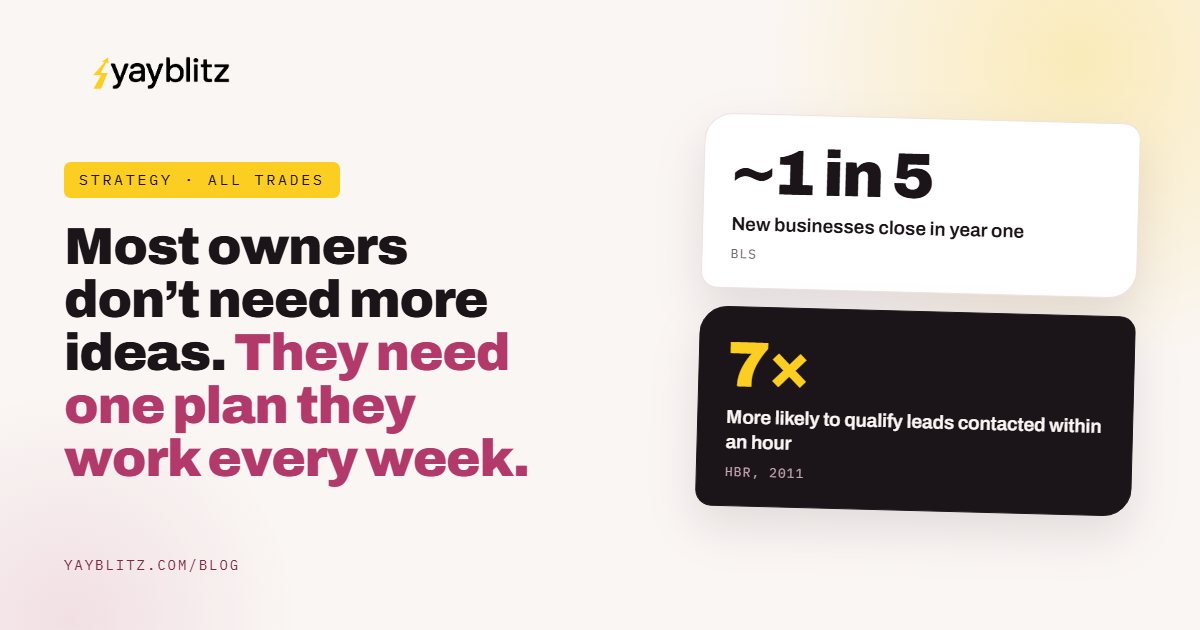
The stakes are real. The U.S. Bureau of Labor Statistics’ Business Employment Dynamics data shows that roughly one in five new businesses closes within its first year, and about half are gone within five. The businesses that last are rarely the ones with the most ideas. They know their numbers, they’re easy to find, they win the jobs they quote and they keep the customers they win.
This guide lays out a 12-month growth plan built on those four parts. It’s written for owners, operators and investors in any trade: HVAC, plumbing, electrical, roofing, cleaning, lawn care, pest control, pool service and more. Each section ends with what to do this month, and the whole plan is available as a free printable workbook.
A home service growth plan has four parts. First, know your numbers: true cost per billable hour, pricing, margin and a weekly scorecard. Second, get found: a strong Google Business Profile, a fast website, reviews and one or two tracked paid channels.
Third, win the job: answer every lead within minutes, use consistent call and quote scripts and follow up on every unsold estimate. Fourth, keep the customer: recurring plans, reminders and referrals. Review the scorecard weekly, run a monthly marketing calendar and reset goals every quarter.
What Is a Home Service Growth Plan?
A simple, written system that sets your targets, the actions that hit them and the weekly numbers that show whether it’s working.
A traditional business plan, like the one in the SBA’s business plan guide, is useful for funding and big decisions. A growth plan is different: it’s an operating tool you use every week. It answers four questions. What does each hour and job really cost? Where do customers find us? How many leads become jobs? How many customers come back?
The best growth plans fit on a few pages. If it takes an hour to read, nobody will use it.
A plan you work every week beats a perfect plan in a drawer.
Why Do So Many Home Service Businesses Stall?
They price from guesses, depend on one lead source, lose leads to slow follow-up and treat every customer as a one-time sale.
- →Pricing from guesses: prices that don’t cover the true cost of an hour
- →One lead source: one algorithm change or ad price increase hurts everything
- →Slow response: leads go to whoever answers first
- →No quote follow-up: unsold estimates disappear
- →No recurring revenue: every month starts from zero
- →No scorecard: problems show up months late, in the bank account
Each of these is fixable with a simple habit. The plan below turns those habits into a weekly and monthly routine.
Part 1: How Do You Know Your Numbers?
Calculate your fully loaded cost per billable hour, set prices from it and track a short weekly scorecard.
Start with your true cost per billable hour. Add up wages, payroll taxes, workers’ comp, vehicles, insurance, software, marketing, rent and everything else for a year. Divide by billable hours, not paid hours. Many owners are shocked by the result, because driving, admin and training eat a large share of the day.
Then set your selling rate: cost per hour ÷ (1 − target margin). A 20% markup is only a 16.7% margin. Our guide on pricing home services walks through the full calculation.
Which Numbers Belong on a Weekly Scorecard?
Leads, booked jobs, close rate, average ticket, revenue, response time, new reviews and recurring customers.
A scorecard is a handful of numbers you check every week, ideally in 15 minutes with your team. Keep it short enough that you never skip it.
Our guide to home service KPIs explains each metric and how to calculate it.
Part 2: How Do You Get Found by More Customers?
A complete Google Business Profile, a fast website with service and area pages, steady reviews, and one or two tracked paid channels.
For most local service businesses, the Google Business Profile drives more calls than any other channel. Choose the right primary category, list every service and service area, add real job photos weekly and reply to every review. Our Google Business Profile checklist covers every setting.
Your website should load fast, show your phone number on every page and have one page for each core service and each main town you serve. Our home service website guide covers the essentials, and our guide on getting recommended by AI search explains how clear, structured pages also help you show up in AI answers.
Add paid channels only when your profile, site and phone handling are ready. Start with one, such as Local Services Ads or Search ads, and track every lead to a booked job. Our guide to local SEO vs LSA vs Google Ads explains how to split a budget.
How Many Reviews Do You Need?
Enough to look established in your market. Many consumers want 20 or more and at least a four-star rating.
BrightLocal’s 2026 survey found 68% of consumers only use businesses rated four stars or higher, and 47% won’t use a business with fewer than 20 reviews. Reviews also influence map rankings and AI recommendations.
Build reviews into your process: ask in person at the end of every job, send a one-tap link the same day and reply to every review. Never pay or offer discounts for reviews. Our guide on how to get more Google reviews includes scripts.
Part 3: How Do You Win More of the Jobs You Quote?
Answer fast, use consistent scripts, present clear options and follow up on every unsold estimate.
Speed matters. A widely cited Harvard Business Review study found that firms contacting leads within an hour were about seven times more likely to qualify them than those that waited longer. Set up instant text replies for missed calls and forms, and track average response time on your scorecard. Our speed-to-lead guide shows simple systems.
Use the same call script every time: understand the problem, confirm the address, offer two time slots, confirm the price or visit fee, and send a text confirmation. Our phone scripts guide has examples for common situations.
The job usually goes to the company that answers first and follows up last.
How Should You Follow Up on Unsold Quotes?
On a set schedule: same day, day 1, day 3, day 7, day 14 and day 30, with a helpful reason each time.
Unsold estimates are often the biggest pile of missed revenue in a home service business. Customers are busy, comparing options or waiting on a spouse. A simple, respectful follow-up schedule wins a meaningful share back.
Track every quote’s follow-ups and outcome. Our guide to lead follow-up for contractors covers automation.
Part 4: How Do You Keep Customers Coming Back?
Recurring plans, seasonal reminders, great communication and a simple referral program.
Winning a new customer usually costs far more than keeping an existing one. Offer a recurring plan where it fits your trade, such as maintenance agreements, service plans or recurring visits. Send seasonal reminders, follow up after jobs and stay in touch.
Ask happy customers for referrals and make it easy with a simple thank-you. Our guides to customer retention, service agreements and referral programs explain each step.
What Does a 12-Month Growth Calendar Look Like?
Each month has one main focus that matches your season: planning, reviews, seasonal campaigns, peak delivery, retention and the next year’s plan.
Adjust the timing to your trade and climate. The structure matters more than the exact months.
Our home service marketing calendar has more detail by month.
How Should You Budget for Growth?
Set a marketing budget as a share of target revenue, split it across proven channels and judge each by cost per booked job.
Decide your revenue target, then the marketing budget needed to reach it. Split it across your Google profile and website, review generation, one or two paid channels and retention. Judge every channel by cost per booked job and revenue per job, not clicks or leads.
Our guide to home service marketing budgets explains how to set and split a budget.
How Do You Run the Plan Every Week, Month and Quarter?
Weekly: scorecard. Monthly: calendar focus and budget check. Quarterly: reset goals and fix the weakest part.
Consistency beats intensity. Fifteen minutes every Monday will do more than a two-day retreat once a year.
How Do You Set Growth Targets That Make Sense?
Work backward from the profit you want: revenue needed, jobs needed, leads needed and the marketing that produces them.
Start with the yearly profit you want the business to produce, including fair pay for yourself. Divide by your net margin to get the revenue target. Divide revenue by your average ticket to get the number of jobs, then divide jobs by your close rate to get the number of leads you need.
This turns a vague goal like “grow 30%” into specific weekly numbers you can put on the scorecard. It also shows where the easiest gains are. Raising the close rate or average ticket often reaches the goal with fewer new leads, which costs less than buying more traffic.
How Do You Plan for Seasonality and Cash Flow?
Map your busy and slow months, build a cash reserve in peak season and use recurring plans and off-season offers to fill gaps.
Almost every trade has a season. HVAC peaks in summer and winter, lawn and pool work follow the weather, roofing follows storms. Look at last year’s revenue by month and mark your peak and slow periods.
In peak months, set aside cash to cover at least the slowest two or three months of fixed costs. In slow months, push recurring plan renewals, maintenance visits, off-season discounts on planned work and partner outreach. Recurring revenue is the most reliable way to flatten the curve, because it arrives whether the phone rings or not.
When Should You Hire, and Who Should You Hire First?
Hire when the scorecard shows demand you can’t serve. Often the first hire should answer phones, not do field work.
The scorecard tells you when it’s time. If response time is rising, leads are going unanswered or jobs are booked more than a week out, you’re losing revenue. Many owners hire another technician first, when the real bottleneck is that nobody answers the phone while they’re on a job.
A part-time office person, a call answering service or an AI receptionist can often add more booked revenue than another field worker. Our guide to an AI receptionist for service businesses compares the options. When you do hire field staff, write down how each job should be done so quality doesn’t depend on you.
How Does AI Search Change the Growth Plan?
AI answers pull from clear, factual pages, reviews and consistent business details, so the same basics that win on Google also help you get recommended.
More customers now ask AI assistants and AI-powered search for recommendations. These tools tend to favor businesses with consistent names, addresses and phone numbers across the web, strong review profiles and websites that answer common questions clearly, with real prices or price ranges, service areas and credentials.
You don’t need a separate strategy. Keep your Google Business Profile complete, write service pages that answer the questions customers actually ask and keep collecting reviews. Our guide on getting recommended by AI covers the details.
How Do You Use the Free Growth Operating System Workbook?
Print it, fill in your numbers in week one, then use the scorecard every Monday and the calendar every month.
The workbook turns this guide into pages you can write on. In the first week, complete the true hourly cost and pricing pages. From week two, fill in the weekly scorecard every Monday. Use the call scripts and quote follow-up tracker every day, and the review system after every job.
At the start of each month, open the 12-month calendar and pick that month’s focus. At the end of each quarter, look back at the scorecards, find the weakest of the four parts and make it the next quarter’s priority. Most owners find that one page used consistently is worth more than any single campaign.
What Should Investors and Buyers Look For?
Clean numbers, diversified lead sources, documented sales process, recurring revenue and a business that doesn’t depend on the owner.
If you plan to sell, raise money or bring in a partner one day, the same plan builds value. Buyers want reliable financials, a weekly scorecard history, diverse and measurable lead sources, a documented sales and follow-up process, recurring revenue and a team that can run the business without the owner.
- →Clean numbers: job costing and margins by service
- →Lead diversity: no single channel dominates
- →Documented process: scripts, pricebook, follow-up
- →Recurring revenue: plans and repeat customers
- →Reputation: reviews and referrals
- →Team: managers who run day-to-day
What Should You Do in the First 30 Days?
Calculate your true hourly cost, start a weekly scorecard, fix your Google profile, set up instant lead replies and start quote follow-up.
Then use the 12-month calendar to choose each month’s focus.
The 16-point growth plan checklist
Tick what you already have. The first unticked items are your next moves.
Know your numbers
4 itemsGet found
4 itemsWin the job
4 itemsKeep the customer
4 itemsFrequently Asked Questions
What is a home service growth plan?+
How is a growth plan different from a business plan?+
What should a home service scorecard include?+
How do I calculate my true hourly cost?+
How fast should I respond to leads?+
How many reviews does a home service business need?+
How often should I follow up on quotes?+
What do buyers look for in a home service business?+
One Plan, Every Week
Know your numbers, get found, win the job and keep the customer. Review the scorecard every week, run the calendar every month and fix the weakest part every quarter. That’s the whole system.
Growth is a habit, not a campaign.
Yay Blitz helps home service businesses businesses connect Graphic and Web Design, Paid Local Advertising, and AI Lead Management into one measurable system for getting and converting leads.
Want a second opinion? Book a Free Strategy Assessment. We’ll review your website, Google profile and lead follow-up and show you where your next customers are coming from.
 Funnel Strategy
 Graphic & Web Design
 Paid Local Ad
 Social Media Marketing