

Fencing looks like a simple business: dig holes, set posts, hang panels. In reality, fence companies live or die on three things most new owners underestimate: accurate estimates, material cost and cash flow, and crew productivity. Get those right and fencing can be steady, profitable work with a clear product homeowners understand.
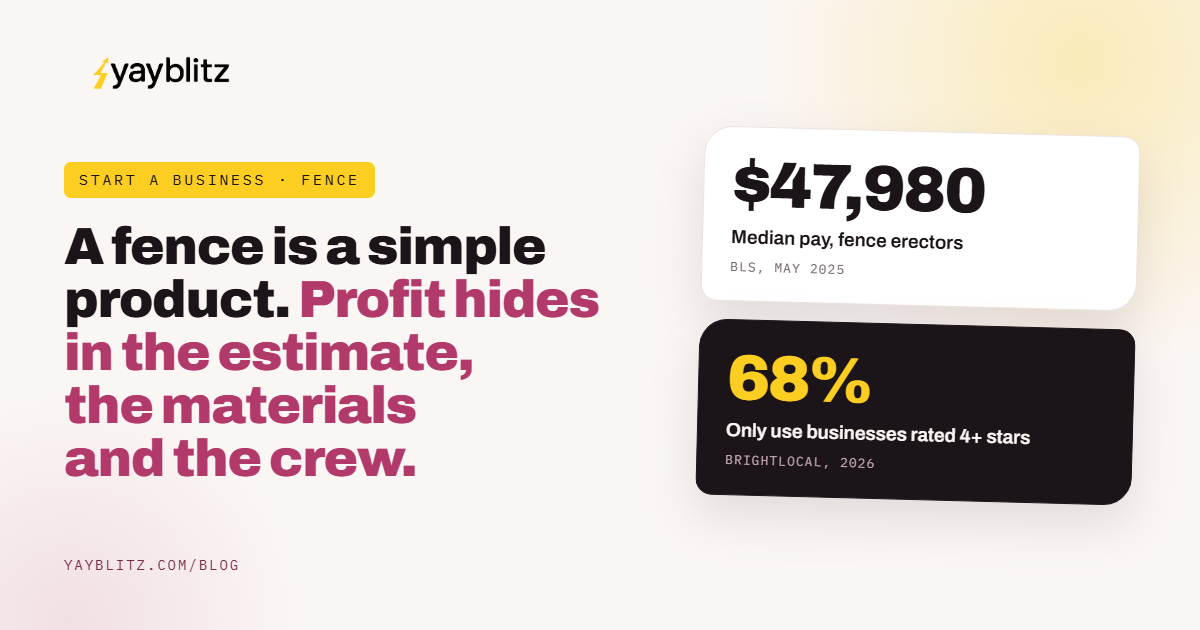
Demand comes from new homeowners, pet owners, pool installs, privacy upgrades, property lines, HOAs, builders and commercial sites. Labor is a big part of every job. The U.S. Bureau of Labor Statistics reports a median wage of $23.07 an hour for fence erectors in May 2025, before payroll taxes, workers’ compensation and benefits.
This guide is written for the founder deciding whether to start, the operator who has to run profitable crews, and the investor or buyer evaluating a fence company. It covers licensing, 811 and permits, insurance, materials and suppliers, equipment, services, estimating and pricing, deposits and cash flow, unit economics, KPIs, marketing, hiring, software, growth paths, what makes a fence company valuable and a first-90-days plan.
To start a fence company, register the business, check state and local contractor licensing rules, carry general liability and workers’ compensation, set up supplier accounts for wood, vinyl, aluminum and chain link, and build a process to call 811 and check permits, HOA rules and property lines before every install.
Then estimate from accurate measurements using your real crew-hour cost and material prices, collect deposits that cover materials, schedule crews for full productive days, launch a website and Google profile with real project photos, answer leads quickly and track revenue per crew-day and close rate every week.
Is Starting a Fence Company Worth It in 2026?
Yes, for owners who estimate accurately and manage cash flow. Demand is broad, the product is easy to explain and jobs are a good size.
Fence jobs are big enough to be profitable but quick enough that a crew can finish several a week. Customers understand the product, and every finished fence is a visible advertisement to neighbors.
The challenges are material price swings, weather, rocky or difficult ground, underground utilities, permits and HOA rules, and labor shortages. New owners also tend to underestimate how much cash they need to buy materials before customers pay.
In fencing, the estimate is the business. Get it wrong and the crew pays for it.
Do You Need a License to Start a Fence Company?
It depends on your state and city. Some require a contractor or specialty license, especially above a project value. Most require permits for many fences.
Some states license fence contractors directly or as part of general or home improvement contractor licensing, often above a dollar threshold. Others require only a business license. Many cities require a fence permit and set height, setback and material rules, and some require inspections for pool fences.
Check your state contractor board, city building department and the SBA guide to licenses and permits. Keep a simple checklist for each job: permit, HOA approval, property line, and utility locate.
Why Do You Need to Call 811 Before Every Fence Job?
Because every post hole can hit a buried utility line. Calling 811 for a free locate is the law in most states and protects your crew and customer.
Fence installers dig more holes than almost any other residential trade. 811 is the national call-before-you-dig number that routes your request to the local one-call center, which notifies utilities to mark buried lines, usually for free. Most states require a locate request a few business days before digging.
Make the locate request part of every job workflow, keep the ticket number in the job file, photograph the marks and dig carefully near them. Private lines like sprinkler systems, pool lines and lighting usually aren’t marked by 811, so ask the homeowner about them before you dig.
What About Property Lines, HOAs and Pool Fences?
Confirm property lines with the owner, get HOA approval in writing, and follow local pool barrier rules.
Fences often cause neighbor disputes. Ask the customer to confirm property lines, ideally with a survey, and include a clause in your contract that the owner is responsible for the location. Many HOAs require approval for style, height and color before work starts; get it in writing.
Pool fences are safety barriers, and many cities have specific rules on height, gaps and self-closing, self-latching gates. The U.S. Consumer Product Safety Commission’s Pool Safely program explains why barriers matter. Check local code before you quote a pool fence.
How Should You Set Up the Business Legally?
Choose a business structure, register your name, get an EIN and keep business money separate from day one.
Most new fence businesses start as a sole proprietorship or a single-member LLC. An LLC can separate business and personal liability, which matters when you work in customers’ homes and on their property. The SBA compares the options in its guide to choosing a business structure, and a local accountant can help you pick the right one for your state.
Register your business name, apply for a free Employer Identification Number from the IRS and open a business bank account. Track every job’s estimated and actual crew hours and materials. That comparison is how you learn to estimate.
What Insurance Does a Fence Business Need?
General liability at minimum, plus commercial auto, tools and equipment cover, and workers’ compensation once you hire.
Hitting a gas, electric or fiber line can be dangerous and expensive. Confirm your general liability covers utility damage and ask about limits. Builders, HOAs and commercial customers will ask for certificates.
- →General liability: property damage, utility strikes and injuries
- →Workers’ compensation: required in most states once you hire
- →Commercial auto: trucks and trailers
- →Tools and equipment: augers, skid steers and tools
- →Contractor bond: required in some states and cities
The SBA’s guide to business insurance explains the main types. Get quotes from an agent who insures contractors, keep certificates ready to send and put “licensed and insured” on your website, truck and quotes once it’s true.
How Do You Choose Materials and Suppliers?
Pick two or three materials you’ll install well, open accounts with reliable suppliers and track material prices every month.
Supplier relationships matter. Ask about contractor pricing, delivery, payment terms and stock levels. Material availability can delay jobs as much as weather.
What Equipment Do You Need?
A truck and trailer, a post hole auger, hand and power tools, levels and string lines. Rent a skid steer or mini excavator until you need one.
- →Truck and trailer: to haul materials, tools and debris
- →Auger: one-person or towable post hole auger
- →Post tools: post hole diggers, tamping bars, post drivers
- →Power tools: saws, drills, impact drivers
- →Layout: string lines, levels, measuring wheels
- →Concrete: mixing tools or delivery
- →Heavy equipment: skid steer or mini excavator rentals for tough ground
How Do You Work Out Your Startup Costs?
List tools, vehicle, licensing, insurance, software, marketing and working cash, then get real local quotes for each line.
Startup costs for a fence business vary widely depending on whether you already own a work vehicle and tools, buy new or used, and start alone or with a crew. Rather than trusting a national average, build your own list and price every line locally.
Material deposits are the key to cash flow. Many fence companies collect a substantial deposit at signing to order materials. The SBA guide to funding your business covers loans, lines of credit and other options if you need them.
Which Fence Services Should You Offer?
Residential installs in two or three materials, plus gates and repairs. Add commercial, pool and specialty fencing later.
Residential privacy and pet fences are the core for most new companies. Gates and repairs build relationships and fill gaps in the schedule. Pool fences, decorative aluminum and commercial chain link can come later.
Repairs and replacements after storms are also steady work. Staining and sealing wood fences can create repeat revenue.
How Do You Estimate and Price Fence Jobs?
Measure on site, count posts, panels, gates and terrain, then price materials plus crew hours at your real cost, plus profit.
Fence pricing is often quoted per linear foot, but your estimate should be built from components: posts, rails, pickets or panels, gates, hardware, concrete and removal of old fence. Then estimate crew hours, adjusting for slopes, rocky soil, roots, access and removal.
Multiply crew hours by your fully loaded crew-hour cost, add materials with markup, permit costs, disposal and profit. Compare estimated and actual hours on every job. Our guide on pricing home services explains the method.
Per-foot pricing is for customers. Component pricing is for profit.
How Should You Handle Deposits and Cash Flow?
Collect a deposit at signing to cover materials, and the balance on completion.
Materials are often the largest cost on a fence job, and you usually pay for them before you’re paid. A deposit at signing that covers materials protects your cash flow. Check whether your state limits deposit amounts for home improvement contracts.
Write clear contracts with scope, materials, layout, payment schedule, property line responsibility, HOA approval and warranty terms.
What Do the Unit Economics of a Fence Crew Look Like?
Revenue per crew-day minus crew labor, materials, equipment and fuel. Track it every week.
Productivity, not price, usually separates profitable fence companies. A crew that installs efficiently with no return trips for missing materials earns far more per day.
Which KPIs Should a Fence Company Owner Track?
Revenue per crew-day, close rate, average job size, estimate accuracy, backlog and material cost percentage.
Do You Need a Website?
Yes. A fast site with service pages, service areas, real job photos, reviews, your license details and one-tap calling is enough to start.
Almost every customer checks the website before calling, even when they found you on Google Maps or through a referral. For fence companies, the site has one job: make it easy to trust you and contact you. Put the phone number at the top of every page, show your license and insurance, and use real photos of your work and your team rather than stock images.
Create one page for each main service, such as wood, vinyl, aluminum and chain link fences, gates, repairs, pool fencing and commercial fencing, plus pages for the towns you serve. Add your best reviews, a short story about you and a simple quote or booking form. Our fence company marketing guide covers how to turn those pages into estimates.
How Do You Set Up Your Google Business Profile?
Create and verify it on day one, choose the most accurate category, list every service and service area, and keep adding photos and reviews.
Your Google Business Profile decides whether you appear in the map results when someone searches “fence company near me.” For many local service businesses, it produces more calls than the website. Set it up as a service-area business if customers don’t visit your location, and follow Google’s guidelines for representing your business so it isn’t suspended.
Pick the most accurate primary category, add every service you offer and the areas you cover, and upload real job photos every week. Reply to every review and answer questions. Our Google Business Profile checklist covers every setting.
How Do You Get Your First Fence Customers?
Yard signs, neighbor letters, realtors, builders, pool companies and a strong Google profile.
- →Yard signs: on every finished fence, with permission
- →Neighbor letters: to homes near each job
- →Pool companies: pool barrier fencing
- →Builders and landscapers: new construction and outdoor projects
- →Realtors: new homeowners and pre-sale repairs
- →HOAs and property managers: repairs and replacements
When you’re ready for paid search, our guide to Google Ads for fence companies explains setup.
How Do You Get Reviews Early?
Ask every happy customer the same day, send a one-tap link and reply to every review.
Reviews often decide who gets the call. BrightLocal’s 2026 survey found 68% of consumers only use businesses rated four stars or higher, and 47% won’t use a business with fewer than 20 reviews. A new fence business needs to close that gap quickly.
Ask at the final walkthrough when the customer sees the finished fence, and include a photo in your request. Ask them to mention the service and their town, which naturally adds useful detail. Never pay or offer discounts for reviews. Our guide on how to get more Google reviews includes scripts.
How Fast Should You Answer Leads?
Within minutes. Customers often contact several companies and hire the first one that responds clearly.
A widely cited Harvard Business Review study found that firms contacting leads within an hour were about seven times more likely to qualify them than firms that waited longer. Homeowners often request several fence estimates. The company that responds first and books a measurement visit quickly has the best chance to win.
Set up an instant text reply for missed calls and form submissions, block time between jobs to call back and track how long each lead waits. Our speed-to-lead guide and our guide to an AI receptionist show simple systems for small teams.
What Software Do You Need?
A CRM with estimating, measurements, photos, scheduling, deposits and follow-up.
Fence software should let you draw layouts, generate estimates and material lists, collect e-signatures and deposits, schedule crews and follow up on unsold estimates automatically.
Unsold estimates are often the biggest source of missed revenue. Our guide to lead follow-up for contractors shows how to follow up without being pushy.
What Makes a Fence Company Valuable?
Consistent profit, accurate estimating, trained crew leaders, supplier relationships, repeat partners and owner independence.
Buyers look for consistent margins, documented estimating, trained crew leaders who can run jobs, builder and HOA relationships, clean financial records and a company that doesn’t depend on the owner selling every job.
- →Margins: consistent gross profit per job
- →Systems: documented estimating and job process
- →People: crew leaders and a salesperson
- →Partners: builders, pool companies and HOAs
- →Records: job costing and contracts
- →Reputation: reviews and project photos
What Mistakes Do New Fence Companies Make?
Underestimating labor, ignoring utilities and permits, no deposits, poor material management and no follow-up.
- →Underestimating labor: slopes, rock and removal take longer
- →Skipping 811: dangerous and costly utility strikes
- →No permits or HOA approval: forced removal and disputes
- →No deposits: cash tied up in materials
- →Material shortages: return trips and lost days
- →No follow-up: unsold estimates left behind
What Should Your First 90 Days Look Like?
Set up legally, open supplier accounts and build your estimating process, then win your first jobs and add systems.
By day 90, compare estimated and actual hours on every job, and know your revenue per crew-day and close rate.
The 16-point fence company startup checklist
Tick what you already have. The first unticked items are your next moves.
Legal and safety
4 itemsOperations
4 itemsMarketing
4 itemsValue building
4 itemsFrequently Asked Questions
Do you need a license to start a fence company?+
How much do fence installers make?+
Do fence installers need to call 811?+
How should I price fence installation?+
What fence materials should a new company offer?+
Should fence companies take deposits?+
How do fence companies get customers?+
What makes a fence company profitable?+
Build a Fence Company That Profits From Every Foot
Estimate from components, call 811 every time, collect deposits, keep crews productive, follow up on every estimate and track the numbers weekly. Those habits make a fence company profitable now and valuable later.
Good fences make good neighbors. Good estimates make good companies.
Yay Blitz helps fence companies businesses connect Graphic and Web Design, Paid Local Advertising, and AI Lead Management into one measurable system for getting and converting leads.
Want a second opinion? Book a Free Strategy Assessment. We’ll review your website, Google profile and lead follow-up and show you where your next customers are coming from.
 Funnel Strategy
 Graphic & Web Design
 Paid Local Ad
 Social Media Marketing