

Painting is one of the most accessible trades to start. You don’t need years of apprenticeship, a van full of specialized tools or a large upfront investment. That’s also why the market is crowded: many painters work on their own or in small crews, and homeowners often struggle to tell a professional from someone who just bought a sprayer.
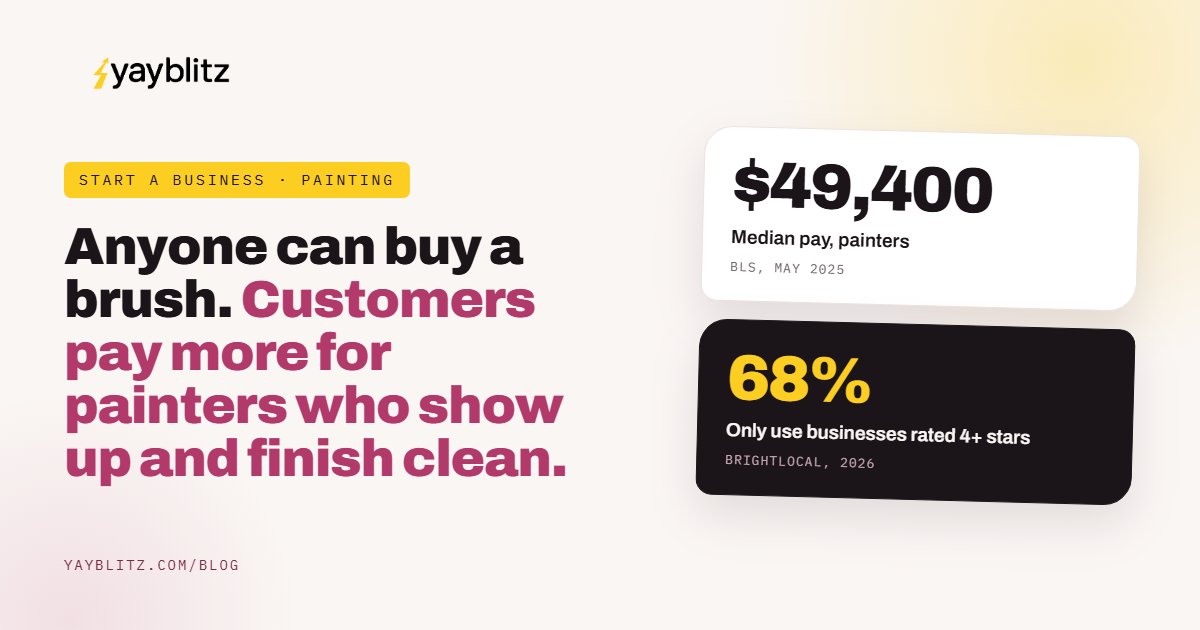
The opportunity is in standing out. Homeowners and property managers want a painter who shows up on time, protects floors and furniture, communicates clearly, follows lead-safe rules on older homes and finishes cleanly. BLS reports a median pay of about $49,400 for construction and maintenance painters in May 2025. Owners who build a professional business can earn well beyond that by pricing properly and running multiple crews.
This guide covers how to start a painting business step by step: licensing, EPA lead-safe certification, legal setup, insurance, equipment and startup costs, which services to start with, estimating and pricing, crews and subcontractors, your website and Google Business Profile, first customers, reviews, ads, lead response, software, repeat and commercial work, hiring, common mistakes and your first 90 days.
To start a painting business, check your state and local contractor licensing rules, get EPA lead-safe certification if you’ll work on homes built before 1978, register the business, carry general liability insurance and buy professional equipment for the work you’ll offer first.
Then estimate from measured surfaces, prep time, materials and your real labor cost, launch a website and Google Business Profile with real before-and-after photos, answer leads quickly, protect every home you work in and ask every happy customer for a review.
Is a Painting Business Worth Starting in 2026?
Yes, with low startup costs and steady demand, if you compete on professionalism rather than price.
Painting demand comes from repaints, home sales, remodels, rentals and commercial maintenance. BLS projects employment of construction and maintenance painters to grow modestly over the next decade, and a large share of painters are self-employed. That means plenty of competition, especially at the low end.
The businesses that grow don’t try to be the cheapest. They offer reliable scheduling, thorough prep, clean job sites, clear written estimates and warranties. They also build systems for estimating, crew management and follow-up so the owner isn’t painting every wall.
In a crowded trade, professionalism is the easiest way to stand out and the hardest for competitors to copy.
Do You Need a License to Start a Painting Business?
It depends on your state and city. Some require a contractor license or registration, especially above a dollar threshold.
Painting licensing varies widely. Some states require a contractor license for painting work above a certain project value. Others require only registration or a local business license. A few have specific painting or home improvement contractor licenses.
Check your state contractor board and city before you start. The SBA’s guide to licenses and permits explains where to look. Keep copies, because property managers and commercial clients often ask.
What Is EPA Lead-Safe Certification and Do You Need It?
If you disturb paint in homes or child-occupied facilities built before 1978, you generally need EPA RRP firm certification and a certified renovator.
Many homes built before 1978 contain lead-based paint. The EPA’s Renovation, Repair and Painting (RRP) Rule requires firms that disturb painted surfaces in pre-1978 homes, schools and child care facilities to be certified, use certified renovators and follow lead-safe work practices. Some states run their own authorized programs.
Lead-safe practices include containment, dust control, specific cleaning steps and record keeping. Getting certified protects customers, protects your crews and protects your business from penalties. It’s also a selling point: many homeowners don’t know about the rule until you explain it.
How Should You Set Up the Business Legally?
Choose a business structure, register your name, get an EIN and keep business money separate from day one.
Most new painting businesses start as a sole proprietorship or a single-member LLC. An LLC can separate business and personal liability, which matters when you work in customers’ homes and on their property. The SBA compares the options in its guide to choosing a business structure, and a local accountant can help you pick the right one for your state.
Register your business name, apply for a free Employer Identification Number from the IRS and open a business bank account. Track every job’s labor hours and materials against the estimate. It’s the fastest way to learn which jobs and crews are profitable.
What Insurance Does a Painting Business Need?
General liability at minimum, plus commercial auto, tools and equipment cover, and workers’ compensation once you hire.
Paint spills, ladder accidents and overspray on cars or neighbors’ property can all lead to claims. General liability insurance covers many of these risks, and most property managers and commercial customers will ask for a certificate before you start.
- →General liability: damage to floors, furniture, landscaping and injuries to others
- →Workers’ compensation: usually required once you hire employees
- →Commercial auto: vehicles used for work
- →Tools and equipment: sprayers, ladders and tools
The SBA’s guide to business insurance explains the main types. Get quotes from an agent who insures contractors, keep certificates ready to send and put “licensed and insured” on your website, truck and quotes once it’s true.
What Equipment Do You Need to Start?
Quality brushes and rollers, ladders, drop cloths, prep tools, a sprayer for larger jobs and a reliable vehicle.
- →Brushes and rollers: professional quality for clean finishes
- →Ladders and planks: sized for the homes you’ll work on
- →Prep tools: scrapers, sanders, caulk guns, patching tools
- →Protection: drop cloths, plastic, tape and masking machines
- →Sprayer: airless sprayer for exteriors, cabinets and large areas
- →Vehicle: truck or van with secure storage
- →Lead-safe kit: containment materials and HEPA vacuum for pre-1978 homes
Start with what you need for interior and exterior residential work, then add specialized equipment like lifts or cabinet spray setups as demand grows.
How Do You Work Out Your Startup Costs?
List tools, vehicle, licensing, insurance, software, marketing and working cash, then get real local quotes for each line.
Startup costs for a painting business vary widely depending on whether you already own a work vehicle and tools, buy new or used, and start alone or with a crew. Rather than trusting a national average, build your own list and price every line locally.
Open a contractor account with a paint supplier; trade pricing and payment terms improve margins and cash flow. The SBA guide to funding your business covers loans, lines of credit and other options if you need them.
Which Painting Services Should You Start With?
Residential interior and exterior repaints first, then cabinets, specialty finishes and commercial work.
Interior repaints keep crews busy year-round, while exteriors are seasonal in many climates but often larger jobs. Cabinet painting has strong margins but requires skill and the right spray setup. Drywall repair, staining and deck finishing are natural add-ons.
Commercial repaints for offices, retail, apartments and HOAs can provide steady volume once you have crews and insurance in place, but often require evening or weekend work and formal bids.
How Do You Estimate and Price Painting Jobs?
Measure surfaces, estimate prep and production time, add materials, overhead and profit, and present options.
Most painting estimates are built from labor. Measure the surfaces, estimate how long prep and painting will take based on your crew’s real production rates, multiply by your fully loaded labor cost, then add materials, equipment, overhead and profit. Prep is where most estimates go wrong, so look closely at peeling, repairs and access.
Offer options, such as different paint lines or adding trim and doors, and write clear scopes listing what’s included, colors, number of coats and cleanup. Our guide on pricing home services explains how to calculate your true hourly cost.
Price the prep. That’s where the quality is, and where profits disappear.
Should You Use Crews or Subcontractors?
Many painting companies start with the owner painting, then add employee crews or trusted subcontractors.
Employee crews give you control over quality and scheduling but bring payroll, workers’ comp and training costs. Subcontractors are flexible but carry risks if they’re misclassified or if quality slips. Learn the legal tests in your state and get advice before choosing.
Either way, use written standards for prep, protection, cleanup and communication, and check quality on every job. Customers judge your company by the crew in their home.
Do You Need a Website?
Yes. A fast site with service pages, service areas, real job photos, reviews, your license details and one-tap calling is enough to start.
Almost every customer checks the website before calling, even when they found you on Google Maps or through a referral. For painting contractors, the site has one job: make it easy to trust you and contact you. Put the phone number at the top of every page, show your license and insurance, and use real photos of your work and your team rather than stock images.
Create one page for each main service, such as interior painting, exterior painting, cabinet painting and commercial repaints, plus pages for the towns you serve. Add your best reviews, a short story about you and a simple quote or booking form. Our guide to painting contractor SEO explains how to make those pages rank.
How Do You Set Up Your Google Business Profile?
Create and verify it on day one, choose the most accurate category, list every service and service area, and keep adding photos and reviews.
Your Google Business Profile decides whether you appear in the map results when someone searches “house painters near me.” For many local service businesses, it produces more calls than the website. Set it up as a service-area business if customers don’t visit your location, and follow Google’s guidelines for representing your business so it isn’t suspended.
Pick the most accurate primary category, add every service you offer and the areas you cover, and upload real job photos every week. Reply to every review and answer questions. Our Google Business Profile checklist covers every setting.
How Do You Get Your First Painting Customers?
Your network, realtors, property managers, yard signs and neighbor marketing around each job.
- →Your network: friends, family and their referrals
- →Realtors: pre-listing touch-ups and buyer repaints
- →Property managers: turnover painting between tenants
- →Remodelers and builders: painting as part of their projects
- →Yard signs: on every exterior job, with permission
- →Neighbor letters: to homes near each completed project
Our painting contractor marketing guide covers more channels.
How Do You Get Reviews Early?
Ask every happy customer the same day, send a one-tap link and reply to every review.
Reviews often decide who gets the call. BrightLocal’s 2026 survey found 68% of consumers only use businesses rated four stars or higher, and 47% won’t use a business with fewer than 20 reviews. A new painting business needs to close that gap quickly.
Ask during the final walkthrough when the customer sees the finished rooms, then text a review link with a before-and-after photo. Ask them to mention the service and their town, which naturally adds useful detail. Never pay or offer discounts for reviews. Our guide on how to get more Google reviews includes scripts.
Should You Use Paid Ads When You Start?
Yes, once your profile, website and reviews are ready. Start small with targeted Search ads and Local Services Ads.
Painting searches are less urgent than plumbing or HVAC, so homeowners compare more. Target high-intent searches like “exterior house painters” and “cabinet painting” in your best areas, block jobs and DIY searches and track calls and forms to signed jobs.
Our guide to Google Ads for painters explains campaign setup.
How Fast Should You Answer Leads?
Within minutes. Customers often contact several companies and hire the first one that responds clearly.
A widely cited Harvard Business Review study found that firms contacting leads within an hour were about seven times more likely to qualify them than firms that waited longer. Homeowners often request several painting estimates. The painter who responds first and books a visit quickly has the best chance of winning the job.
Set up an instant text reply for missed calls and form submissions, block time between jobs to call back and track how long each lead waits. Our speed-to-lead guide and our guide to an AI receptionist show simple systems for small teams.
What Software Do You Need?
A CRM or estimating tool for leads, estimates, scheduling, job costing, invoicing and follow-up.
Painting software helps you track leads, send professional estimates with options, schedule crews, collect deposits, compare actual hours to estimates and follow up on unsold quotes automatically.
Look for estimate templates, e-signatures, job costing and automated follow-up. Unsold estimates are often your biggest missed revenue.
How Do You Build Repeat and Commercial Work?
Stay in touch with past customers, offer touch-up programs and build relationships with property managers.
Homeowners repaint rooms and exteriors every few years. Keep every customer in your CRM, send seasonal reminders and offer a touch-up visit a year after big jobs. Our guide to customer retention shows how.
For steady volume, build relationships with property managers, HOAs and commercial building owners. Recurring repaint and turnover work smooths out seasonality.
How Do You Protect Customers’ Homes and Your Reputation?
Use a written protection and cleanup standard on every job and walk through it with the customer.
Homeowners remember how you treated their home as much as the finished color. Before starting, walk through with the customer, note existing damage, agree which rooms and furniture will be moved and confirm daily start and finish times. Cover floors, furniture and fixtures, and mask carefully.
At the end of each day, leave rooms tidy and safe. On the final day, remove all protection, clean up thoroughly, do a walkthrough together and fix any touch-ups on the spot. Leave a labeled can of each color for future touch-ups. These small steps prevent complaints, earn better reviews and lead to referrals.
Write these steps into a one-page standard every crew follows. Consistency is what turns a good job into a reputation.
What Mistakes Do New Painting Businesses Make?
Underpricing prep, skipping lead-safe rules, poor protection, no follow-up and competing on price.
- →Underpricing prep: jobs that take twice as long as estimated
- →Ignoring lead rules: penalties and health risks on pre-1978 homes
- →Poor protection: damaged floors and furniture
- →Vague scopes: disputes over what was included
- →No follow-up: unsold estimates left on the table
- →Competing on price: attracting the least loyal customers
What Should Your First 90 Days Look Like?
Set up legally, get certified, win first jobs from your network and partners, then add systems.
By day 90, compare estimated and actual hours on every job, track your close rate and know which lead sources produce signed work.
The 16-point painting startup checklist
Tick what you already have. The first unticked items are your next moves.
Licensing and legal
4 itemsOperations
4 itemsMarketing
4 itemsGrowth
4 itemsFrequently Asked Questions
How much does it cost to start a painting business?+
Do you need a license to start a painting business?+
Do painters need EPA lead certification?+
How much do painters make?+
How should I price painting jobs?+
How do painting businesses get customers?+
Is a painting business profitable?+
Should a painting company use employees or subcontractors?+
Build a Painting Business Customers Recommend
Get licensed and lead-safe certified, price the prep, protect every home, communicate clearly and follow up. Those habits help a painting company stand out in a crowded market and grow beyond one crew.
Clean lines, clean job sites and clear communication. That’s what customers remember.
Yay Blitz helps painting contractors businesses connect Graphic and Web Design, Paid Local Advertising, and AI Lead Management into one measurable system for getting and converting leads.
Want a second opinion? Book a Free Strategy Assessment. We’ll review your website, Google profile and lead follow-up and show you where your next customers are coming from.
 Funnel Strategy
 Graphic & Web Design
 Paid Local Ad
 Social Media Marketing