

Pressure washing is one of the easiest home service businesses to start. The equipment fits in a truck or on a trailer, the results are visible before and after, and almost every home and business has a driveway, deck, siding or storefront that needs cleaning. That low barrier is also the problem. Anyone can buy a machine, so the businesses that last are the ones that set up properly, price for profit and get found first.
Many new pressure washing owners spend their savings on equipment and then wait for the phone to ring. They underprice to win the first jobs, skip insurance, wash chemicals into storm drains without knowing the rules and never ask happy customers for a review. A year later they are busy in spring, broke in winter and competing on price with the next new operator.
This guide walks through how to start a pressure washing business the right way: the skills and training you need, licenses and insurance, legal setup, equipment, startup costs, which services to offer, how to price, runoff and chemical rules, branding, your website and Google Business Profile, how to win your first customers and reviews, when to use ads, how fast to answer leads, what software to use, how to build recurring revenue and what your first 90 days should look like.
To start a pressure washing business, learn the difference between pressure washing and soft washing, register the business, get general liability insurance, buy reliable equipment sized to the jobs you want, and set prices from your costs and target hourly rate rather than from competitors.
Then set up a simple website and a complete Google Business Profile, win your first customers from neighbors, referrals and local partners, ask every happy customer for a review, answer leads within minutes and turn one-time jobs into yearly cleaning plans.
Is a Pressure Washing Business Worth Starting in 2026?
Yes, if you treat it as a service business with repeat customers, not a machine you rent out by the hour.
Pressure washing has low startup costs compared with most trades, visible results that sell themselves and steady demand from homeowners, property managers, restaurants, gas stations and HOAs. Most surfaces need cleaning again every year or two, so a happy customer can become recurring revenue.
The downsides are real too. Competition is high because the barrier to entry is low, demand is seasonal in colder climates, and the work is physical. The owners who build a lasting business choose a clear service area, offer the higher-value services such as house soft washing and roof cleaning, and build a customer list they can market to every year.
The machine doesn’t build the business. Your pricing, reviews and repeat customers do.
What Skills and Training Do You Need?
Learn surface-by-surface cleaning, soft washing, chemical safety and how to quote accurately.
Different surfaces need different methods. Concrete can take high pressure, while siding, roofs, painted wood and some stone can be damaged by it. Soft washing uses low pressure with cleaning solutions to remove algae, mold and mildew safely. Knowing which method to use, and when, protects customers’ property and your reputation.
Before taking paid jobs, practice on your own property and on friends’ driveways, decks and siding. Learn how to mix and apply cleaning solutions safely, how to protect plants and windows, how to read product safety data sheets and how to estimate how long a job will take. Industry trade groups and manufacturer training can shorten the learning curve. Good quoting is a skill too: you need to measure square footage, judge how dirty a surface is and spot access problems before you price.
Do You Need a License or Permit to Pressure Wash?
Usually you need a general business license, and some states or cities require more. Check locally before your first job.
There is no single national pressure washing license in the United States. Most owners need a local or state business license, and some cities require registration for mobile services or permits for discharging wash water. Some states also require a contractor license if your work crosses into painting, sealing or repairs.
Check with your city, county and state before you start. The SBA’s guide to applying for licenses and permits explains what to look for. Write down what you find and keep copies of every license, because commercial customers and property managers will often ask for them.
How Should You Set Up the Business Legally?
Choose a business structure, register your name, get an EIN and open a separate bank account.
Most new pressure washing businesses start as a sole proprietorship or a single-member LLC. An LLC can separate business and personal liability, which matters when you work on other people’s property. The SBA explains the options in its guide to choosing a business structure. Talk to a local accountant if you are unsure.
Next, register your business name with your state, apply for a free Employer Identification Number from the IRS and open a business bank account. Keep every receipt from day one. Clean books make taxes easier, show you which services are profitable and help if you ever need a loan for a truck or second rig.
What Insurance Does a Pressure Washing Business Need?
General liability at minimum, plus commercial auto, and workers’ compensation once you hire.
Pressure washing can damage property. A wand too close to siding, a chemical that kills a flower bed or water forced into a window frame can turn into a claim. General liability insurance covers many of these risks, and most commercial customers will ask for a certificate of insurance before you start.
- →General liability: covers damage to customer property and injuries to others
- →Commercial auto: covers the truck and trailer you use for work
- →Inland marine or equipment: covers machines and tools if they are stolen or damaged
- →Workers’ compensation: usually required once you hire employees
The SBA’s guide to business insurance is a good starting point. Get quotes from an agent who works with contractors, and put “fully insured” on your website and quotes once you are.
What Equipment Do You Need to Start?
A reliable pressure washer, a soft wash setup, a surface cleaner, hoses, chemicals and safety gear.
Buy for the work you want, not the biggest machine you can afford. Residential driveways and houses can be done with a solid gas-powered unit. Larger flatwork and commercial jobs need more flow, measured in gallons per minute, which is what really speeds up cleaning.
- →Pressure washer: a reliable commercial-grade unit with enough flow for flatwork
- →Soft wash system: a separate low-pressure pump and tank for siding and roofs
- →Surface cleaner: cleans driveways and patios evenly and much faster than a wand
- →Hoses, reels and nozzles: enough length to reach the back of a typical home
- →Water supply: a buffer tank if you work where water pressure is low
- →Chemicals and PPE: cleaning solutions, eye protection, gloves, boots and respirators where needed
- →Vehicle: a truck or trailer that holds everything securely
Start with fewer, better tools. A cheap machine that breaks in your first busy week costs you jobs and reviews.
How Do You Work Out Your Startup Costs?
List equipment, vehicle, insurance, licensing, marketing and three months of running costs, then price each locally.
Startup costs vary widely depending on whether you already own a truck, buy new or used equipment and start residential or commercial. Rather than rely on someone else’s number, build your own list and get real local quotes.
Keep a cash cushion. The first months often have uneven income, and running out of money for chemicals or a pump repair in your first busy season stalls the business. The SBA guide to funding your business covers loans and other options if you need them.
Which Services Should You Offer First?
Start with driveways, house washing and decks, then add roofs, commercial and add-ons once you’re confident.
Driveways, sidewalks and patios are easy to quote and show dramatic before-and-after results. House soft washing is often the highest-value residential job and leads naturally to repeat work. Decks and fences add volume in spring and summer.
Once you have experience and insurance in place, add roof cleaning, gutter brightening, commercial storefronts, dumpster pads, drive-thrus and HOA common areas. Commercial work can provide steady scheduled income, but it often needs night or early-morning work and stricter runoff control. Offer packages, such as house plus driveway, to raise the average job value without more driving time.
How Should You Price Pressure Washing Jobs?
Price from your costs and a target hourly rate, quote by job or square footage, and set a minimum charge.
Underpricing is the most common mistake new owners make. Work out what each hour on site really costs you, including fuel, chemicals, insurance, equipment wear, drive time and your own pay, then add profit. That gives you a target hourly rate. Use it to set prices per square foot for flatwork and per job for houses, roofs and decks.
Set a minimum job charge so small jobs still cover the drive. Offer good, better and best options, such as a driveway clean, a driveway clean plus sealing, or a full exterior package. Our guide to pricing home services walks through the method in detail.
If your price only works when every day is full, it’s too low.
What About Water Runoff and Chemicals?
Keep wash water and chemicals out of storm drains, follow product labels and know your local rules.
Storm drains often lead directly to rivers and streams, so wash water carrying chemicals, oil or debris can break local and federal rules. The EPA’s stormwater program explains the basics, and many cities have their own discharge requirements, especially for commercial work.
Learn how to block drains, recover water where required and choose products suited to each surface. Rinse plants before and after applying solutions, follow label dilution rates and store chemicals safely in your vehicle. Doing this properly protects the environment, keeps you out of trouble and becomes a selling point with property managers.
How Do You Choose a Name and Brand?
Pick a clear, memorable name that includes what you do, and use it consistently everywhere.
A name that says what you do, such as including “pressure washing” or “exterior cleaning,” helps customers remember you and understand your truck signage at a glance. Avoid names too similar to local competitors, and check that the domain and social handles are available.
Keep the logo simple and readable on a truck, yard sign and door hanger. Use the same name, phone number and address on your website, Google Business Profile, invoices and directories. Consistency builds trust and helps search engines and AI assistants understand who you are.
Do You Need a Website?
Yes. A simple, fast site with services, photos, service areas, reviews and an easy quote form is enough to start.
Most customers will check your website before they call, even if they found you on Google Maps or a neighbor’s recommendation. A basic site that loads fast on a phone, shows real before-and-after photos and makes it easy to call or request a quote will beat a fancy site that hides the phone number.
Create a page for each main service, such as house washing, driveway cleaning and roof cleaning, and list the towns you serve. Add your insurance status, a short story about you and your best reviews. Our home service website guide covers what each page should include.
How Do You Set Up Your Google Business Profile?
Create and verify it on day one, choose the right categories, add services, photos and service areas, and keep it active.
For most local service businesses, the Google Business Profile is the single most important free marketing tool. It decides whether you appear in the map results when someone searches “pressure washing near me.” Set it up as a service-area business if you don’t have a storefront, and follow Google’s guidelines for representing your business.
Choose the most accurate primary category, list every service, add your service areas and upload real job photos weekly. Post updates, answer questions and reply to every review. Our Google Business Profile checklist lists every setting to complete.
How Do You Get Your First Customers?
Start close to home: neighbors, friends, local partners and visible marketing in a few target neighborhoods.
Your first 20 customers usually come from people who already know you or can see your work. Tell everyone you know, offer an introductory price to a few neighbors in exchange for honest reviews and photos, and hang door hangers in the same street after every job.
- →Neighbor marketing: door hangers and yard signs on the streets around each job
- →Local partners: realtors, property managers, painters, window cleaners and landscapers
- →Community: local Facebook groups, Nextdoor and community events
- →Commercial walk-ins: storefronts, restaurants and gas stations with visibly dirty concrete
Focus on a few neighborhoods instead of the whole city. Clustering jobs cuts drive time, and neighbors noticing a clean driveway next door is one of the best ads you can get.
How Do You Get Reviews Early?
Ask every happy customer the same day, make it one tap and reply to every review.
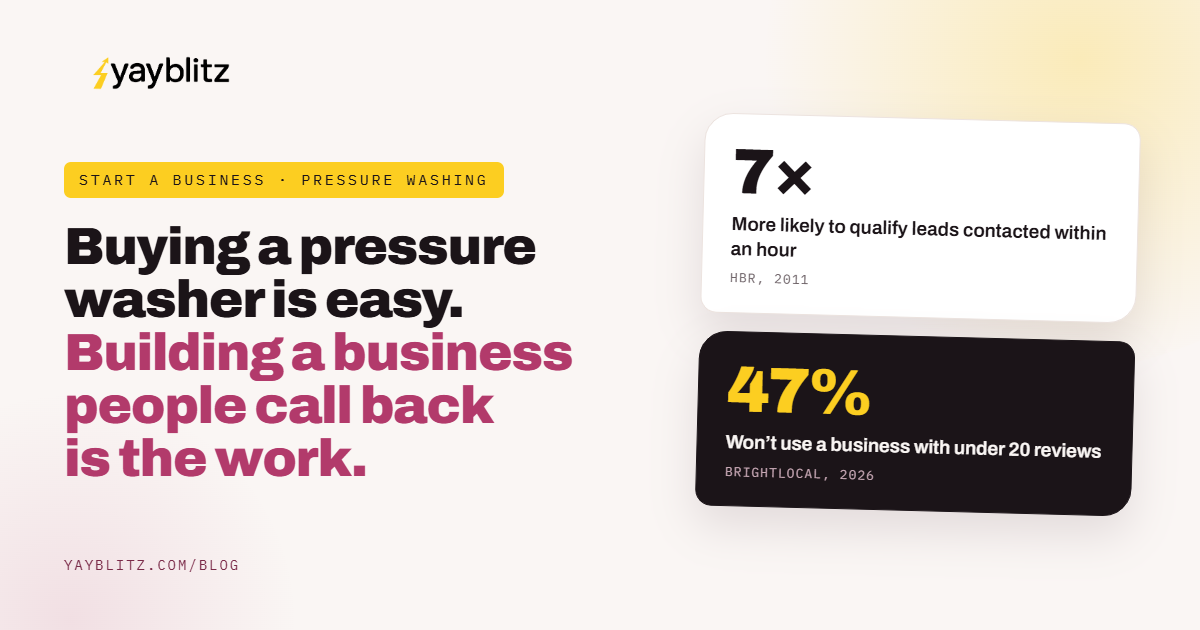
Reviews are often what decides who gets the call. BrightLocal’s 2026 survey found that 68% of consumers only use businesses rated four stars or higher and 47% won’t use a business with fewer than 20 reviews. A new business needs to close that gap quickly.
Ask in person when the customer sees the finished job, then send a text with a direct review link. Mention the service and town so the review naturally includes those details. Never offer incentives for reviews. Our guide on how to get more Google reviews includes scripts and timing.
Should You Use Paid Ads When You Start?
Only once your profile, website and reviews are ready, and start small with tightly targeted searches.
Paid ads can speed up growth, but they magnify whatever is behind them. If your website is weak, you have few reviews or you miss calls, ads waste money. Get the basics right first.
When you are ready, Google Local Services Ads and tightly targeted Search ads for “house washing” or “driveway cleaning” in your best neighborhoods are usually the most efficient starting points. Use strong negative keywords to block searches for pressure washer rentals, parts and DIY tips. Our comparison of Local Services Ads vs Google Ads explains the difference.
How Fast Should You Answer Leads?
Within minutes. The first business to respond often wins the job.
Homeowners often contact several companies at once. A widely cited Harvard Business Review study found firms that contacted leads within an hour were about seven times more likely to qualify them than those that waited longer. When you’re on a job with a wand in your hand, that is hard, so plan for it.
Use an auto-text that replies instantly to missed calls and form submissions, set aside time between jobs to call back and ask customers to send photos so you can give a quick price range. Our speed-to-lead guide covers simple systems that work for small teams.
What Software Do You Need?
A simple CRM or field service app for quotes, scheduling, invoicing, payments and review requests.
Spreadsheets and paper notes work for the first few jobs, but they break quickly. A field service or CRM tool lets you send quotes, schedule jobs, take payments, store photos and send follow-ups and review requests automatically.
Look for online booking, text messaging, quote follow-up, recurring job reminders and simple reporting. Our guide to pressure washing CRM explains which features matter most for a small team.
How Do You Build Recurring Revenue?
Offer annual cleaning plans, remind past customers each season and sign recurring commercial contracts.
One-time jobs keep you busy. Recurring work makes you a business. Every house you wash will need it again, so offer an annual or twice-yearly plan at the end of each job, and send reminders to every past customer each spring.
For commercial customers, propose scheduled cleaning for storefronts, drive-thrus, dumpster pads and sidewalks. These contracts smooth out seasonality and make it easier to hire. Our guide to customer retention for home services shows how to build a simple reminder system.
When Should You Hire Your First Employee?
When you are consistently turning away work or your own time is better spent selling and quoting.
Many owners wait too long, then burn out in peak season. Track how many jobs you turn away and how many hours you spend quoting and answering calls. When you are booked out for weeks or quoting in the evenings every night, it is time to hire.
Start with a helper who can grow into a lead technician. Train them on surface safety and chemicals before letting them work alone, and check your insurance and workers’ compensation obligations before their first day.
What Mistakes Do New Pressure Washing Businesses Make?
Underpricing, skipping insurance, damaging surfaces, ignoring runoff rules and not collecting reviews.
- →Underpricing: winning jobs that don’t cover equipment, fuel and your time
- →No insurance: one damage claim can end the business
- →Too much pressure: damaging siding, wood or roofs that needed soft washing
- →Ignoring runoff: washing chemicals into storm drains
- →No review system: staying invisible on Google Maps
- →Missed calls: losing jobs to whoever answers first
- →No follow-up: never contacting past customers again
Each of these is easy to avoid with a little planning, and fixing them early is much cheaper than recovering from them later.
What Does Your First 90 Days Look Like?
Set up in month one, win your first customers in month two and build systems in month three.
By day 90, you should know your real cost per job, your best services and neighborhoods, and where your customers come from. That is the foundation for growing on purpose rather than by luck.
The 16-point pressure washing startup checklist
Tick what you already have. The first unticked items are your next moves.
Setup
4 itemsOperations
4 itemsMarketing
4 itemsGrowth
4 itemsFrequently Asked Questions
How much does it cost to start a pressure washing business?+
Do you need a license to start a pressure washing business?+
What insurance does a pressure washing business need?+
How do pressure washing businesses get customers?+
How should I price pressure washing?+
What is the difference between pressure washing and soft washing?+
Is pressure washing a profitable business?+
How do I get my first pressure washing reviews?+
Build a Pressure Washing Business, Not Just a Side Hustle
Set up properly, price for profit, protect surfaces and storm drains, get found on Google, answer fast and turn every job into a repeat customer. Those habits separate the businesses that last from the ones that sell their equipment after one season.
Clean once, get paid. Build a list, get paid every year.
Yay Blitz helps pressure washing businesses connect Graphic and Web Design, Paid Local Advertising, and AI Lead Management into one measurable system for getting and converting leads.
Want a second opinion? Book a Free Strategy Assessment. We’ll review your website, Google profile and lead follow-up and show you where your next customers are coming from.
 Funnel Strategy
 Graphic & Web Design
 Paid Local Ad
 Social Media Marketing