

Tree service is one of the highest-ticket outdoor trades a small team can run. A single removal can be worth more than a week of mowing, storms create sudden surges in demand, and homeowners rarely want to climb a 70-foot oak themselves. It’s also one of the most dangerous jobs in the country, and that fact shapes every part of the business: insurance costs, hiring, equipment, pricing and reputation.
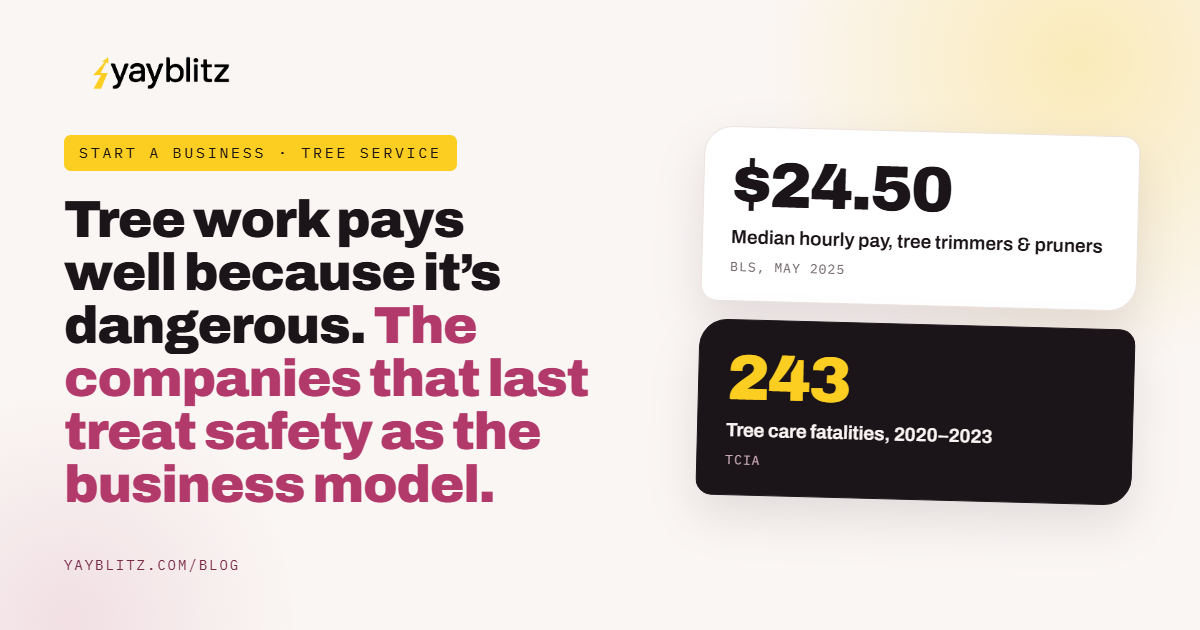
The Tree Care Industry Association documented 243 tree care fatalities between 2020 and 2023, roughly 61 a year, and more than two-thirds involved workers with less than one year of experience. Meanwhile, the U.S. Bureau of Labor Statistics reports a median wage of $24.50 an hour for tree trimmers and pruners, the highest of the grounds maintenance jobs it tracks, with employment projected to grow 4% from 2025 to 2035.
This guide is written for the founder deciding whether to start, the operator who has to run safe, productive crews, and the investor or buyer evaluating a tree company. It covers licensing and certification, safety programs, insurance, equipment, services, bidding, storm work, unit economics, KPIs, marketing, hiring, software, growth paths, what makes a tree company valuable and a first-90-days plan.
To start a tree service business, register the business, check state and city licensing rules for tree work and pesticide applications, carry general liability and workers’ compensation that specifically cover tree work, and build a written safety program based on the ANSI Z133 standard before anyone climbs.
Then buy or lease only the equipment your first jobs require, bid every job from a site visit using your real crew-hour cost, consider ISA arborist certification to win higher-value work, answer leads quickly and track revenue per crew-day, close rate and safety incidents every week.
Is Starting a Tree Service Business Worth It in 2026?
Yes, for operators who take safety and pricing seriously. Tickets are high, demand is steady and storms bring surges.
Trees keep growing, storms keep coming and municipalities, utilities, builders and homeowners all need trees pruned, removed and assessed. Many removals are expensive enough that a small, well-run crew can earn strong margins without a huge customer base.
The risks are equally real: high insurance premiums, expensive equipment, injury exposure, weather delays and competition from uninsured operators. The companies that succeed price for those risks instead of pretending they don’t exist.
Cheap tree work isn’t cheap. Someone always pays for the risk.
What Licenses and Certifications Do You Need?
A business license everywhere. Some states and cities license tree work, and pesticide or plant health work needs an applicator license. ISA certification is voluntary but valuable.
Tree service licensing varies. Many states only require a business license, but some cities and states require a tree care or arborist license, contractor registration or proof of insurance. Work near power lines is restricted to qualified line-clearance workers. If you apply pesticides or fertilizers for plant health care, you’ll need a state applicator license.
The International Society of Arboriculture offers credentials like ISA Certified Arborist and Tree Risk Assessment Qualification. They aren’t required in most places, but they signal expertise to homeowners, municipalities and commercial clients, and they support higher-value services like tree risk assessments and plant health care.
How Do You Build a Safety Program?
Write one based on ANSI Z133, train every worker before they work, hold a job briefing on every site and enforce it without exceptions.
There’s no single OSHA tree care standard, but OSHA treats the industry as high-hazard and the ANSI Z133 safety standard is the recognized industry benchmark. OSHA’s hazard bulletin on falls and falling objects in tree care describes fatal incidents that a preliminary inspection of the tree could have prevented.
- →Job briefing: every job, every day: hazards, roles, drop zones, communication
- →Tree inspection: check for decay, cracks and dead limbs before climbing or rigging
- →Electrical hazards: treat all overhead lines as energized; only qualified workers near lines
- →PPE: helmet, eye and hearing protection, chainsaw protection, gloves
- →Fall protection: second means of attachment when cutting aloft
- →Equipment checks: saws, ropes, rigging, chippers and aerial lifts inspected and logged
- →Training records: document every worker’s training and qualifications
New workers are the highest-risk group. Pair them with experienced climbers, limit their tasks until they’re trained and never let schedule pressure override safety.
How Should You Set Up the Business Legally?
Choose a business structure, register your name, get an EIN and keep business money separate from day one.
Most new tree service businesses start as a sole proprietorship or a single-member LLC. An LLC can separate business and personal liability, which matters when you work in customers’ homes and on their property. The SBA compares the options in its guide to choosing a business structure, and a local accountant can help you pick the right one for your state.
Register your business name, apply for a free Employer Identification Number from the IRS and open a business bank account. Track revenue and costs by crew-day from the start. It’s the single most useful number in a tree business.
What Insurance Does a Tree Service Business Need?
General liability at minimum, plus commercial auto, tools and equipment cover, and workers’ compensation once you hire.
Tree work is one of the most expensive classes for workers’ compensation, and some insurers decline it. Work with an agent who specializes in tree care, confirm your policy doesn’t exclude climbing or removals, and build insurance into every price. Homeowners, property managers and municipalities will ask for certificates.
- →General liability: property damage from falling trees and limbs; confirm tree work is covered
- →Workers’ compensation: required in most states once you hire; tree work is a high-rate class
- →Commercial auto: trucks, chip trucks and trailers
- →Inland marine: chippers, stump grinders, lifts and saws
- →Umbrella: extra liability limits for large removals near homes
The SBA’s guide to business insurance explains the main types. Get quotes from an agent who insures contractors, keep certificates ready to send and put “licensed and insured” on your website, truck and quotes once it’s true.
What Equipment Do You Need to Start?
A truck, chipper, saws, climbing and rigging gear, and safety equipment. Rent or subcontract bucket trucks, cranes and grinders at first.
Heavy equipment is expensive to buy and maintain. Rent or subcontract until you have steady demand, then buy the piece that’s costing you the most in rentals and lost productivity.
How Do You Work Out Your Startup Costs?
List tools, vehicle, licensing, insurance, software, marketing and working cash, then get real local quotes for each line.
Startup costs for a tree service business vary widely depending on whether you already own a work vehicle and tools, buy new or used, and start alone or with a crew. Rather than trusting a national average, build your own list and price every line locally.
Equipment loans and leases are common in tree care. Compare the monthly cost against expected crew-days of use before you commit. The SBA guide to funding your business covers loans, lines of credit and other options if you need them.
Which Tree Services Should You Offer?
Pruning, removals and stump grinding first, then storm response, plant health care, risk assessments and commercial work.
Pruning programs and plant health care create repeat customers. Removals create big tickets. The healthiest tree companies have both.
How Do You Bid Tree Jobs Profitably?
Always bid from a site visit, using your real crew-hour cost, equipment, disposal and risk, then add profit.
Tree jobs are rarely alike. Size, lean, decay, access, targets underneath (houses, cars, power lines) and disposal all change the time and risk. Visit every site, photograph the tree and surroundings, and write down the method you’ll use.
Build the price from crew hours × your fully loaded crew-hour cost, plus equipment (owned or rented), disposal or dump fees, permits, traffic control and a risk factor for hazardous work. Our guide on pricing home services explains how to calculate your true hourly cost.
Bid the tree, the targets and the method, not just the height.
Should You Do Storm Work?
Yes, if you’re prepared. Storm work brings high demand, but it brings more risk, insurance claims and out-of-town competition.
After major storms, damaged trees on homes, cars and power lines create urgent demand. Prepare in advance: have a storm pricing policy, know your insurance and documentation requirements, and set limits on what you’ll take on.
Storm work is often the most dangerous tree work: trees under tension, broken limbs hung up in canopies and downed lines. Never touch or work near downed lines until the utility confirms they’re de-energized. Document every job with photos for homeowners’ insurance claims.
What Do the Unit Economics of a Tree Crew Look Like?
Revenue per crew-day minus crew labor, equipment, fuel, disposal and insurance. Track it every week.
Use your own numbers. This structure shows how to calculate crew profitability.
Workers’ compensation is a much larger share of payroll in tree work than in most trades, so include it in every crew-day calculation.
Which KPIs Should a Tree Service Owner Track?
Revenue per crew-day, close rate, average ticket, backlog, equipment utilization and safety incidents.
Do You Need a Website?
Yes. A fast site with service pages, service areas, real job photos, reviews, your license details and one-tap calling is enough to start.
Almost every customer checks the website before calling, even when they found you on Google Maps or through a referral. For tree service companies, the site has one job: make it easy to trust you and contact you. Put the phone number at the top of every page, show your license and insurance, and use real photos of your work and your team rather than stock images.
Create one page for each main service, such as tree removal, pruning and trimming, stump grinding, storm cleanup, plant health care and land clearing, plus pages for the towns you serve. Add your best reviews, a short story about you and a simple quote or booking form. Our tree service SEO guide explains how to rank those pages.
How Do You Set Up Your Google Business Profile?
Create and verify it on day one, choose the most accurate category, list every service and service area, and keep adding photos and reviews.
Your Google Business Profile decides whether you appear in the map results when someone searches “tree removal near me.” For many local service businesses, it produces more calls than the website. Set it up as a service-area business if customers don’t visit your location, and follow Google’s guidelines for representing your business so it isn’t suspended.
Pick the most accurate primary category, add every service you offer and the areas you cover, and upload real job photos every week. Reply to every review and answer questions. Our Google Business Profile checklist covers every setting.
How Do You Get Your First Tree Service Customers?
Neighbors near every job, realtors, property managers, landscapers, HOAs and a strong Google profile.
- →Neighbors: door hangers near every job; trees on adjacent lots often need work too
- →Landscapers: refer tree work they don’t do
- →Property managers and HOAs: pruning programs and hazard removal
- →Realtors and inspectors: tree issues found during sales
- →Builders: lot clearing and tree protection
- →Municipalities: bid on public tree contracts once established
Our guide to Google Ads for tree service explains how to add paid search when you’re ready.
How Do You Get Reviews Early?
Ask every happy customer the same day, send a one-tap link and reply to every review.
Reviews often decide who gets the call. BrightLocal’s 2026 survey found 68% of consumers only use businesses rated four stars or higher, and 47% won’t use a business with fewer than 20 reviews. A new tree service business needs to close that gap quickly.
Ask after cleanup, when the yard looks better than before, and send before-and-after photos with the request. Ask them to mention the service and their town, which naturally adds useful detail. Never pay or offer discounts for reviews. Our guide on how to get more Google reviews includes scripts.
How Fast Should You Answer Leads?
Within minutes. Customers often contact several companies and hire the first one that responds clearly.
A widely cited Harvard Business Review study found that firms contacting leads within an hour were about seven times more likely to qualify them than firms that waited longer. Homeowners worried about a dead or leaning tree, especially after a storm, usually book the first insured company that responds with a clear plan.
Set up an instant text reply for missed calls and form submissions, block time between jobs to call back and track how long each lead waits. Our speed-to-lead guide and our guide to an AI receptionist show simple systems for small teams.
What Software Do You Need?
A tree service CRM for leads, estimates with photos, scheduling, crew assignments, invoicing and follow-up.
Software keeps track of site photos and notes, sends professional estimates, schedules crews and equipment, and follows up on unsold estimates. It also gives you the crew-day and close-rate numbers you need.
Our guide to tree service CRM explains what to look for.
How Do You Hire and Keep Good Crews?
Pay fairly, train thoroughly, promote from within and build a culture where anyone can stop unsafe work.
Experienced climbers are in short supply. Offer competitive pay, structured training and clear advancement from groundworker to climber to crew leader. Pay for certifications like ISA Certified Arborist.
Remember that inexperienced workers face the highest risk. Don’t rush new hires into climbing or felling. A strong safety culture also lowers turnover and insurance costs.
What Makes a Tree Service Company Valuable?
Recurring pruning and plant health revenue, a strong safety record, well-maintained equipment, trained crews and diversified customers.
Buyers and lenders look at recurring revenue, customer mix, safety and insurance history, equipment condition and how dependent the company is on the owner. A business with recurring pruning programs, commercial or municipal contracts and a clean safety record is worth more than one that depends on storm work and the owner climbing.
- →Recurring revenue: pruning programs and plant health care
- →Safety record: lower insurance costs and lower risk
- →Equipment: maintained, documented and paid down
- →Crews: trained crew leaders who can run jobs
- →Customer mix: residential, commercial and municipal
- →Records: job costing, safety logs and contracts
What Mistakes Do New Tree Service Businesses Make?
Underinsuring, skipping safety, buying too much equipment, underbidding removals and relying only on storms.
- →Underinsuring: policies that exclude tree work
- →Skipping safety: injuries, fatalities and lawsuits
- →Equipment debt: buying before demand exists
- →Underbidding removals: ignoring risk, rigging and disposal
- →Storm dependence: no work between storms
- →No follow-up: unsold estimates left behind
What Should Your First 90 Days Look Like?
Set up insurance and safety first, win your first jobs next, then build recurring work and systems.
By day 90, know your revenue per crew-day, close rate, average ticket and cost of insurance per crew-day.
The 16-point tree service startup checklist
Tick what you already have. The first unticked items are your next moves.
Safety and legal
4 itemsOperations
4 itemsMarketing
4 itemsValue building
4 itemsFrequently Asked Questions
Do you need a license to start a tree service business?+
How much do tree trimmers make?+
Is tree work dangerous?+
What is ANSI Z133?+
What insurance does a tree service company need?+
How should I price tree removal?+
Do I need ISA certification?+
What equipment do I need to start a tree service?+
Build a Tree Company That Lasts
Put safety first, insure properly, bid from real costs, rent before you buy, build recurring pruning work and track crew-day profit every week. That’s how a tree service grows beyond the owner’s climbing rope.
Every crew home safe, every job priced right.
Yay Blitz helps tree service companies businesses connect Graphic and Web Design, Paid Local Advertising, and AI Lead Management into one measurable system for getting and converting leads.
Want a second opinion? Book a Free Strategy Assessment. We’ll review your website, Google profile and lead follow-up and show you where your next customers are coming from.
 Funnel Strategy
 Graphic & Web Design
 Paid Local Ad
 Social Media Marketing