

Electrical work is changing fast. Homeowners are adding EV chargers, upgrading panels for heat pumps and induction ranges, installing standby generators and adding solar and batteries. Businesses need lighting upgrades, data wiring and maintenance. For licensed electricians, that creates a strong opportunity to build their own company.
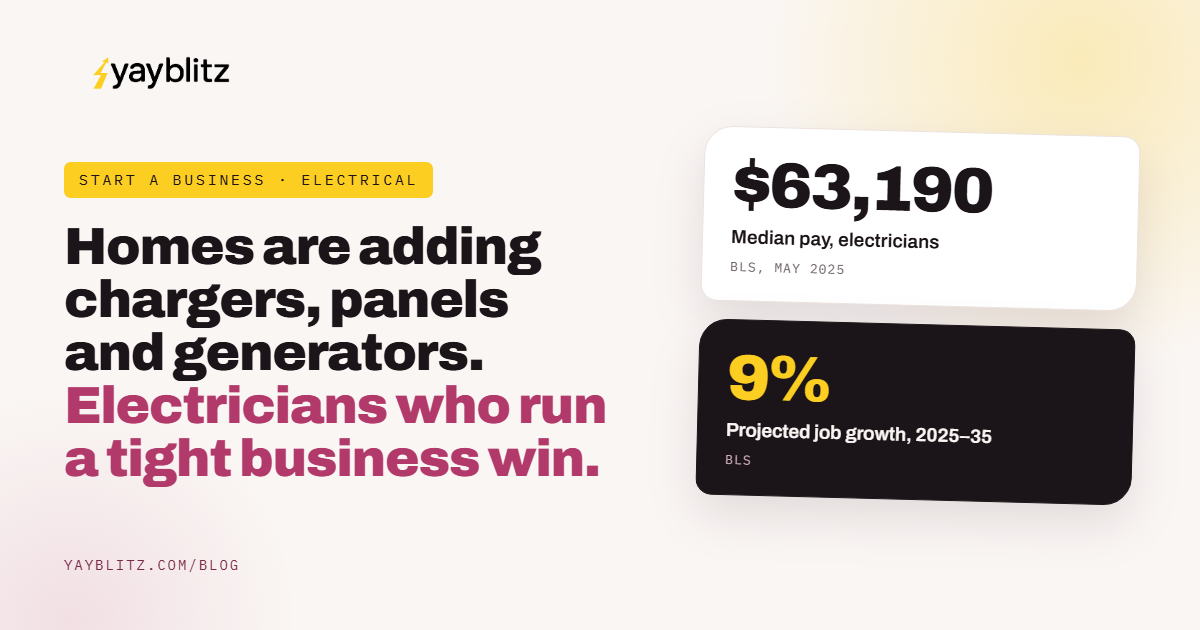
The U.S. Bureau of Labor Statistics projects electrician employment to grow 9% from 2025 to 2035, much faster than average, with about 72,700 openings a year. BLS also notes that most states require electricians to be licensed, which limits who can compete. The challenge is turning strong technical skill into a profitable business: pricing correctly, handling permits and inspections efficiently, marketing consistently and hiring well.
This guide covers how to start an electrical contracting business step by step: licensing, legal setup, insurance and bonding, permits and inspections, tools and vans, startup costs, which services to start with, flat-rate pricing, growth markets like EV chargers and generators, your website and Google Business Profile, first customers, reviews, ads, lead response, software, hiring, common mistakes and a first-90-days plan.
To start an electrical contracting business, hold the master electrician or electrical contractor license your state requires, register the business, carry general liability, auto and workers’ compensation insurance and any required bond, and learn the permit and inspection process in your area.
Then focus on residential service and upgrades, price with a flat-rate pricebook built from your real costs, launch a fast website and a complete Google Business Profile, answer every lead within minutes and ask every happy customer for a review.
Is Starting an Electrical Business Worth It in 2026?
Yes. Demand is growing, licensing limits competition and new technology creates higher-value jobs.
BLS reports a median pay of $63,190 for electricians in May 2025, with about 821,000 jobs nationwide. Electrification, EV adoption, aging housing stock and new construction all support demand.
The risks are real too. Electrical mistakes can cause fires and injuries, insurance is essential, inspections can delay jobs and cash flow can be tight on larger projects. Owners who succeed choose a clear focus, price for profit and build systems before they hire.
The license lets you start. Pricing, permits and follow-up decide whether you grow.
What Licenses Do You Need to Start an Electrical Business?
In most states, a master electrician or electrical contractor license, plus a business license and permits for regulated work.
BLS notes that most states require electricians to be licensed, and most electricians learn through an apprenticeship that typically includes about 2,000 hours of paid on-the-job training each year. To run your own company, many states require a master electrician license or an electrical contractor license, which can involve years of experience, exams covering the National Electrical Code and proof of insurance.
Some states license at the state level, others at the city or county level, and some require a separate business or contractor registration. Check with your state licensing board and local building department before you advertise, and display your license number on your website, vans and proposals.
- →Master or contractor license: required in most places to run an electrical company
- →Business license: local registration to operate
- →Permits: required for most new circuits, panel work and installations
- →Continuing education: many states require it to renew licenses
How Should You Set Up the Business Legally?
Choose a business structure, register your name, get an EIN and keep business money separate from day one.
Most new electrical businesses start as a sole proprietorship or a single-member LLC. An LLC can separate business and personal liability, which matters when you work in customers’ homes and on their property. The SBA compares the options in its guide to choosing a business structure, and a local accountant can help you pick the right one for your state.
Register your business name, apply for a free Employer Identification Number from the IRS and open a business bank account. Electrical work ranges from quick service calls to large projects. Separate books and job costing show which work actually makes money.
What Insurance Does a Electrical Contracting Business Need?
General liability at minimum, plus commercial auto, tools and equipment cover, and workers’ compensation once you hire.
Electrical work carries serious fire and injury risks. Insurance protects you and your customers, and most builders, property managers and commercial customers will require certificates before you start.
- →General liability: fire, property damage and injuries to others
- →Workers’ compensation: required in most states once you hire
- →Commercial auto: every van and truck
- →Tools and equipment: testers, tools and materials on the van
- →License bond: required in many states and cities
The SBA’s guide to business insurance explains the main types. Get quotes from an agent who insures contractors, keep certificates ready to send and put “licensed and insured” on your website, truck and quotes once it’s true.
How Do Permits and Inspections Work for Electrical Jobs?
Most new circuits, panel changes and installations require a permit and inspection. Build them into your schedule and pricing.
Local building departments enforce electrical codes, usually based on the National Electrical Code (NFPA 70) with local amendments. Permits and inspections protect homeowners and you, and skipping them can lead to fines, failed sales when homes change hands and liability if something goes wrong.
Learn how your local departments handle permits, inspection scheduling and utility coordination for panel and service changes. Include permit fees and the time spent on them in your prices, and explain to customers why permits matter. It builds trust and separates you from unlicensed competition.
What Tools and Vehicle Do You Need?
A reliable service van, testing equipment, hand and power tools, safety gear and common materials on board.
- →Service van: shelving, wire storage and secure bins
- →Testing equipment: multimeter, clamp meter, circuit tracer and insulation tester
- →Hand and power tools: drills, fish tapes, benders, crimpers and saws
- →Safety gear: PPE, insulated tools, lockout/tagout kits and ladders
- →Common materials: breakers, devices, wire, boxes, connectors and fittings
Stock the parts you use most so you can finish most service calls on the first visit.
How Do You Work Out Your Startup Costs?
List tools, vehicle, licensing, insurance, software, marketing and working cash, then get real local quotes for each line.
Startup costs for a electrical business vary widely depending on whether you already own a work vehicle and tools, buy new or used, and start alone or with a crew. Rather than trusting a national average, build your own list and price every line locally.
Open accounts with electrical supply houses early; terms help with materials for panel upgrades and larger projects. The SBA guide to funding your business covers loans, lines of credit and other options if you need them.
Which Electrical Services Should You Start With?
Residential service and upgrades: troubleshooting, panels, circuits, lighting, EV chargers and generators.
Residential service work builds a customer list quickly and usually pays better than new construction. Troubleshooting, adding circuits, replacing devices and lighting are common entry points. Panel upgrades and service changes are higher-value jobs, often triggered by new appliances, heat pumps or EV chargers.
Later, consider commercial service, tenant improvements, solar and battery installs, smart home wiring or low-voltage work. Many new owners avoid large new construction projects at first because of thin margins, retainage and slow payments.
How Should You Price Electrical Work?
Use flat-rate pricing for service work and detailed estimates for projects, both built from real costs plus profit.
Flat-rate pricing gives customers a clear price before work starts and rewards efficient work. Build each price from materials, average labor time, your fully loaded hourly cost, overhead, permit costs and profit. For larger projects, estimate labor and materials carefully and include contingency for older homes.
Your fully loaded hour includes wages, payroll taxes, insurance, vehicle, fuel, tools, software, office costs and unbillable time like driving and supply runs. Our guide on pricing home services explains the full method.
Charging by the hour punishes you for being good. Price the result.
Which Growth Markets Should New Electricians Watch?
EV chargers, panel upgrades, standby generators, solar and batteries, and lighting retrofits.
Many homes need more capacity as they add EV chargers, heat pumps and induction cooking, which drives panel and service upgrades. Standby generators are popular in areas with frequent outages. Solar and battery systems need electrical expertise, and businesses replace older lighting with LED to cut costs.
Pick one or two growth services that fit your skills and market, learn them well, and create dedicated website pages for each. Our electrician marketing guide explains how to promote them.
Do You Need a Website?
Yes. A fast site with service pages, service areas, real job photos, reviews, your license details and one-tap calling is enough to start.
Almost every customer checks the website before calling, even when they found you on Google Maps or through a referral. For electricians, the site has one job: make it easy to trust you and contact you. Put the phone number at the top of every page, show your license and insurance, and use real photos of your work and your team rather than stock images.
Create one page for each main service, such as panel upgrades, EV chargers, lighting, troubleshooting, generators and rewiring, plus pages for the towns you serve. Add your best reviews, a short story about you and a simple quote or booking form. Our guide to SEO for electricians explains how to make those pages rank locally.
How Do You Set Up Your Google Business Profile?
Create and verify it on day one, choose the most accurate category, list every service and service area, and keep adding photos and reviews.
Your Google Business Profile decides whether you appear in the map results when someone searches “electrician near me.” For many local service businesses, it produces more calls than the website. Set it up as a service-area business if customers don’t visit your location, and follow Google’s guidelines for representing your business so it isn’t suspended.
Pick the most accurate primary category, add every service you offer and the areas you cover, and upload real job photos every week. Reply to every review and answer questions. Our Google Business Profile checklist covers every setting to complete.
How Do You Get Your First Electrical Customers?
Your network, contractors and partners who need an electrician, and a strong Google profile.
- →Your network: friends, family and past customers
- →Trade partners: HVAC, plumbing, remodeling, solar and pool companies
- →Real estate: realtors and home inspectors who find electrical issues
- →Property managers: repairs across multiple properties
- →Google profile: complete, active and collecting reviews
Check any non-compete with your previous employer before contacting their customers. Track every lead source so you know where to invest.
How Do You Get Reviews Early?
Ask every happy customer the same day, send a one-tap link and reply to every review.
Reviews often decide who gets the call. BrightLocal’s 2026 survey found 68% of consumers only use businesses rated four stars or higher, and 47% won’t use a business with fewer than 20 reviews. A new electrical business needs to close that gap quickly.
Ask once the job is complete and tested, and the customer has seen it working. Text the review link before you leave. Ask them to mention the service and their town, which naturally adds useful detail. Never pay or offer discounts for reviews. Our guide on how to get more Google reviews includes scripts.
Should You Use Paid Ads When You Start?
Yes, once your profile, site and call handling are ready. Start with Local Services Ads and focused Search ads.
Electrical problems are often urgent, so search ads can produce calls quickly. Local Services Ads charge per lead and show a Google Guaranteed badge. Search ads let you target specific services like panel upgrades or EV charger installation.
Use negative keywords to block jobs, training and DIY searches, and track calls to booked jobs. Our guide to Google Ads for electricians explains setup and budgeting.
How Fast Should You Answer Leads?
Within minutes. Customers often contact several companies and hire the first one that responds clearly.
A widely cited Harvard Business Review study found that firms contacting leads within an hour were about seven times more likely to qualify them than firms that waited longer. Electrical problems often feel urgent and unsafe to homeowners. The first electrician to answer and book a visit usually wins the job.
Set up an instant text reply for missed calls and form submissions, block time between jobs to call back and track how long each lead waits. Our speed-to-lead guide and our guide to an AI receptionist show simple systems for small teams.
What Software Do You Need?
Field service software for scheduling, dispatch, a pricebook, invoicing, payments, permits and follow-up.
Software helps you book and dispatch calls, present options, take payment on site, store photos and permit details and send reminders and review requests automatically.
Our guide to electrician CRM explains what to look for.
When Should You Hire Your First Electrician?
When you’re regularly turning down work or booking days out, and cash flow can support another wage.
With roughly 72,700 openings a year nationwide, competition for licensed electricians is strong. Many owners start with an apprentice, who increases productivity while learning. Check your state’s supervision rules for apprentices.
Offer fair pay, training, a reliable vehicle and a path to advance. A good office person to answer calls and handle permits can also free up your time sooner than a second electrician.
How Do You Win Commercial and Property Management Work?
Start small with maintenance and repairs, prove you’re reliable, then bid on larger projects.
Commercial customers and property managers value reliability, documentation and fast response more than the lowest price. Start with service and maintenance work such as lighting repairs, tenant turnovers and troubleshooting. Respond quickly, send clear invoices with photos and keep certificates of insurance up to date.
Once you’ve proven yourself, ask about larger projects like lighting retrofits, tenant improvements and service upgrades. Be careful with payment terms: commercial work often pays in 30 to 60 days and may include retainage. Make sure your cash flow can handle the wait before you take on large jobs.
Keep a simple file for each commercial account with panel schedules, past work and photos. When their next problem comes up, you’ll diagnose it faster than any competitor. Track these accounts separately so you know their real profitability. A few reliable commercial accounts can smooth out seasonal swings in residential demand.
What Mistakes Do New Electrical Businesses Make?
Underpricing, skipping permits, depending on builders, missed calls and no tracking.
- →Underpricing: rates that don’t cover your true cost
- →Skipping permits: fines, failed inspections and liability
- →Builder dependence: thin margins and slow payments
- →Missed calls: urgent jobs go to whoever answers
- →No specialization: no reason for customers to choose you
- →No tracking: not knowing which marketing works
What Should Your First 90 Days Look Like?
Get licensed and set up, win first customers from your network and partners, then add systems.
By day 90 you should know your average ticket, close rate on upgrades and cost per booked job by source.
The 16-point electrical startup checklist
Tick what you already have. The first unticked items are your next moves.
Licensing and legal
4 itemsOperations
4 itemsMarketing
4 itemsGrowth
4 itemsFrequently Asked Questions
How much does it cost to start an electrical business?+
Do you need a license to start an electrical business?+
How much do electricians make?+
Is the electrical industry growing?+
What services should a new electrical business offer?+
How should electricians price their work?+
Do electrical jobs need permits?+
How do new electricians get customers?+
Build an Electrical Company That Grows Beyond You
Get licensed and insured, follow permits, price like an owner, specialize in a growth service, answer every lead fast and turn customers into reviews and referrals. That’s how a skilled electrician becomes a business owner.
Safe, permitted, on time and fairly priced: that’s a brand customers remember.
Yay Blitz helps electricians businesses connect Graphic and Web Design, Paid Local Advertising, and AI Lead Management into one measurable system for getting and converting leads.
Want a second opinion? Book a Free Strategy Assessment. We’ll review your website, Google profile and lead follow-up and show you where your next customers are coming from.
 Funnel Strategy
 Graphic & Web Design
 Paid Local Ad
 Social Media Marketing