

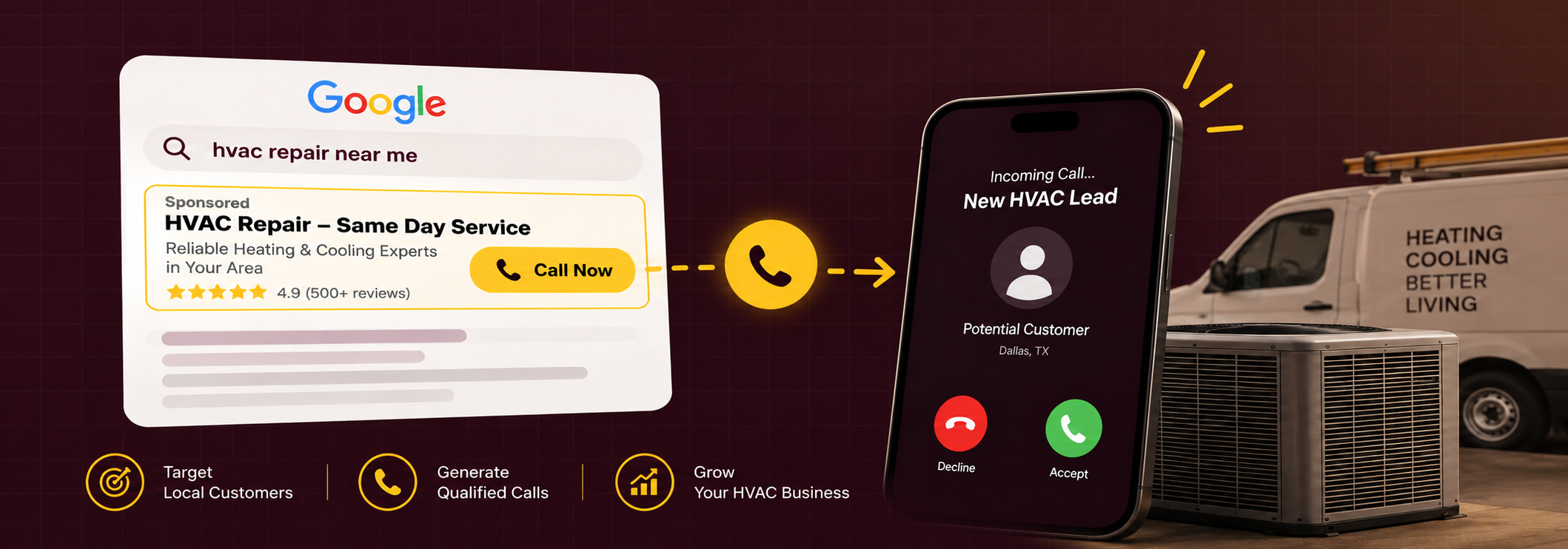
An HVAC contractor can target the right keyword, write a relevant Google Ad, and reach a homeowner who genuinely needs service, yet still lose the opportunity after the click. This often happens when the visitor reaches a page that feels generic, does not match what they searched for, or makes the next step difficult to understand.
At that point, the campaign has already paid to create the opportunity, and the landing page is responsible for turning that attention into a qualified call, estimate request, or scheduled appointment. That is why HVAC landing page design belongs inside the advertising strategy. A homeowner searching for urgent AC repair has different expectations from someone considering a full HVAC replacement, and the page should reflect those differences.
The strongest HVAC landing pages quickly confirm the service, establish local relevance, provide enough proof to reduce uncertainty, and make the next action obvious. For the broader acquisition picture, our HVAC lead generation guide explains how search visibility, advertising, website conversion, and follow up work together to create more booked jobs.
What Is an HVAC Landing Page?
An HVAC landing page is a focused page built around a specific service, campaign, offer, or customer intent. A homepage may need to explain the entire company, but a landing page has a narrower job. It should continue the conversation that started in Google and help a particular visitor take a particular action.
An AC repair landing page, for example, should reassure the visitor that you repair AC systems in their area, show why your company can be trusted, answer the questions that may stop them from calling, and make requesting service easy. Google recommends closely matching landing page content with the keywords and ads that brought the visitor there. When the search, ad, and page all speak to the same need, the customer spends less time figuring out whether they reached the right business.
A homeowner searches "AC repair Fort Worth" and clicks the same ad. Where they land decides whether they call.
A homepage is not automatically a bad destination for paid traffic, but it should not be used simply because it is the easiest URL to select. The dedicated page removes the uncertainty instead of asking the visitor to resolve it.
Start With Customer Intent Before Designing the Page
There is no single HVAC landing page structure that should be copied across every campaign. The right page depends on what the customer searched for, how urgent the problem is, what the service is worth, and how much information the homeowner needs before contacting the company.
Before designing the page, ask one question: what does this specific customer need to know before taking the next step? That answer should shape the page more than any generic template.
Mainly wants to know whether you repair the problem, serve the area, look credible, and can respond.
Needs installation experience, equipment options, financing, warranties, reviews, and the estimate process.
Cares most about what the service includes, whether the offer is legitimate, and how easy scheduling is.
Phone First or Form First?
The best primary action depends on the service and customer intent. The business also needs to consider what happens after the action. A page that encourages calls will not produce much value if the company consistently misses them, while a form can convert well on paper and still lose revenue if responses take hours.
Lead With the Phone
A call may be the natural next step because the customer wants immediate help. Tap to call should be obvious on mobile, and someone has to answer. Lead response is part of conversion, which is why AI lead management for contractors should be considered alongside landing page performance.
Keep the Form Short
Someone considering a new system may be comfortable requesting an estimate. Review every required field and ask whether the business genuinely needs that information before speaking with the customer. If not, collect it later.
Build Trust Around the Questions Homeowners Actually Have
Trust matters in HVAC because customers may be inviting technicians into their homes and making decisions involving significant amounts of money. This is where branding and lead quality connect. Two contractors may offer similar services, but the company that communicates more clearly and provides stronger proof can feel like the safer choice.
Stock photography can support the layout, but real team, vehicle, equipment, and project images usually provide stronger evidence that there is an established local operation behind the advertising.
Make Mobile Experience and Speed Part of Conversion
Many HVAC searches happen from phones, especially when a customer has an immediate problem. Text should be easy to read, buttons comfortable to tap, forms simple to complete, and the phone number obvious. Large popups, slow video, oversized images, and excessive animation create friction at exactly the moment the customer is trying to solve a problem.
Speed matters even more with paid traffic because the click has already cost money. The goal is not to chase a perfect technical score, but the page should load quickly enough that customers reach useful information without feeling delayed. Test the page on an actual phone, place a call, complete the form, and move through the content the way a customer would.
Track the Journey From Click to Booked Job
Calls and form submissions are useful conversion metrics, but they are only the first measurable outcomes. The stronger measurement path follows the visitor from the ad click to the inquiry, then to qualification, appointment, booked job, and revenue.
This matters when comparing services. A maintenance page may generate many inexpensive leads, while a replacement page produces fewer inquiries with much higher average value. Looking only at cost per lead can create the wrong conclusion. The same principle applies across PPC for contractors. Cheap leads do not automatically mean profitable advertising.
Testing should focus on meaningful questions first. Does the headline match the service? Is the primary action right for the customer? Is the offer relevant? Is the form creating unnecessary friction? Once those fundamentals work, smaller tests involving layout, imagery, CTA wording, and proof placement become more useful.
Three HVAC Landing Page Structures
The point is not to copy these structures exactly. It is to recognize that different customer intent creates different information needs.
Emergency AC Repair
HVAC Replacement
Seasonal Tune Up
A maintenance page can usually be more concise than the other two.
Common HVAC Landing Page Mistakes
Most landing page problems are not sophisticated. Campaigns send all traffic to the homepage, unrelated services compete for attention, the headline does not match the ad, forms ask too many questions, reviews appear too late, the mobile experience feels awkward, or calls are not tracked properly.
Slow response is another common weakness. A landing page may create legitimate opportunities, but those leads can disappear before anyone speaks with them. Landing page conversion is therefore not only a design issue. It sits between advertising, website experience, trust, lead handling, and sales performance.
Frequently Asked Questions
What is an HVAC landing page?+
Should HVAC Google Ads go to the homepage?+
What should an HVAC landing page include?+
How many landing pages does an HVAC company need?+
Should an HVAC landing page use a phone number or form?+
Does landing page experience affect Google Ads?+
Build the Page Around the Job You Want to Book
The best HVAC landing page is not the one with the most sections or the newest design trend. It is the page that understands why the customer clicked and gives that person a clear, credible path toward the next step.
Start with the search intent, match the ad to that need, continue the same message on the landing page, provide enough proof to reduce uncertainty, and make contacting the business easy. Then follow the lead beyond the form so you can understand whether the page is contributing to qualified calls, appointments, and booked jobs rather than simply generating activity.
Yay Blitz helps local service companies connect paid local advertising, conversion focused pages, lead tracking, and follow up into one measurable growth system. If your HVAC campaigns are generating clicks but not enough qualified calls, increasing traffic may not be the first solution. Start with a free strategy assessment to identify where your funnel is losing opportunities.
 Funnel Strategy
 Graphic & Web Design
 Paid Local Ad
 Marketing Strategy