

Landscaping covers very different businesses: weekly mowing routes, seasonal cleanups, irrigation, tree and shrub care, and design-build projects like patios, retaining walls and outdoor kitchens. Customers search for each differently, and they compare companies on very different things. A homeowner looking for weekly mowing wants reliability and price. One planning a $40,000 patio wants a portfolio and a designer they trust.
This guide covers local SEO for landscaping companies: how Google ranks you, how to structure your profile and website around the work you want most, how to use project portfolios and route density, how to plan seasonal content and how to track results. For general foundations, see our local SEO guide.
Landscaping SEO is the work of ranking in Google’s map pack and local results for searches like “landscaper near me,” “lawn care service” and “patio installation.” Google says local results depend on relevance, distance and prominence.
Landscapers improve them with an accurate profile, separate pages for maintenance and design-build services, project portfolios, seasonal content, route-focused town pages, steady reviews and local links.
Why Does Local SEO Matter for Landscapers?
Customers search locally, compare visually and want someone on their street.
Landscaping is local by nature. Customers want a company that already works in their neighborhood, because it suggests reliability and fair pricing. Maintenance companies also benefit from route density: more clients on the same streets means more profit per day.
The industry is large and competitive. The Bureau of Labor Statistics estimates about 171,600 openings each year for grounds maintenance workers. Many small companies compete in every town, so visibility and proof decide who gets the call.
Local SEO helps you attract the work you want most, whether that’s maintenance on dense routes or larger design-build projects.
How Does Google Rank Landscaping Companies?
Relevance, distance and prominence.
Google says local results depend on relevance, distance and prominence. Clear services and specific pages improve relevance; reviews and portfolio content build prominence.
What Do Landscaping Customers Search For?
Maintenance, design, hardscape, seasonal and cost searches.
Map each group to a page. See local keyword research.
How Should Landscapers Set Up Their Google Business Profile?
Category for your main revenue, every service and a route-focused area.
Follow Google’s guidelines. See the Google Business Profile checklist.
Why Should Landscapers Separate Maintenance and Design-Build?
Different customers, searches and proof.
Maintenance customers want reliability, price and convenience. Design-build customers want creativity, craftsmanship and a portfolio. Mixing both on one page confuses both groups and weakens relevance for each search.
Build separate sections of your site. Maintenance pages should explain service frequency, what’s included, pricing or ranges and how scheduling works. Design-build pages should focus on process, portfolio, budgets and timelines. Link them, since maintenance clients often become design clients later.
Which Pages Should a Landscaping Website Have?
Maintenance, design, hardscape, seasonal and portfolio pages.
Each page should open with a short answer, then include local photos, reviews and FAQs. See the home service website guide.
How Should Landscapers Build Project Portfolios?
Project pages with stories, locations and before-and-after photos.
Landscaping is visual, and customers want to see what you’ve built nearby. For design and hardscape projects, publish project pages: the town, the client’s goals, design decisions, materials, timeline and before-and-after photos. Add a client quote if they agree.
Project pages rank for specific searches like “bluestone patio [town],” give AI tools concrete facts and help prospects imagine their own yard. Aim for one or two new projects a month in the building season.
How Should Landscapers Plan Seasonal SEO?
Prepare pages and posts before each season starts.
Update prices, photos and FAQs a month ahead. Publish Google posts that match each season, and check Google Trends for your region.
How Do Landscapers Get More Reviews?
Ask after visible results, and regularly from maintenance clients.
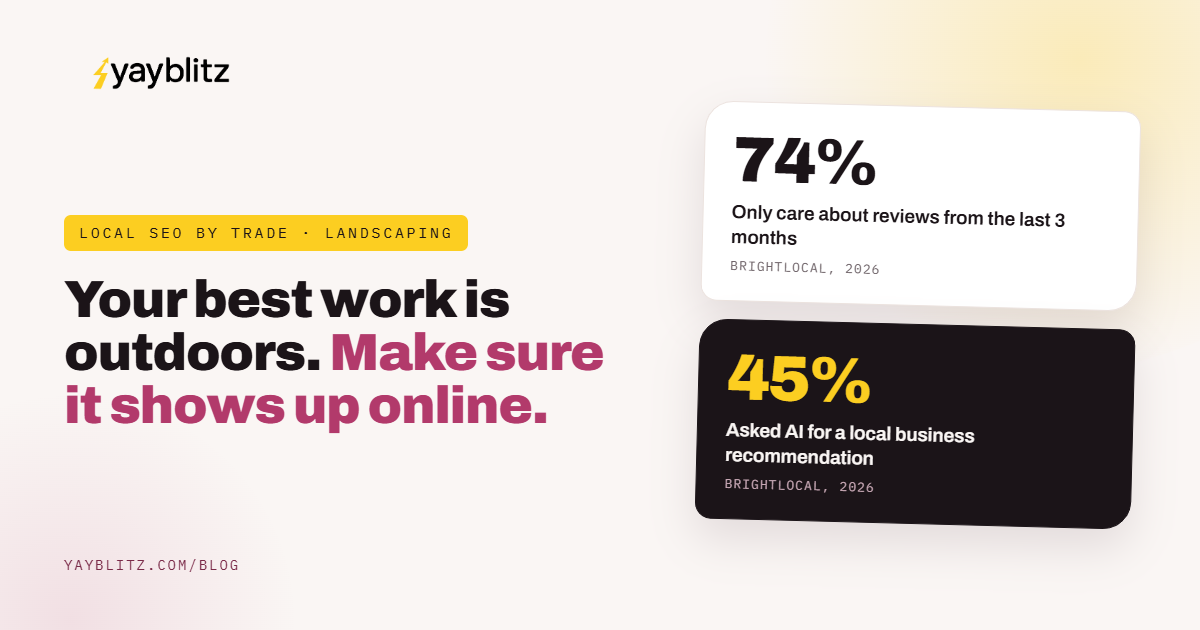
BrightLocal’s 2026 survey found 47% of consumers won’t use a business with fewer than 20 reviews and 74% only care about reviews from the last three months. Maintenance clients see you often, which makes regular reviews possible.
Ask design-build clients at the final walkthrough. Ask maintenance clients after the first month, when they see consistent results. Send a text link and invite them to mention the service and town. Reply to every review. See how to get more Google reviews.
How Should Landscapers Use Town Pages?
Focus on route-dense towns and real local projects.
For maintenance, profit depends on route density. Build town pages for the areas where you most want more clients, with local projects, reviews and notes on soil, HOA rules or common yard styles. List other towns on a service area page.
Avoid copy-paste pages; Google’s spam policies warn against doorway pages. See location pages that rank.
Which Links Help Landscapers?
Suppliers, associations, garden centers and community groups.
Paver and stone manufacturers often run contractor locators. Nurseries and garden centers may recommend installers. State landscape associations list members. HOAs, property managers, realtors and builders can link to preferred landscapers. Community gardens, school projects and local home tours earn mentions.
Avoid buying links. See local link building.
What Content Should Landscapers Publish?
Answers to cost, timing and care questions.
Start each article with a direct answer and link to the matching service page. Follow Google’s guidance on helpful content.
How Does AI Search Affect Landscapers?
AI tools recommend companies and answer seasonal questions.
BrightLocal found 45% of consumers have used AI tools for local recommendations. Homeowners ask assistants about costs, timing and local companies.
Clear service pages, price ranges, project pages and consistent listings help assistants describe you accurately. See how to get recommended by AI.
What Technical Basics Matter?
Fast, image-heavy pages and accurate structured data.
Portfolios are image-heavy, so compress photos, use modern formats and lazy-load galleries. Test on a phone. Add local business structured data using the closest type, matching your profile, and check indexing in Search Console.
How Is Commercial Landscaping SEO Different?
Contracts, property managers and documentation.
Commercial clients such as HOAs, office parks and property managers search for commercial landscape maintenance and snow contracts. They value reliability, insurance, reporting and response times. Build commercial pages with property types served, contract options and reporting. Links from property management associations help.
How Should Landscapers Track SEO?
Maintenance sign-ups, design consultations and revenue from search.
Track maintenance and design-build separately; they have different values and cycles. See tracking local SEO results.
What SEO Mistakes Do Landscapers Make?
Mixed pages, no portfolio and stale seasonal content.
How Should Landscapers Write Maintenance Pages?
Frequency, inclusions, pricing and scheduling in plain terms.
Maintenance customers want to know exactly what they get. Start with a short answer: what’s included, how often you visit and a price range. Then explain each element, such as mowing, edging, trimming, blowing, weed control and seasonal add-ons.
Explain scheduling: which day of the week, what happens in rain and how to pause or skip. Mention communication, such as visit notifications. Add reviews that mention reliability and a simple sign-up form. Clear maintenance pages attract the steady clients that make routes profitable.
How Should Landscapers Write Design-Build Pages?
Process, budgets, timelines and portfolio.
Design-build clients want to understand how the project works and what it will cost. Explain your process: consultation, site visit, design, proposal, revisions, scheduling, construction and walkthrough. Give budget ranges for common project types and explain what changes them.
Feature local projects with photos and stories. Include reviews from design-build clients. Offer a clear next step, such as booking a consultation, and explain any design fee.
How Should Landscapers Use Before-and-After Photos?
Same angles, good light and seasonal context.
Landscaping transformations are dramatic, and before-and-after photos sell them. Take before photos from fixed points you’ll reuse after completion. Consider follow-up photos a season or year later, when plantings have filled in.
Post pairs weekly on your profile during the building season. Use them on project pages with short captions explaining what changed.
How Do Landscapers Handle Snow Removal SEO?
Separate pages, contracts and response times.
If you offer snow removal, build a dedicated page explaining residential and commercial options, contracts or per-push pricing, response times and coverage areas. Searches peak before and during the first storms, so update the page in early fall.
Snow contracts can keep crews busy in winter. Track snow sign-ups from search separately.
How Should Landscapers Price Online?
Ranges for maintenance and common projects.
Publish ranges for weekly maintenance by lot size and for common projects such as patios, walls and planting beds. Explain what changes the price: materials, access, slope and site prep. Ranges help qualify leads and give AI tools accurate information.
Update ranges yearly as material and labor costs change.
How Do Landscapers Use Reviews in Marketing?
Feature service-specific reviews on matching pages.
Feature maintenance reviews that mention reliability on maintenance pages, and design-build reviews that mention creativity and craftsmanship on design pages. Use first names and towns with permission.
Ask customers to mention the service and town in reviews to strengthen relevance.
How Should Landscapers Handle Irrigation and Lighting SEO?
Dedicated pages for specialty services.
Irrigation installation, repair, startup and winterization, as well as landscape lighting, are distinct searches. Build pages for each service you offer, with process, ranges, seasonal timing and photos.
These services often bring repeat work and can fill gaps between larger projects.
How Do Landscapers Use Google Posts?
Weekly seasonal updates, projects and offers.
Google posts show activity and give customers reasons to call. Post a recent project, a seasonal tip, an early-booking offer for spring or a reminder about fall cleanups. Add a photo and a clear call to action.
Plan posts on a seasonal calendar so you’re always a few weeks ahead of demand.
How Should Landscapers Respond to Weather Delays?
Communicate proactively and reflect it in content.
Weather affects every landscaping schedule. Explain your rain policy on maintenance and project pages, and send proactive updates to clients when delays happen. Clear communication prevents negative reviews.
If a review mentions a delay, reply calmly and explain how you handled it.
How Do Landscapers Compete With National Lawn Care Brands?
Local proof, personal service and design capability.
National lawn care brands have big budgets and recognisable names. Local landscapers can compete with local project stories, owner and crew photos, flexible service and design capabilities national brands may not offer.
Highlight what makes you local and personal in your profile description, website and reviews.
How Should Landscapers Prioritise Their First Pages?
Start with the service that brings the most profit.
If maintenance routes are your core business, build maintenance pages and route-focused town pages first. If design-build drives profit, start with the portfolio and hardscape pages. Then add seasonal and specialty pages.
Each strong page beats several thin ones.
What Does a 90-Day Landscaping SEO Plan Look Like?
Profile and service split first, then portfolio and seasonal content.
For broader marketing, see landscaping marketing.
The 16-point landscaping SEO checklist
Tick what you already do well. The first unticked items are usually your next best move.
Profile
4 itemsProof
4 itemsWebsite
4 itemsMeasure
4 itemsShow the work, and the right customers find you. That’s fixable.
Landscaping SEO questions
What is landscaping SEO?+
What category should a landscaper use?+
Should maintenance and design be on separate pages?+
Do project pages help landscaping SEO?+
When should I update seasonal pages?+
Should landscapers publish prices?+
Does AI search matter for landscapers?+
Let Your Work Be Found
Landscaping SEO means separating maintenance and design, showing real projects, preparing for each season, focusing on route-dense towns and earning steady reviews.
Great yards sell themselves, if people can find them.
Yay Blitz helps landscaping companies connect Graphic and Web Design, Paid Local Advertising, and AI Lead Management into one measurable system for getting and converting leads.
Want a second opinion? Book a Free Strategy Assessment. We’ll audit your landscaping SEO and plan your next season.
 Funnel Strategy
 Graphic & Web Design
 Paid Local Ad
 Social Media Marketing