

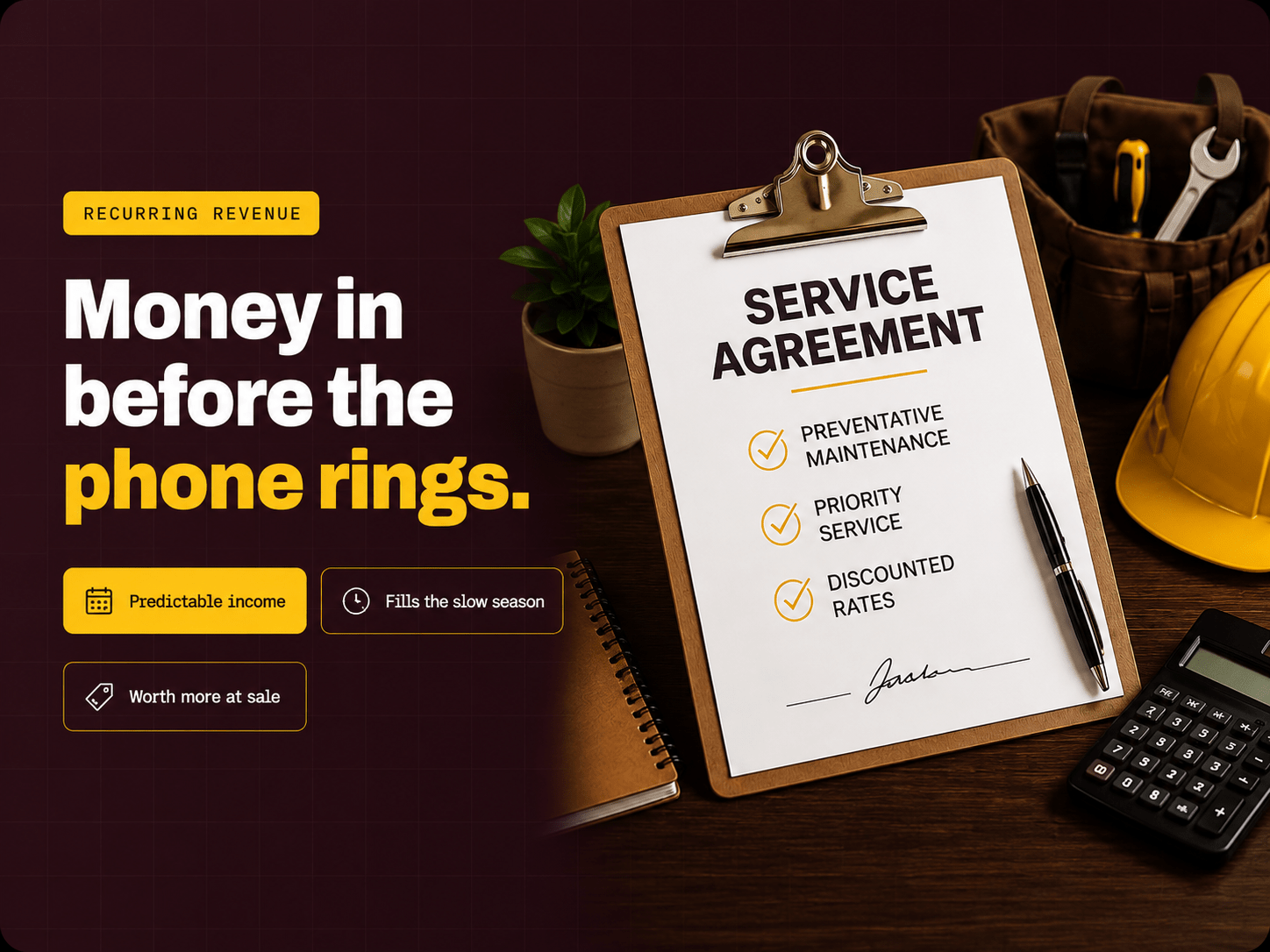
Here is the difference between a contracting business that stresses its owner out and one that does not, and it has almost nothing to do with how good the work is. The calm ones have money coming in before the phone rings. The stressed ones start every month at zero.
That gap has a name. Recurring revenue. And the tool that builds it for a local service business is boring on the surface and quietly transformational underneath: the service agreement, also called a maintenance plan or membership. If you install air conditioners, clear drains, treat for pests, inspect roofs, or service garage doors, this is very likely the single highest leverage thing you can add to your business this year. Not a new ad channel. This. Here is exactly how to build one, price it, sell it, and promote it.
Why Recurring Revenue Changes Everything
A one time job pays you once. A member pays you every year, calls you first, and sends you their neighbors. That difference compounds in five ways that matter to an owner.
What a Service Agreement Actually Is
At its core, a member pays you a set amount, monthly or annually, and in return gets scheduled maintenance plus a bundle of perks that make staying with you the obvious choice. The shape varies by trade, but the idea is identical.
A One-Time Job
A Member
What to Put in the Plan
A plan sells when the value is obvious and the price feels small next to it. The visits are the backbone. But the perks are what make it a no brainer, and most of them cost you very little.
How to Price It
Do not price the plan as just the cost of the visits. Price it for margin and for retention, because the real return is the repair work, replacements, and referrals a member sends you over years, not the tune up itself.
Most contractors land on a monthly option that feels painless, often in the range of a streaming subscription or two per month, with an annual option at a small discount to encourage the bigger commitment. Offer no more than two or three tiers. One is often enough to start. Complexity kills conversion, and a single clear plan at a single clear price will out enroll a confusing menu every time.
How to Sell It (The Part Everyone Skips)
Service agreements are sold in person, at one specific moment: the end of a job that went well. Your technician just fixed the problem, was on time, was clean, and earned the customer's trust. That is the moment. Give your techs a simple, low pressure script and make enrollment a single step.
How to Market It
Selling at the job is where most memberships come from, but marketing multiplies it. Start with the customers you already have, because they are the easiest yes you will ever get. Email and text your existing list with a simple, direct offer. Add a line about the plan to every invoice and estimate. Put a clear, benefit led page on your website, mention it on your Google Business Profile, and let your team bring it up on every service call.
Then make renewals automatic, because a plan that quietly lapses is worse than no plan. Automated reminders before each visit and renewal keep members active without anyone having to chase them, and this is exactly the kind of thing an AI lead management setup handles well. The same organic and paid channels that drive new HVAC lead generation can also promote the plan to the right homeowners, turning first time callers into long term members.
And the base is the small part. Those same members call you first for repairs and referrals, so the true return is several times the membership fee. Figures are illustrative, but the shape holds across trades.
Common Mistakes
A few things sink otherwise good plans. Underpricing so the plan loses money instead of building margin. Not actually delivering the visits, which destroys trust fast. Making it too complicated with five tiers nobody understands. Having no renewal system, so members quietly lapse. And the biggest one, not training and expecting techs to offer it at every job, which is where the enrollments actually come from.
How to Start This Month
You do not need a perfect program to begin. Pick one simple plan with one clear price and a couple of genuine perks. Write the one paragraph tech script above and train your team to say it at the end of every completed job. Then email and text your existing customers the same offer this week. Get renewals on an automatic reminder. That is enough to start turning one time jobs into a base of income that shows up whether or not the phone rings.
Frequently Asked Questions
What is a service agreement for a contractor? +
How much should I charge for a maintenance plan? +
How do I actually get customers to sign up? +
Is recurring revenue really worth it for a small contractor? +
How do I keep members from lapsing? +
The Bottom Line
Recurring revenue is the quiet difference between a contracting business that owns its owner and one the owner actually controls. A simple service agreement, sold at the end of every good job and promoted to the customers you already have, turns unpredictable one time work into income you can count on. It is not flashy. It just works, month after month.
If you want help turning your customer base into a membership engine, and automating the reminders and renewals so it runs without you chasing it, that is the kind of system we build. Start with a free audit and we will show you where the recurring revenue is hiding in the business you already have.
 Funnel Strategy
 Graphic & Web Design
 Paid Local Ad
 Marketing Strategy