

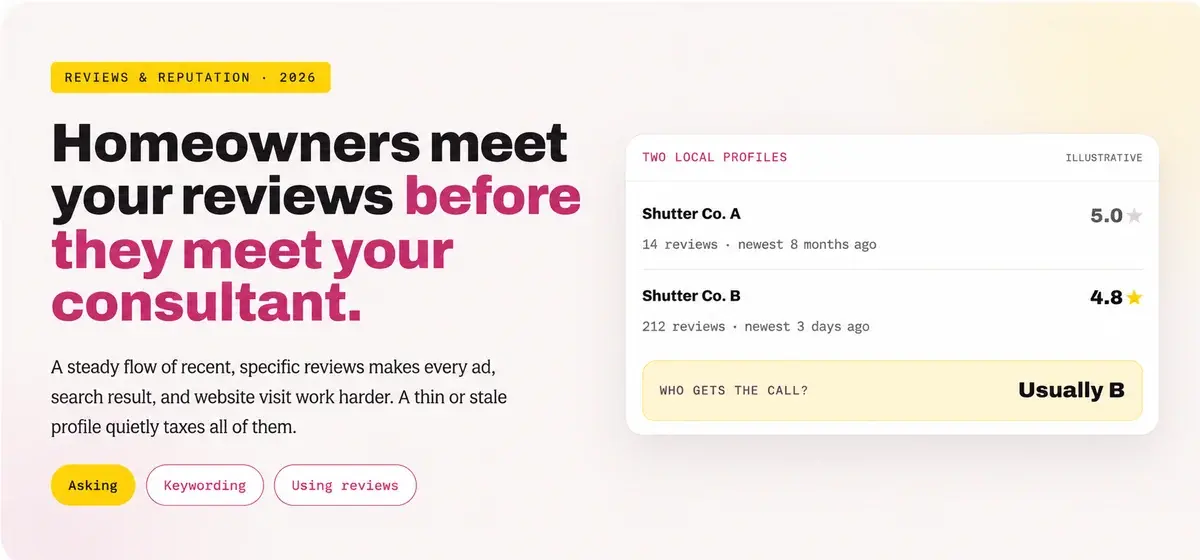
Before a homeowner books a blinds or shutters consultation, they almost always look you up. They compare star ratings on Google, scan a few recent reviews, and decide whether you feel like a safe company to invite into their home.
Most window treatment businesses have plenty of happy customers. Far fewer have a review profile that shows it. Reviews come in randomly, a few per quarter, usually from whoever happened to remember.
Your reputation is already earned on every install. The question is whether anyone can see it.
This guide explains how owners can build a review process that is consistent, honest, compliant with platform rules, and connected to the rest of their marketing, so reviews do more than sit on a profile.
Reviews Are Part of the Sales Process
Window treatments are a considered purchase. The homeowner is letting a stranger measure every window in the house and is spending thousands of dollars on something they will live with for years. Before they fill out a form or call, they want reassurance.
Reviews provide that reassurance at almost every step:
That makes reputation a conversion lever, not a vanity metric. It sits alongside the work covered in Google Business Profile Optimization and Window Treatment Consultation Conversion , and it influences both.
What Homeowners Actually Look For
Few homeowners read every review. They skim the rating, the count, the most recent few, and anything negative. In window treatments, they are usually checking for the same handful of concerns:
That last one matters more than owners expect. A review describing a delayed order that was handled well can build more trust than ten reviews that just say “great job.”
Recency and Volume Beat a Perfect Score
Many owners chase a flawless 5.0. Homeowners tend to trust a profile that looks active and real. A slightly lower rating with many recent, detailed reviews often feels safer than a perfect score from a small number of old ones.
Consider a company that installs around forty projects a month. If only one in ten customers leaves a review, that is four reviews a month. If a simple process lifts that to one in three, the same installs produce thirteen.
No extra customers. No extra spend. Just a consistent ask. Over a year, that gap is often what separates the company that looks established from the one that looks small.
Ask When Satisfaction Is Highest
The best moment to ask is usually right after the installer finishes, when the homeowner is standing in a room that suddenly looks finished. A request that arrives three weeks later competes with everything else in their inbox.
The installer is often the person the homeowner feels most grateful to. Train installers to make a short, natural ask at the walkthrough, then let the system send the link while the moment is still fresh.
Make Asking a Process, Not a Favor
When asking depends on individual memory, it happens on good weeks and disappears on busy ones. Tie it to the job status in your CRM so every completed install triggers the same steps.
Automation handles the timing. AI Lead Management for Contractors can send the link when a job is marked complete and log whether a review arrived. The human ask at the walkthrough is still what makes people actually follow through.
Help Customers Write Reviews That Sell
Most customers want to help but do not know what to say. You cannot script their words, but you can prompt them to mention details future homeowners care about.
A simple line in the request does this: “If you have a moment, it really helps other homeowners when you mention which rooms and products we installed.” Specific reviews also reinforce the product and location relevance discussed in Window Treatment SEO .
Stay Inside the Rules
Shortcuts on reviews can cost far more than they gain. Platforms remove reviews that break their policies and can restrict profiles that repeatedly violate them, and regulators treat fake or manipulated reviews as deceptive advertising. Keep the process clean:
Ask every customer. Let them say what they actually think.
Policies change, so check current platform guidelines and applicable rules before launching any review program, and make sure text requests follow consent and messaging requirements.
Respond to Every Review
Responses are written for the next homeowner as much as the reviewer. A profile where the owner replies thoughtfully looks like a business that pays attention.
Good responses to positive reviews are short and specific. Thank the customer by name, reference the project, and credit the team member involved: “Thank you, Maria. We are glad the motorized shades in your sunroom are making afternoons more comfortable. I will pass your note on to James.”
Avoid pasting the same line under every review. Copy and paste replies tell readers nobody is really reading.
Handle Negative Reviews Without Making Them Worse
Every established company eventually gets a critical review. A delayed order, a shade that arrived the wrong color, a miscommunication about price. How the business responds is often more persuasive than the complaint itself.
Only report a review for removal when it genuinely breaks platform policy, such as a review from someone who was never a customer. Disagreeing with it is not enough.
Put Reviews to Work Across Your Marketing
Reviews should not live only on Google. With customer permission where needed, the strongest ones can support every stage of the buying journey:
Over time, reviews become part of the brand itself. Strong, consistent proof is one reason branding drives higher quality leads .
Measure Reputation Like a Lead Source
What gets tracked gets done. Review the numbers monthly:
In this illustrative example, the same customers and the same link produce very different results depending on whether anyone asks in person. For multi location businesses, compare locations too. A strong review base in each service area supports location based marketing .
What to Review First
Open your Google Business Profile and your job list for the last ninety days. Then ask:
Most owners find the answer quickly. Plenty of happy customers, no consistent ask, and replies that stopped months ago. All of it is fixable within a few weeks.
Twenty questions for your review profile
Use this checklist against the last ninety days of completed installs.
Asking
5 itemsQuality and compliance
5 itemsResponding
5 itemsUsing and measuring
5 itemsIf many of those answers are no, your best marketing asset is already installed in customers' homes. It just is not visible yet.
Frequently Asked Questions From Blinds and Shutters Owners
How many Google reviews does a window treatment company need?+
When is the best time to ask for a review?+
Can we offer a discount in exchange for a review?+
Should we respond to positive reviews too?+
How should we handle a negative review?+
Do reviews help local SEO?+
Make Your Reputation as Visible as Your Work
Good installs create happy customers. A simple, consistent review process turns those customers into proof the next homeowner can see.
The best review strategy is a great job, followed by a clear ask.
Ask every customer at the right moment, reply to every review, learn from the critical ones, and put the strongest proof where buying decisions happen. Before spending more on blinds leads , make sure the homeowners you already reach can see why others chose you.
Yay Blitz helps blinds, shutters, and other local service businesses connect Paid Local Advertising , Graphic and Web Design , review workflows, and AI Lead Management for Contractors into one measurable acquisition and conversion system.
If your work is strong but your profile does not show it, start with a Free Strategy Assessment . We will review how your reputation compares locally and where reviews can lift conversion across your marketing.
 Funnel Strategy
 Graphic & Web Design
 Paid Local Ad
 Marketing Strategy