

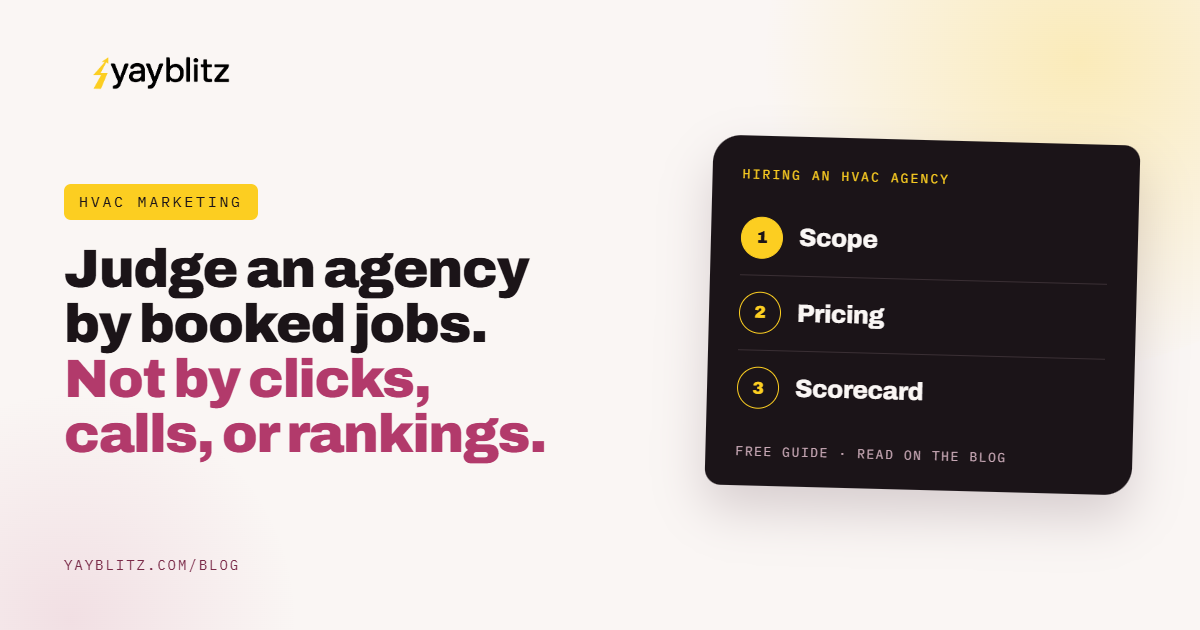
The pitch usually sounds the same. More calls, higher rankings, a dashboard full of green arrows. Six months later, the owner looks at the board in July and can’t tell whether the agency helped, because nobody agreed what “helped” meant.
HVAC makes this harder than most trades. Demand swings with the weather, so a good month can be a heat wave and a bad month can be a mild spring. Calls aren’t jobs, and a repair call isn’t a $12,000 replacement. An agency can look brilliant or useless depending on which number you read.
This guide helps you hire well. It covers when an agency makes sense for an HVAC company, what the scope should include, how pricing works, who should own what, the questions that separate strong partners from weak ones, and a 90-day scorecard. Use it with anyone you interview, including us.
When Does an HVAC Company Need an Agency?
When a specific stage is holding you back and nobody on your team has the time or skill to fix it, such as weak map pack visibility, Google Ads that waste money, Local Services Ads you can’t manage, or no reliable call tracking.
An agency isn’t the first fix if the leak is inside the business. If calls go to voicemail at 6 PM, booking rate is low, or replacement estimates get no follow-up, more leads mostly cost more. Our HVAC Contractor Growth Playbook explains how to find your weakest stage before you spend.
Agency, Freelancer, In-House, or Software Vendor?
A full-service agency gives breadth and continuity; specialists and freelancers go deep on one channel; an in-house marketer knows the business; field service software vendors may offer marketing add-ons. Many HVAC companies combine an in-house coordinator with outside specialists.
A common split for growing shops: an in-house coordinator handles reviews, photos, social posts, membership campaigns, and CRM hygiene, while an agency handles paid search, Local Services Ads, SEO, tracking, and reporting.
What Should an HVAC Agency Actually Do?
Run and connect visibility, tracking, and reporting: Google Business Profile, website and service pages, SEO, Local Services Ads, Google Ads, call tracking, and a monthly report on booked jobs by source. Good agencies also measure response, even if they don’t run it.
An agency that runs ads but never asks how many calls your CSRs book, or how many replacement estimates close, is optimizing half the system.
What Makes HVAC Marketing Different for an Agency?
Seasonality, urgency, capacity, and two sales motions. An HVAC agency has to plan budgets around weather, protect you from buying calls you can’t answer, and separate repair, replacement, and maintenance demand.
Ask every agency how it handled a heat wave for another client. The answer tells you whether they understand the trade.
How Much Does an HVAC Marketing Agency Cost?
It depends on scope, channels, and ad spend. Agencies charge monthly retainers, a percentage of ad spend, per-lead fees, project fees, or a mix. Ad spend and Local Services Ads lead charges are usually paid directly to Google.
Model the total cost at three spend levels: your slowest month, an average month, and a peak month. A percentage-of-spend model can look cheap in April and expensive in July.
Count agency fees inside each channel’s cost when you calculate cost per booked job. Our HVAC cost per lead guide covers the lead side of that math.
Who Should Own Your Accounts and Data?
You should. Your Google Ads account, Local Services Ads profile, Google Business Profile, website, domain, call tracking numbers, analytics, and CRM data should be in your name, with the agency given access.
If an agency insists on owning any of these, ask what happens when you leave. The safest answer is “you keep everything, and we hand over all logins and files within a week.”
What Questions Should You Ask Before You Sign?
Ask how they measure success, how they handle seasonality and capacity, who does the work, what HVAC results they can show, what you’ll own, and what happens in the first 90 days.
Compare answers side by side. The agency that asks the most questions about your booking rate and replacement process usually understands the business best.
What Are the Red Flags?
Guaranteed rankings, agency-owned accounts, call counts with no booked-job data, long lock-ins, shared leads sold as exclusive, outdated incentive claims, and no questions about your capacity or CSRs.
One more: an agency that blames your CSRs for every result but won’t help measure or improve booking. The phones are part of the system, and a good partner will look at them with you.
What Should the Contract Include?
A written scope, deliverables, reporting, account ownership, a reasonable term with an exit clause, data handover, how ad spend and LSA charges are billed, and who handles compliance for texting and call recording.
If the agency sets up texting or AI phone answering, confirm consent and recording notices are handled. Our AI receptionist guide covers the basics. This isn’t legal advice; have counsel review any contract.
How Should Onboarding Work?
The first 30 days should cover access, a tracking audit, a seasonal baseline, quick fixes, and a written 90-day plan.
Your side matters too. Agencies move faster when you send job photos weekly, share call recordings, approve changes quickly, and give honest numbers on booking rate, average ticket, and replacement close rate.
How Do You Judge an HVAC Agency After 90 Days?
Compare booked jobs, booking rate, and cost per booked job with the same period last year, adjusted for weather, and check that tracking and reporting are solid.
Weather can hide or exaggerate results. Compare like with like, and look at booked jobs per qualified call as well as totals. By day 90 you should see clean tracking, less waste, and a clear direction.
How Do You Make the Final Decision?
Shortlist two or three agencies, compare answers, call references, start with a defined first phase, and agree the scorecard in writing.
Whoever you hire, use the HVAC Growth Playbook as a shared map so you and the agency agree which stage you’re fixing and why. For the ads side, see PPC for contractors.
Twenty questions to answer before talking to agencies
Answer yes or no. The more yes answers, the faster any agency can produce results for you.
Access
5 itemsBaseline
5 itemsOperations
5 itemsGoals
5 itemsIf several answers are no, fix them first or make them part of the agency’s first 30 days. That's fixable.
Frequently Asked Questions About Hiring an HVAC Marketing Agency
Should an HVAC company hire a marketing agency?+
How much does an HVAC marketing agency cost?+
What should an HVAC agency report each month?+
Who should own our Google Ads and LSA accounts?+
How long until an HVAC agency shows results?+
What are red flags when hiring an HVAC agency?+
Should our agency manage Local Services Ads?+
What should we prepare before hiring an agency?+
Hire a Partner Who Talks About Booked Jobs.
The right HVAC agency will ask about your booking rate before your keywords, plan for heat waves before they arrive, and leave you owning everything it builds. Use these questions and the scorecard with anyone you talk to, including us.
Define the stage. Ask hard questions. Measure booked jobs.
For related guides, see the HVAC Growth Playbook, HVAC cost per lead, and Google Ads for HVAC.
Yay Blitz helps HVAC companies connect Graphic and Web Design, Paid Local Advertising, and AI Lead Management into one measurable system for getting and converting leads.
If you’re comparing HVAC agencies, start with a Free Strategy Assessment. We’ll run the same audit we’d run as your agency and share the findings, whether or not you hire us.
 Funnel Strategy
 Graphic & Web Design
 Paid Local Ad
 Social Media Marketing