

Every HVAC owner knows the pattern. The first hot week floods the phones. Three weeks of mild weather and the board looks thin. Then the first cold snap hits and it starts again.
Industry shipment data shows how big the swing is. AHRI figures reported by Contracting Business show 763,443 central air conditioners and air-source heat pumps shipped in July 2025, compared with 408,244 in December 2025. That’s nearly twice as many units in a peak month as in a slow one, before counting the repair calls that follow the same curve.
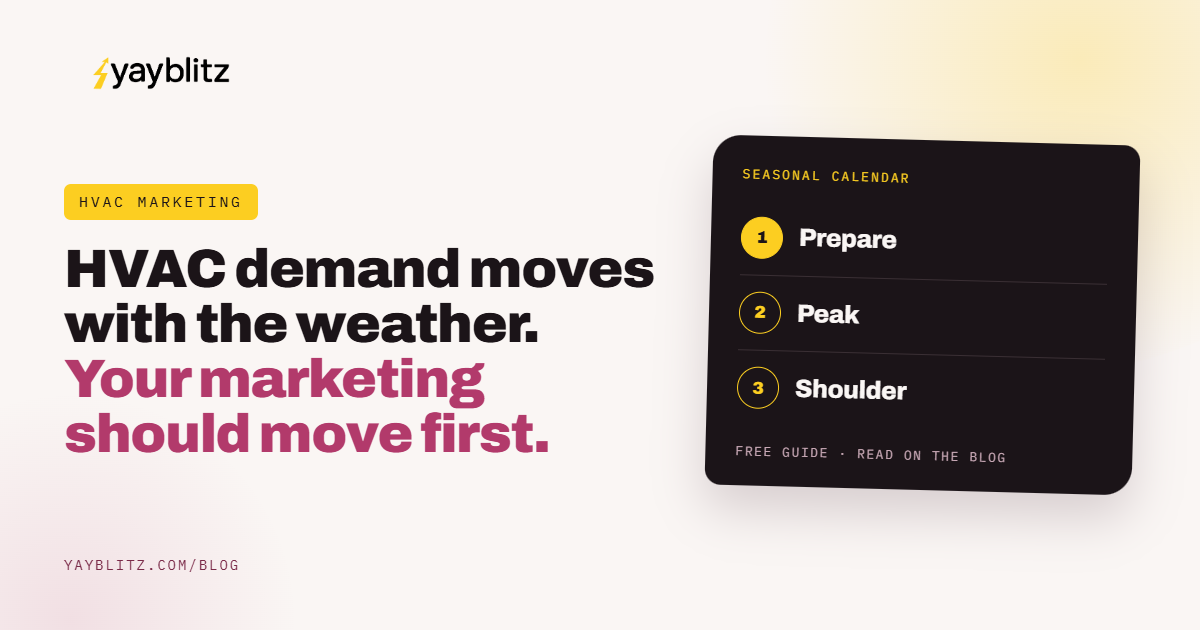
A seasonal calendar turns that swing into a plan. Instead of reacting to the weather, you prepare before each peak, ride it with the right campaigns, and use the shoulder months to build the memberships, reviews, and replacement pipeline that make the next peak more profitable. Adjust timing for your own climate.
Build your calendar around four phases: pre-cooling (spring), cooling peak (summer), pre-heating (fall), and heating peak (winter), with shoulder periods between.
Run tune-ups and staffing before each peak, protect capacity during it, and use the shoulder months for memberships, replacement follow-up, reviews, and reactivation.
Why Does HVAC Marketing Need a Seasonal Calendar?
Because demand rises and falls sharply with the weather. Without a calendar, budgets run out at peak, campaigns launch too late, and the slow months are wasted.
Shipments are a proxy for installations, not a count of service calls. But repair and replacement calls follow the same pattern: the first heat wave and the first freeze bring the biggest spikes.
Most marketing mistakes in HVAC are timing mistakes. A tune-up campaign launched after the first heat wave is too late; the board is already full of repair calls. A membership push in peak season competes with emergency work for CSR time. A replacement campaign that pauses in the shoulder months leaves quotes unfollowed.
A calendar fixes timing. It also makes budgeting easier, because you can plan base spend, peak increases, and reserves in advance. Our HVAC marketing budget guide covers the money side.
What Are the Four Phases of the HVAC Year?
Pre-cooling, cooling peak, pre-heating, and heating peak, with shoulder periods between. The exact months depend on your climate.
In hot southern markets, cooling peak may run from May through September, with a short heating season. In northern markets, heating may be the bigger season. Mark your own phase dates from last year’s call volume by week.
How Do You Build Your Own Calendar From Last Year’s Data?
Export calls and booked jobs by week for the last two years, mark when each peak started and ended, and plan campaigns to launch four to six weeks earlier.
Two years is better than one because one hot or mild year can mislead. If you only have one year, use it and add a margin on either side.
What Should You Run in the Pre-Cooling Season?
AC tune-up campaigns to members and past customers, hiring and training for peak, call coverage plans, and a planned budget increase for the first heat.
Pre-season tune-ups do double duty. They fill the board before peak and surface failing systems before they break. A tech who finds a failing compressor in April has a calm replacement conversation; one who finds it in July has an emergency.
What Should You Do During Cooling Peak?
Answer every call, use the weather reserve when capacity allows, shift spend toward high-value work, pause low-value offers when the board is full, and keep replacement follow-up going.
Protecting capacity is the hardest discipline. When the board is full, spending more on repair ads just creates calls you can’t take. Shift spend toward replacement and high-value keywords, or pause and let the reserve sit. Our booking rate guide covers peak-day call handling.
What Should You Run in the Pre-Heating Season?
Furnace and heat pump tune-ups, carbon monoxide and safety messaging, membership renewals, and replacement offers for systems flagged during summer.
For heat pump positioning in a market where gas furnaces are common, see our heat pump marketing guide.
What Should You Do During Heating Peak?
Same playbook as cooling peak: answer every call, use the reserve on cold snaps with capacity, triage no-heat calls by safety, and keep replacement follow-up going.
No-heat calls carry more risk than no-cooling calls in many climates. Make sure after-hours triage rules are current and on-call coverage can handle a cold snap. Our after-hours calls guide covers triage and pricing.
Heating peak also brings many replacement conversations on older furnaces. Make sure comfort advisors have time blocked for those visits, and that every quote gets follow-up.
How Should You Use the Shoulder Months?
Build the assets that make the next peak more profitable: memberships, reviews, replacement follow-up, past-customer reactivation, indoor air quality, and website and SEO work.
Shoulder months are where many shops win next year. A business that signs members, follows up every open quote, and builds reviews in October and April goes into peak with a fuller board and a stronger profile. Our unsold estimate follow-up guide covers the replacement side.
How Should Ad Budgets Move Through the Year?
Set a base budget for every month, a planned increase ahead of each peak, and a reserve released only for heat waves and cold snaps when you have capacity.
Don’t cut to zero in the shoulder months. SEO, Local Services Ads ranking, and brand awareness lose ground when spend stops entirely. Our Local Services Ads guide explains how LSA responds to budget changes.
What Content and Offers Fit Each Season?
Tie offers and content to what homeowners are thinking about: tune-ups before peaks, urgent repair during peaks, replacements and memberships in between.
Publish seasonal content four to eight weeks before you need it to rank. Our HVAC SEO guide covers what to write and how to structure it.
What Are the Most Common Seasonal Mistakes?
Launching too late, running out of budget at peak, spending into a full board, going dark in shoulder months, and dropping replacement follow-up during busy periods.
Print the calendar and put it where the team sees it. A plan in someone’s head disappears in the first heat wave.
A Sample Calendar for a Cooling-Heavy Market
Here’s how one illustrative calendar might look for a company in a hot southern market, where cooling peak is long and heating is short but sharp.
In March, the company emails and texts members to book spring tune-ups, opens job posts for one tech and one CSR, and confirms overflow call coverage. In April, it opens tune-up offers to past customers without a plan, finishes training new hires, and builds cooling campaigns at base budget.
From May through August, paid budgets rise on a planned schedule, the weather reserve sits ready, and the office checks capacity every morning. Replacement follow-up runs every week no matter how busy the board is. In September and October, the focus shifts to memberships, unsold quotes from summer, review requests, and website content for heating season.
November brings heating tune-ups and safety messaging, with heating campaigns built at base. December through February is mostly base budget with a reserve for cold snaps, plus replacement follow-up and reactivation of customers who haven’t had service in over a year.
A company in a cold northern market would flip the weights, with a longer heating peak and a shorter cooling one. The structure stays the same: prepare, peak, shoulder, repeat. Write your version on one page and share it with the team.
Twenty questions before next season
Answer yes or no. Every no is a place the weather may be running your marketing instead of you.
Data
5 itemsDuring peak
5 itemsBefore peak
5 itemsShoulder
5 itemsIf several answers are no, start by mapping last year’s weekly call curve. That's fixable.
Frequently Asked Questions About HVAC Seasonal Marketing
When should HVAC companies start spring marketing?+
How much does HVAC demand change by season?+
What should HVAC companies do in the slow season?+
Should HVAC companies stop advertising in the off-season?+
When should HVAC tune-up campaigns run?+
How should HVAC budgets change during a heat wave?+
How do I build an HVAC marketing calendar?+
What HVAC offers work best by season?+
Plan for the Weather Before It Arrives.
HVAC demand will always swing with the weather. The companies that grow are the ones that prepare before each peak, protect capacity during it, and use the slow months to build next year’s advantage.
Prepare early. Protect capacity. Build in the shoulders.
For related guides, see the HVAC Growth Playbook, HVAC marketing budget, and service agreements.
Yay Blitz helps HVAC companies connect Graphic and Web Design, Paid Local Advertising, and AI Lead Management into one measurable system for getting and converting leads.
If you want a seasonal plan built from your own call data, start with a Free Strategy Assessment. We’ll map your peaks and shoulders and build campaigns and budgets around them.
 Funnel Strategy
 Graphic & Web Design
 Paid Local Ad
 Social Media Marketing