

Every HVAC owner has a stack of competitors’ postcards somewhere: a $49 tune-up, a cartoon snowman, a phone number in yellow. Most of those cards get a glance on the way to the recycling bin. A few book jobs, and those few usually have something in common.
The ones that work go to the right homes, at the right time, with one clear reason to call. Mail to past customers draws far more response than mail to strangers. The ANA/DMA Response Rate Report found an average 9% response rate for house lists and 4.9% for prospect lists, nearly double. “Response” there means any measurable reply, so the booked-job rate is lower, but the gap holds.
This guide covers who to mail, what to send, how to design a card that gets a call, when to mail, and how to track every response so you know what mail is worth to you.
HVAC direct mail works best when sent to past customers, plan members, homes with aging equipment, and carefully chosen neighborhoods around recent installs. Use a simple postcard with one clear offer, a tracked phone number and a booking link, mailed a few weeks before each season and repeated two or three times.
Judge each mailing on cost per booked job, not response rate.
Does Direct Mail Still Work for HVAC Companies?
Yes, when it goes to the right homes with a clear offer. It’s strongest with past customers and nearby neighbors.
Mail has two advantages digital channels struggle with. It reaches every household on a list, whether or not they’re searching, and it stays in the house for a while. A homeowner who sets a tune-up postcard on the counter in April may still have it when the AC starts struggling in June.
It also has a clear weakness: it costs real money per piece, and it’s wasted on renters, new construction with warranty coverage, and homes outside your service area. That’s why list selection matters more than design.
Treat mail as one part of a past-customer and neighborhood system, alongside email, maintenance plans and referrals.
Who Should HVAC Companies Mail?
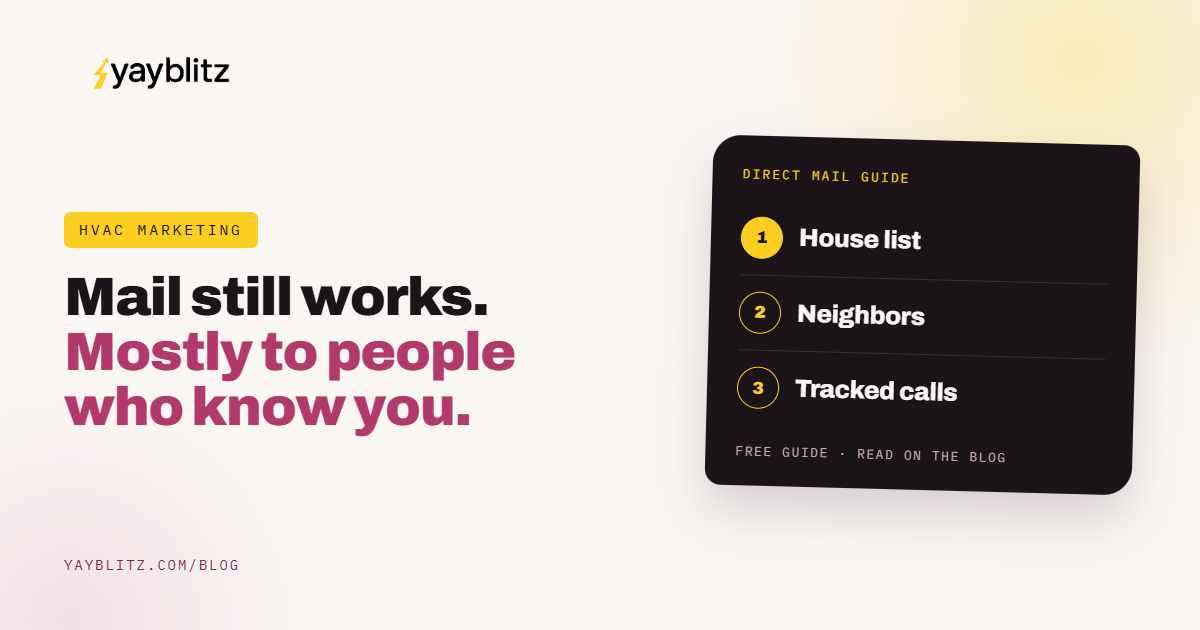
Start with your house list, then nearby neighbors of recent jobs, then targeted homes by age and ownership.
Most companies start at tier 5 because it feels like growth. Start at tier 1. Your own customers cost nothing to find, already trust you, and respond far more often. If your records don’t show equipment age and last visit, fix that in your CRM first.
How Do House Lists and Prospect Lists Compare?
House lists respond at nearly twice the rate of prospect lists, and they usually convert to bigger jobs.
Source: ANA/DMA Response Rate Report, 2018. Newer ANA editions report different figures from smaller samples, but house lists consistently outperform prospect lists.
For HVAC, the gap is wider than the averages suggest. A past customer already has your number, knows your team, and has equipment you’ve seen. A prospect has to choose you over whoever their neighbor used. That doesn’t mean prospect mail is a waste, only that it needs tighter targeting and more repetition to pay back.
What Should an HVAC Company Mail?
Postcards for most campaigns, letters for high-value conversations, and occasional seasonal reminders.
Door hangers aren’t mail, but they work well for neighbor campaigns around a job, delivered by your own team the same week. Check local rules before leaving anything in mailboxes, which in the US is limited to postage-paid mail.
What Offers Work on HVAC Mailers?
A specific seasonal service, a clear price, and a reason to act soon. Avoid offers you’d be embarrassed to honor.
Put a real expiration date on every offer and make sure the same offer appears on your website and in your CSRs’ script. When a homeowner calls about a card and the person answering hasn’t heard of it, the job often goes away.
How Do You Design an HVAC Postcard That Gets Calls?
One headline, one offer, one number, real photos, and a reason to trust you, readable in five seconds.
Test it on someone outside the company: hand them the card for five seconds and ask what it’s offering and how to get it. If they can’t say, simplify. Our graphic design team builds mailers this way.
When Should HVAC Companies Send Direct Mail?
Three to four weeks before each season, in a series of two or three drops, and around predictable weather spikes.
Mail takes time to print and deliver, so it can’t react to a heat wave already underway. Use it to fill the schedule before the rush, and let Google Ads and LSA catch the spike itself. One mailing rarely does much; a series to the same homes does better. See the seasonal calendar.
Should You Use EDDM or a Targeted List?
EDDM is cheaper per piece but reaches everyone on a route. Targeted lists cost more but skip renters and new homes.
EDDM’s strength is simplicity: pick routes on the USPS map and mail every door. Its weakness is waste. If a route is half rentals or brand-new builds, half your cards go to people who can’t or won’t buy. Use route data to pick areas where most homes are owner-occupied and old enough to need a replacement.
How Do Neighbor Mailers Work for HVAC?
After a job, mail or hang cards on nearby homes. Neighbors often have similar homes and similar equipment age.
Homes on the same street were often built in the same year and fitted with similar systems. When one fails, others aren’t far behind. A short card that says “We just installed a new system for your neighbor on Oak Street” turns your truck in the driveway into social proof.
Never name the customer or share their address without permission. Street names, ratings and numbers above are illustrative.
How Do You Track HVAC Direct Mail?
Use a unique phone number, link or code per mailing, ask every caller, and match mailed addresses against booked jobs.
Match-back matters because many people who saw your card will search your name instead of calling the number. Without it, mail looks weaker than it is.
How Do You Work Out If Direct Mail Pays?
Divide the full cost of a mailing by the booked jobs it produced, then compare with your other channels.
Tune-up mailers often look marginal on first-visit revenue alone. They make more sense when you count the plans sold, repairs found, and replacements that follow. Compare cost per booked job with your other channels and track it in your monthly KPIs.
What Direct Mail Mistakes Should HVAC Companies Avoid?
Mailing whole ZIP codes, cluttered cards, untracked numbers, one-off drops, and offers your team doesn’t know about.
Most of these are cheap to fix and make the difference between mail that looks like a cost and mail that pays.
The 20-point HVAC direct mail checklist
Run every mailing through this list before it goes to print.
List
5 itemsTiming
5 itemsCard
5 itemsTracking
5 itemsMost HVAC mail fails on targeting and tracking, not design. That's fixable.
HVAC direct mail questions
Does direct mail work for HVAC companies?+
What is a good direct mail response rate for HVAC?+
When should an HVAC company send direct mail?+
Is EDDM good for HVAC companies?+
What should an HVAC postcard include?+
How do you track HVAC direct mail results?+
Mail the People Most Likely to Call
Direct mail pays when it goes to homes that know you or look like the homes you just served, with one clear offer and a number you can track. Start with your house list, add neighbors, and measure every drop by booked jobs.
Good mail isn’t louder. It’s better aimed.
Pair mail with HVAC email marketing and a referral program. For more channels, see HVAC marketing ideas.
Yay Blitz helps HVAC companies connect Graphic and Web Design, Paid Local Advertising, and AI Lead Management into one measurable system for getting and converting leads.
Want mailers that are tracked from day one? Book a Free Strategy Assessment. We’ll review your lists and design a campaign you can measure.
 Funnel Strategy
 Graphic & Web Design
 Paid Local Ad
 Social Media Marketing