

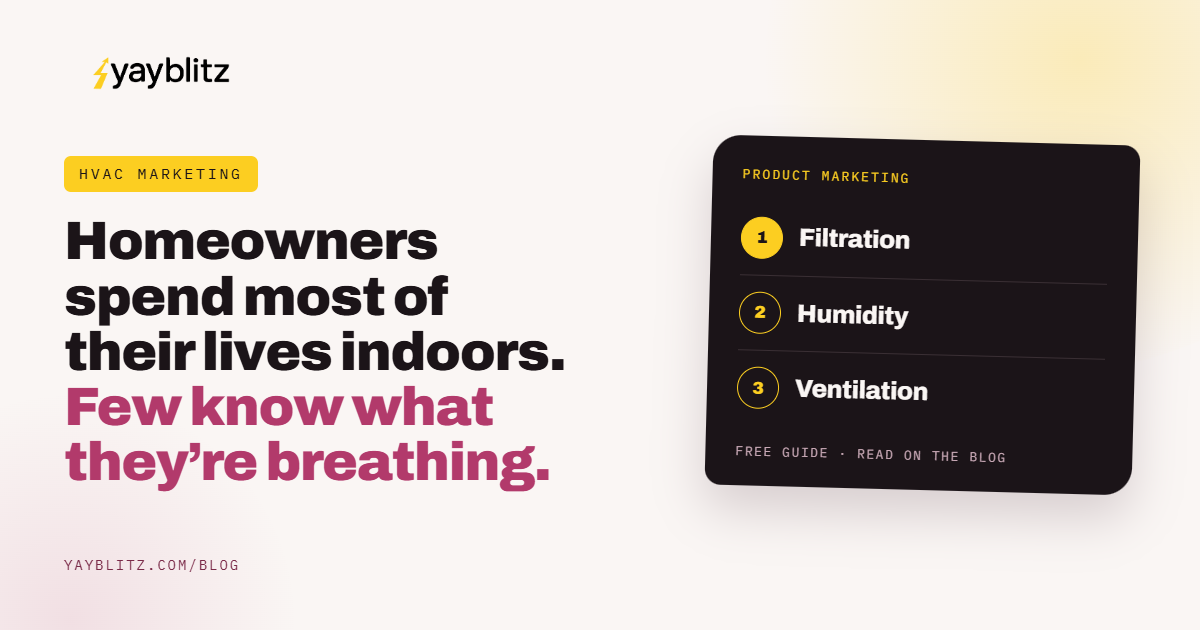
Most HVAC marketing waits for something to break. Indoor air quality is different. Homeowners with allergies, a new baby, a dusty house, or a sticky summer already want better air. They just don’t know an HVAC company is who to call.
The EPA notes that Americans spend about 90% of their time indoors, where some pollutants are often two to five times more concentrated than outside. That’s a real reason for homeowners to care. It’s also exactly the kind of fact that gets twisted into scary ads that hurt trust.
This guide covers which IAQ products are worth offering, how to talk about them honestly, how to sell them on service calls, which campaigns work, and how to measure results. It follows the same approach as our heat pump marketing guide.
HVAC contractors sell indoor air quality best by offering a small menu of proven products, speaking to symptoms homeowners already notice like dust, allergies, stuffiness and humidity, and raising the topic on every service visit. Market it honestly using EPA facts, not fear.
Run campaigns around allergy season, humidity, smoke events and life changes, and measure how often IAQ is added to service calls and replacements.
Why Should HVAC Contractors Market Indoor Air Quality?
Higher-margin add-ons, recurring filter and maintenance revenue, steady work in slow seasons, and a reason to stand out.
Most HVAC marketing competes on speed and price for emergency repairs. IAQ lets you compete on expertise instead.
It also strengthens your maintenance plans: “Includes your filter changes and an annual air quality check” is a concrete benefit.
Which IAQ Products Should You Offer?
A short menu tied to common problems: better filtration, humidity control, fresh-air ventilation, and purification where it fits.
Keep the menu small. Two or three good options per problem are easier for techs to explain and for homeowners to choose from. Pick brands you can stand behind and service.
Match the menu to your climate. A Houston company will sell far more dehumidifiers than a Denver company. See our Houston guide for a humidity-heavy example.
How Should You Talk About Indoor Air Quality?
Start with symptoms people notice, use plain EPA facts for context, and avoid health promises.
IAQ is easy to oversell. Homeowners are tired of scary marketing, and unproven health claims can get ads rejected and create legal risk.
Use the EPA facts as context, not as a threat: most of our time is spent indoors, and some indoor pollutant levels are often higher than outdoors. Then move straight to what the homeowner notices and what you can do about it.
Only repeat performance claims the manufacturer has tested, and say where they come from. If a product isn’t right for a home, say so. That honesty sells the next job.
How Do You Sell IAQ on Service Calls?
Train techs to check, show, and offer: a quick IAQ check on every visit, photos of what they find, and a simple good-better-best choice.
Most IAQ sales happen in the home, not online. Your techs are already there. Give them a simple process:
Never pressure. A homeowner who says “not now” should get a friendly follow-up in the right season. Our guide to unsold estimate follow-up covers sequences, and your CRM should track IAQ offers like any other estimate.
Which IAQ Campaigns Work Best?
Campaigns tied to moments when people notice their air: allergy season, humidity, smoke events, and life changes.
Build these into your seasonal marketing calendar. Email and text work well for past customers. For new homeowners in your area, Facebook ads are a good fit because IAQ is plannable, not urgent.
During smoke events or health scares, lead with genuinely useful advice like closing windows or changing filters. Selling hard during a crisis damages trust.
What IAQ Pages Should Your Website Have?
One main indoor air quality page plus pages for your top products, each answering real homeowner questions.
Homeowners search IAQ questions long before they buy: “why is my house so dusty,” “whole house dehumidifier cost,” “do air purifiers in HVAC work.” Pages that answer those questions honestly can rank and bring in steady leads.
Answer questions directly at the top of each page so Google and AI assistants can quote you. Our guides to HVAC website design and HVAC SEO cover structure and city targeting.
Should You Advertise IAQ?
Yes, carefully. Facebook and retargeting work well; search ads work for specific product searches. Keep the claims modest.
IAQ ads work best when they speak to a symptom and offer a low-risk first step, like an air quality check during a tune-up.
Track IAQ ads on booked jobs, not just leads. See Google Ads for HVAC and call tracking for the setup.
How Do You Measure IAQ Marketing?
Track attach rate on service calls and replacements, IAQ revenue per visit, and filter or plan renewals.
Track attach rate by technician. If one tech sells IAQ on many visits and another rarely does, pair them for a few ride-alongs. Usually the difference is the questions they ask, not the price.
Report IAQ alongside your other numbers in your CRM. When it’s visible, it improves.
The 20-point IAQ marketing checklist
Use this to build an IAQ program homeowners trust and your techs actually sell.
Products
5 itemsIn the home
5 itemsMessaging
5 itemsMarketing & tracking
5 itemsMost HVAC companies sell IAQ only when a homeowner asks. That's fixable.
Indoor air quality marketing questions
How do HVAC companies sell indoor air quality?+
What IAQ products should an HVAC contractor offer?+
How much time do Americans spend indoors?+
Can HVAC companies make health claims about air purifiers?+
When is the best time to market indoor air quality?+
How do you measure IAQ sales?+
Sell Comfort, Not Fear
Indoor air quality can become one of your steadiest, highest-margin services. Keep the menu short, lead with what homeowners notice, use honest facts, and make IAQ part of every visit. Then market it at the moments people care most.
Honest IAQ sells better than scary IAQ.
For other high-value services, read heat pump marketing. For plannable campaigns, see Facebook ads for HVAC.
Yay Blitz helps HVAC companies connect Graphic and Web Design, Paid Local Advertising, and AI Lead Management into one measurable system for getting and converting leads.
Want to build an IAQ program? Book a Free Strategy Assessment. We’ll look at your offers, messaging, and how your techs present them.
 Funnel Strategy
 Graphic & Web Design
 Paid Local Ad
 Social Media Marketing