

If your blinds or shutters business is getting decent leads and booking appointments, but too many consultations end with “we need to think about it,” the problem may no longer be marketing. It may be the consultation itself.
That is an uncomfortable idea for many owners because the appointment often feels productive. The homeowner is friendly. Measurements are taken. Fabrics, shutters, shades, or motorization options are discussed. The consultant spends an hour in the home. A quote is promised. Everyone leaves on good terms.
Then nothing happens.
The quote is opened but not accepted. Calls go unanswered. The homeowner says they are still comparing options. Another company wins the project. The owner responds by asking for more leads when the bigger opportunity may be improving window treatment consultation conversion.
A custom window treatment business does not make money when an appointment is booked. It makes money when the right appointment becomes a profitable sold and installed project. That makes the consultation one of the most important conversion points in the entire growth system.
Good Leads Can Still Produce Weak Sales
Owners often assume that stronger leads automatically produce stronger sales. Better leads certainly help, but the relationship is not automatic.
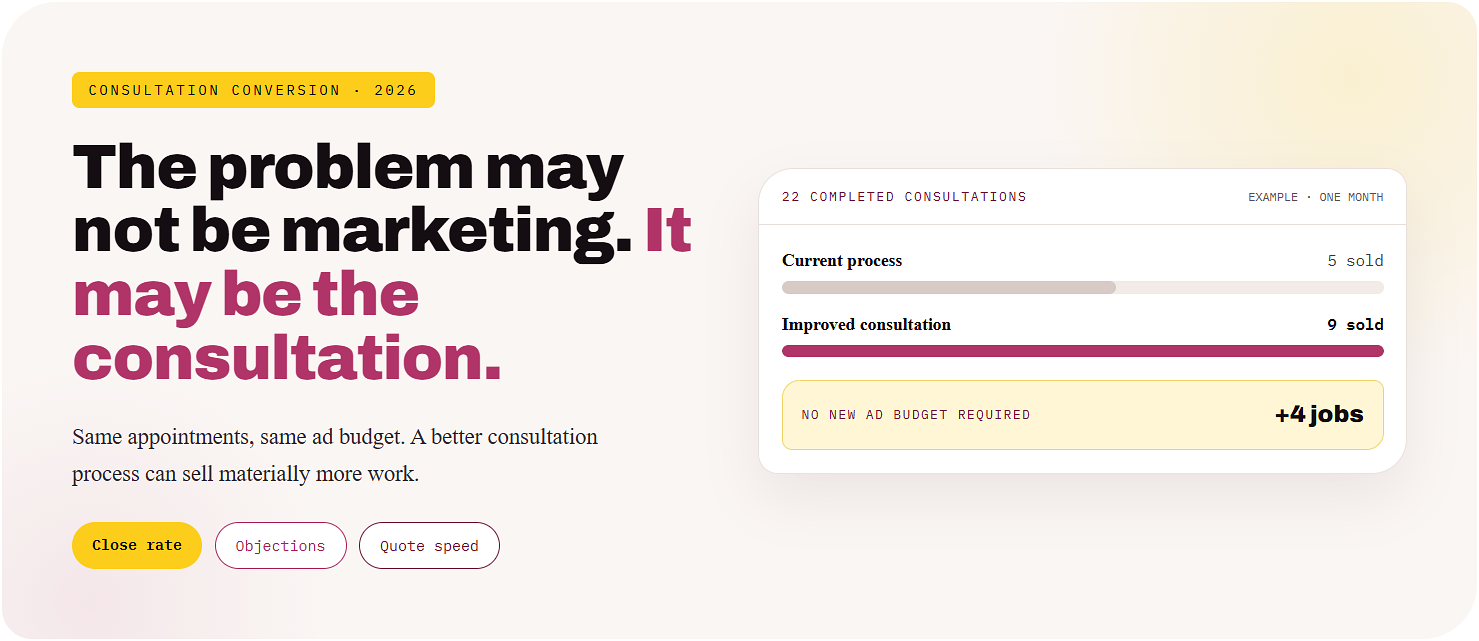
Imagine a company generates forty qualified inquiries in one month. Twenty five book consultations. Twenty two consultations actually happen. That sounds healthy. But if only five projects sell, the owner has a sales conversion problem somewhere between the appointment and the decision.
Now imagine the company improves the consultation process and sells nine projects from the same twenty two completed appointments:
No new ad budget was required. No new SEO campaign was required. The same demand created materially more revenue.
If the owner only sees lead count, cost per lead, and booked appointments, the most expensive leak in the funnel can remain hidden.
Start by Knowing Your Real Consultation Close Rate
Before changing scripts, discounts, products, or salespeople, establish the baseline.
That number should be reviewed carefully because the definition matters. Do not count appointments that were canceled or never happened. Do not mix commercial bids, designer relationships, small repair requests, and residential whole house consultations if their buying processes are very different. Do not treat every project size as identical.
The useful question is not simply “What is our close rate?” It is “Where is our close rate strong, and where is it weak?” Break the number down by consultant, lead source, product category, service area , project size, showroom versus in home appointment, and new customer versus referral where you have enough volume to make the comparison useful.
A 35 percent close rate may mean something completely different when the sources underneath it perform this differently.
The Consultation Starts Before Anyone Rings the Doorbell
A common mistake is treating the appointment start time as the beginning of the sales process. The consultation starts when the customer books. What happens between booking and arrival shapes confidence:
Uncertainty creates weak appointments.
A simple confirmation message can explain the appointment, identify the consultant, confirm the address and time, mention what the homeowner may want to think about beforehand, and make rescheduling easy. A short portfolio link can help them see relevant work. For a motorized shade consultation, the confirmation might also ask whether the homeowner uses a smart home platform or has particular windows they are concerned about.
The objective is not to overwhelm the customer with homework. It is to make the appointment feel organized before it begins.
If the lead came through the website, the same experience should already have started there. Strong Graphic and Web Design should prepare the homeowner for what the consultation involves rather than treating the form submission as the end of the website journey.
Do Not Walk Into the Appointment Blind
The consultant should know why the customer raised their hand. Before the appointment, review:
If the homeowner responded to a plantation shutters ad, the consultant should not arrive acting as if the product interest is unknown. If the lead came from a motorized shades page, the consultant should be ready for questions about controls, power, large openings, and integration.
This sounds basic, but disconnected systems create a poor customer experience. Marketing collects information. A coordinator books the appointment. The consultant arrives with little context and asks the homeowner to repeat everything.
The owner should treat that as a process failure.
CRM notes, lead routing, calendar details, and pre appointment reminders should give the consultant enough context to begin intelligently. AI Lead Management for Contractors can help with acknowledgment, routing, reminders, and information capture, but the goal is not automation for its own sake. The goal is a better prepared human conversation.
Sell the Problem Before You Sell the Product
Homeowners rarely wake up wanting a specific SKU. They want a room to feel better, look better, work better, or become easier to live in. The consultant should therefore understand the problem before presenting the solution. A homeowner may care about:
Those are buying problems.
If the consultant moves immediately into product samples, colors, and technical specifications, the conversation can become a catalog presentation. A stronger consultation connects the product to what the homeowner is trying to solve.
Ask questions that reveal how the room is used, what currently frustrates the homeowner, what matters most visually, whether light control or privacy is more important, how many rooms are part of the project, whether the project is part of a renovation, and what timing matters. The answers should shape the recommendation.
A premium window treatment company creates value through judgment, not just access to products.
Too Many Choices Can Make the Sale Harder
Window treatment businesses can offer an enormous number of fabrics, colors, control systems, materials, operating styles, and brands. That can be a competitive advantage, but it can also make the consultation harder to close.
The consultant does not need to show everything.
Once the homeowner's priorities are understood, narrow the field. Present a small number of options that genuinely fit the room, budget position, visual preference, and functional need. Explain why each option is being recommended.
Showing twelve unrelated product families can make the decision feel more complicated rather than more valuable.
The same principle applies to plantation shutters. Material, louver size, frame style, color, and panel configuration can all matter, but the consultant should guide the sequence instead of dropping every decision on the customer at once.
Owners should review whether their consultation process creates clarity or creates cognitive load.
Make the Recommendation Feel Specific to the Home
One of the strongest advantages of an in home consultation is context. Use it.
A generic pitch can be delivered anywhere. A useful consultation should connect the recommendation to the actual window, room, light, furniture, trim, architecture, lifestyle, and installation condition in front of the consultant.
Show how the product will interact with the space. Explain stack depth, light gaps, mounting position, privacy, control access, furniture clearance, or visual impact when relevant. For shutters, explain how panel layout and louver size affect the room. For motorization, explain what the customer will actually press, automate, charge, wire, or integrate.
This is where the owner earns differentiation from ecommerce and big box alternatives.
The customer should feel the business understands their home better after the visit than before it.
Use Real Project Proof at the Right Moment
Reviews and project photos should not live only on the website. Bring relevant proof into the consultation when it helps the decision.
The best proof is specific.
Saying “we do this all the time” is weaker than showing the result and explaining the challenge. A short story about how a similar homeowner solved glare, privacy, or a difficult opening can reduce uncertainty without turning the consultation into a long case study presentation.
Yay Blitz Case Studies follow the same principle in marketing. Proof becomes more persuasive when it connects a problem, a solution, and an outcome rather than simply displaying finished work.
Price Should Not Arrive as a Surprise at the End
Custom window treatments can involve substantial investment, especially for whole house projects, premium shutters, large motorized applications, or integrated smart home systems. If the first meaningful price conversation happens only after an hour of product discussion, both the consultant and homeowner can end up surprised.
The answer is not necessarily to publish exact prices for every product. Custom measurements, materials, controls, installation conditions, and project scope can make that impractical. The answer is to manage price expectations honestly throughout the buying process:
When appropriate, present more than one path. A good, better, best structure can help some buyers understand tradeoffs between manual and motorized operation, standard and premium materials, or one room and whole house scope. The options must be genuine, not artificial decoys.
The owner should review how often consultations fail because price expectations were never aligned early enough.
Do Not Discount Before You Understand the Objection
When a homeowner hesitates, many salespeople move too quickly toward price. That can destroy margin without solving the real problem.
Those are different objections.
The consultant should clarify what is holding the decision back before changing the offer. A useful response might be as simple as asking what part of the decision the homeowner still feels uncertain about. That question can reveal whether the issue is trust, product, timing, price, or decision process.
Owners should be particularly careful with automatic discount habits. If every quote is expected to close only after a discount, the business may be training both the sales team and customers to distrust the first price.
Make It Easy for Both Decision Makers to Participate
Window treatment purchases often affect shared spaces, budgets, and design preferences. A consultation can become difficult when one important decision maker is absent.
Do not use this as an excuse to pressure customers into having everyone present. Instead, make participation easier.
The goal is to reduce the number of decisions that have to be reconstructed from memory after the consultant leaves.
A consultation should create decision assets the household can actually use.
Quote Speed Matters Because Buying Momentum Fades
The customer is most engaged while the room, samples, conversation, and recommendation are fresh. If the quote arrives three days later with a generic line item and no context, the emotional and practical momentum of the consultation has already weakened.
Owners should measure quote turnaround time.
If the product and system allow accurate pricing during the consultation, presenting the proposal while the consultant is still there can shorten the decision cycle. If final pricing requires supplier checks or more complex configuration, explain when the proposal will arrive and meet that expectation.
Avoid making the homeowner decode internal product codes to remember what was discussed. A fast quote is valuable only if it is accurate and clear.
The Consultation Does Not End When the Consultant Leaves
Even an excellent appointment can require follow up. Some projects will close immediately. Others will need another conversation, a revised option, a spouse review, financing discussion, color confirmation, or time to compare bids. That is normal.
The mistake is treating every open quote the same way.
This is why the next article in this cluster will focus specifically on Window Treatment Quote Follow Up . For this article, the owner level point is simple: the consultation should end with a clear next step, not with “we will send something over.”
Measure the Appointment Like a Business Process
Owners should be able to follow the conversion path from booked appointment to revenue. A practical consultation dashboard can track:
This does not require a giant enterprise system. Start with data the business can reliably capture.
The important thing is consistency.
If one salesperson records every lost reason and another records nothing, the data will be misleading. If one source is correctly attributed and another is entered as “website,” channel comparisons will be weak. If closed jobs never make it back into the CRM, marketing will keep optimizing against incomplete information.
Google Ads can support qualified lead and converted lead goals when businesses send later outcomes back into the platform. That matters because a company generating paid consultations should eventually teach the system more about which inquiries become meaningful sales outcomes, not simply which people submit forms.
The broader PPC for Contractors strategy follows the same principle. Marketing should be connected to the stages that matter financially.
Do Not Judge Consultants Only by Close Rate
Close rate is important, but using it carelessly can create bad behavior.
Owners should compare context. Look at lead source, product mix, average job value, discounts, gross margin, cancellation rate, and customer experience alongside close rate. A very high close rate achieved by constant discounting may be less healthy than a slightly lower rate with better margins.
The objective is not to create a leaderboard. It is to understand which behaviors and conditions produce strong profitable outcomes.
Record Lost Reasons You Can Actually Act On
“Lost” is not enough. If a quote does not sell, capture a simple reason where possible. Useful categories might include:
Keep the list short enough that the team will actually use it. Over time, these reasons can show the owner where to investigate:
Lost reason data turns vague frustration into management information.
What I Would Review First if Consultations Are Not Closing
If an owner told me, “We are booking enough appointments, but sales are soft,” I would not immediately recommend more ad spend. I would review the last thirty to sixty completed consultations and compare what happened before, during, and after each one.
Then I would look for patterns.
That is how an owner turns a vague sales problem into a fixable operating problem.
Thirty two questions for your recent consultations
Use this checklist against your most recent completed consultations.
Measurement baseline
6 itemsBefore the appointment
6 itemsDuring the consultation
10 itemsQuotes & learning
10 itemsIf many of those answers are no, the company may not have a lead problem. It may have a visibility problem inside the sales process.
Frequently Asked Questions From Blinds and Shutters Owners
What is a good consultation close rate for a blinds company?+
Should we give pricing during the in home consultation?+
Should a spouse or partner be present for the consultation?+
How many product options should a consultant show?+
Should we offer discounts to close more consultations?+
What should we measure besides close rate?+
Can marketing improve consultation close rate?+
The Best Consultation Makes the Decision Easier
A strong window treatment consultation should not feel like a product dump or a pressure session.
It should make the homeowner's decision easier.
The consultant understands the room, identifies the real problem, narrows the right options, explains tradeoffs, shows relevant proof, sets realistic investment expectations, and leaves the customer with a clear proposal and next step. The company then tracks what happened instead of simply marking the appointment complete.
For the owner, that is the real opportunity. If the business already has demand, improving consultation conversion can create more sold work from the leads and appointments you are already paying to generate.
Yay Blitz helps blinds, shutters, and other local service businesses connect Paid Local Advertising, Local SEO vs Paid Ads, Graphic and Web Design, lead tracking, and AI Lead Management for Contractors into one measurable acquisition and conversion system.
If your consultation calendar is active but too many appointments are ending without a sale, start with a Free Strategy Assessment. We can review where the journey is breaking before you spend more money creating additional demand.
 Funnel Strategy
 Graphic & Web Design
 Paid Local Ad
 Marketing Strategy