

Plumbing is one of the most dependable home service trades to own. Pipes leak, drains clog and water heaters fail in every season, in every economy. Customers rarely shop around for long when water is on the floor, so the plumbing companies that answer fast, arrive on time and price clearly win most of the work.
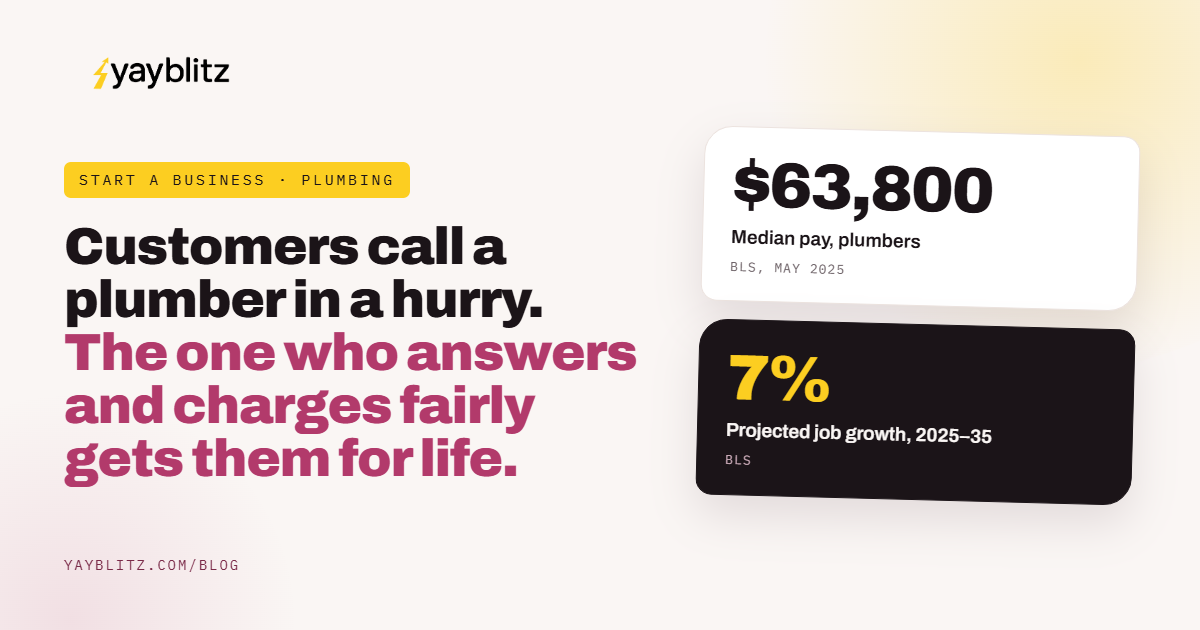
It’s also a trade with high barriers to entry. Most plumbers learn through an apprenticeship, and the U.S. Bureau of Labor Statistics notes that most states and localities require plumbers to be licensed. BLS reports a median pay of $63,800 in May 2025, with the top 10% earning more than $108,420. That licensing barrier protects licensed owners from some low-price competition, but it also means hiring takes planning.
This guide covers how to start a plumbing business step by step: master licensing, legal setup, insurance and bonding, vans, tools and startup costs, which services to offer first, flat-rate pricing, emergency and after-hours calls, permits, your website and Google Business Profile, your first customers and reviews, ads, lead response, software, memberships, hiring, common mistakes and a first-90-days plan.
To start a plumbing business, hold the contractor or master plumber license your state or city requires, register the business, carry general liability and any required bond, and equip a service van for the drain, water heater and repair calls you’ll run most.
Then build a flat-rate pricebook from your real costs, launch a fast website and a complete Google Business Profile, set up a plan for after-hours calls, answer every lead within minutes and ask every happy customer for a review.
Is Starting a Plumbing Business Worth It in 2026?
Yes. Plumbing demand is steady year-round, emergencies drive fast decisions and licensing limits competition.
BLS counts about 510,600 plumber, pipefitter and steamfitter jobs and projects 7% growth from 2025 to 2035, with around 42,000 openings a year. Aging homes, water heater replacements, remodels and new construction all keep demand steady.
The challenges are labor, cash flow and after-hours pressure. Skilled plumbers are hard to hire, emergency calls arrive at all hours and large jobs like repipes or sewer replacements need cash for materials before you’re paid. New owners who plan for those issues, rather than discovering them, are the ones who grow.
Water doesn’t wait. Neither do customers. Speed is your first competitive advantage.
What Licenses Do You Need to Start a Plumbing Business?
Usually a master plumber or plumbing contractor license, plus a business license and permits for regulated work.
Most plumbers learn the trade through an apprenticeship, then progress to journeyman and master levels. BLS notes that most states and localities require plumbers to be licensed. Running your own company typically requires a master plumber or plumbing contractor license, which often means years of documented experience, exams and proof of insurance.
Requirements vary widely. Some states license plumbers statewide, while others leave it to cities or counties. Many also require a separate license or endorsement for gas piping, backflow testing or medical gas. Check with your state licensing board before you advertise, and keep every license current and visible on your website and van.
- →Master or contractor license: required in most places to run a plumbing company
- →Business license: local registration to operate
- →Permits: water heaters, repipes, sewer and gas work often need permits and inspections
- →Specialty endorsements: gas piping, backflow testing and similar work in some states
How Should You Set Up the Business Legally?
Choose a business structure, register your name, get an EIN and keep business money separate from day one.
Most new plumbing businesses start as a sole proprietorship or a single-member LLC. An LLC can separate business and personal liability, which matters when you work in customers’ homes and on their property. The SBA compares the options in its guide to choosing a business structure, and a local accountant can help you pick the right one for your state.
Register your business name, apply for a free Employer Identification Number from the IRS and open a business bank account. Plumbing jobs mix low-ticket service calls with large projects. Tracking costs by job type from the start shows you which work is profitable and which just keeps you busy.
What Insurance Does a Plumbing Business Need?
General liability at minimum, plus commercial auto, tools and equipment cover, and workers’ compensation once you hire.
A failed fitting or a missed shut-off can flood a home. Water damage claims are expensive, so carry enough general liability coverage and ask your agent about the specific risks of plumbing work.
- →General liability: water damage, property damage and injuries
- →Commercial auto: every van and truck
- →Tools and equipment: jetters, cameras and tools on the van
- →Workers’ compensation: required in most states once you hire
- →License bond: required for licensing in many states and cities
The SBA’s guide to business insurance explains the main types. Get quotes from an agent who insures contractors, keep certificates ready to send and put “licensed and insured” on your website, truck and quotes once it’s true.
What Tools, Vehicle and Inventory Do You Need?
A well-organized service van, drain and diagnostic equipment, pipe tools and common repair parts on board.
The goal is to fix most problems on the first visit. Every return trip to the supply house costs time and lowers customer satisfaction, so stock the van with the parts you use most and organize it so anyone can find them.
- →Service van: shelving, bins and secure storage
- →Drain equipment: drum machine, hand augers and, later, a jetter
- →Inspection camera: for sewer and drain diagnosis
- →Pipe tools: cutters, press tools, threaders and torches
- →Common parts: valves, fittings, supply lines, fill valves, cartridges and wax rings
- →Water heater gear: dolly, fittings, venting and code-required parts
Add high-cost equipment like jetters and trenchless tools only when you have steady demand for that work.
How Do You Work Out Your Startup Costs?
List tools, vehicle, licensing, insurance, software, marketing and working cash, then get real local quotes for each line.
Startup costs for a plumbing business vary widely depending on whether you already own a work vehicle and tools, buy new or used, and start alone or with a crew. Rather than trusting a national average, build your own list and price every line locally.
Set up supply house accounts early, because terms on materials help when you take on larger jobs like repipes and sewer replacements. The SBA guide to funding your business covers loans, lines of credit and other options if you need them.
Which Plumbing Services Should You Start With?
Residential service and repair first: drains, water heaters, fixtures and leaks. Add larger and specialty work later.
Service work builds your customer list fastest. Drain cleaning, leak repair, toilet and faucet repairs and water heater replacements are common, easy to explain and create repeat customers. Each visit is also a chance to spot larger needs like old piping or failing sewer lines.
As you grow, add repiping, sewer line repair and replacement, water treatment, tankless water heaters, gas line work and backflow testing where licensed. Many new owners avoid new construction at first because margins are thin and payments can be slow.
How Should You Price Plumbing Work?
Use flat-rate pricing built from parts, average labor time, your fully loaded hourly cost, overhead and profit.
Flat-rate pricing gives the customer a clear price before you start. It avoids disputes about time, rewards efficient work and makes good, better and best options easy to present, such as repairing a water heater, replacing it with a standard tank or upgrading to tankless.
Your fully loaded hourly cost includes wages, taxes, insurance, vehicle, fuel, tools, software, office costs and unbillable time like driving and supply house runs. Many new owners set prices that only work if every hour is billed, which never happens. Our guide on pricing home services explains the full method.
A clear price up front is part of the service. Customers pay for certainty.
How Should You Handle Emergency and After-Hours Calls?
Decide your hours, set clear after-hours pricing and make sure every call is answered, even if you can’t go out.
Burst pipes, sewer backups and failed water heaters often happen at night and on weekends. Emergency work can be profitable, but it can also burn out a small team. Decide up front which hours you’ll cover, what qualifies as an emergency and how much more you charge after hours.
Even if you don’t take every night call, answer every one. A live answering service or AI receptionist can take details, give the customer a clear next step and book the first morning slot. Our guide to handling after-hours calls explains the options.
Do You Need a Website?
Yes. A fast site with service pages, service areas, real job photos, reviews, your license details and one-tap calling is enough to start.
Almost every customer checks the website before calling, even when they found you on Google Maps or through a referral. For plumbers, the site has one job: make it easy to trust you and contact you. Put the phone number at the top of every page, show your license and insurance, and use real photos of your work and your team rather than stock images.
Create one page for each main service, such as drain cleaning, water heaters, leak repair, sewer line work and repiping, plus pages for the towns you serve. Add your best reviews, a short story about you and a simple quote or booking form. Our plumbing website design guide explains which pages, trust signals and calls to action convert best.
How Do You Set Up Your Google Business Profile?
Create and verify it on day one, choose the most accurate category, list every service and service area, and keep adding photos and reviews.
Your Google Business Profile decides whether you appear in the map results when someone searches “plumber near me.” For many local service businesses, it produces more calls than the website. Set it up as a service-area business if customers don’t visit your location, and follow Google’s guidelines for representing your business so it isn’t suspended.
Pick the most accurate primary category, add every service you offer and the areas you cover, and upload real job photos every week. Reply to every review and answer questions. Our Google Business Profile guide for plumbers covers categories, services, photos and posts.
How Do You Get Your First Plumbing Customers?
Your network, local partners, a strong Google profile and fast response to every inquiry.
Early customers usually come from people who already trust you. Let friends, family and past contacts know you’ve started, and check any non-compete with your former employer before contacting their customers.
- →Partners: realtors, home inspectors, property managers, remodelers and HVAC companies
- →Property managers: steady repair work across many units
- →Google profile: complete, active and collecting reviews
- →Local visibility: wrapped van, door hangers near jobs, community groups
Our plumbing marketing guide covers the channels that produce booked jobs.
How Do You Get Reviews Early?
Ask every happy customer the same day, send a one-tap link and reply to every review.
Reviews often decide who gets the call. BrightLocal’s 2026 survey found 68% of consumers only use businesses rated four stars or higher, and 47% won’t use a business with fewer than 20 reviews. A new plumbing business needs to close that gap quickly.
Ask in person when the problem is fixed and the customer is relieved, then text a review link before you leave the driveway. Ask them to mention the service and their town, which naturally adds useful detail. Never pay or offer discounts for reviews. Our guide on how to get more Google reviews includes request scripts.
Should You Use Paid Ads When You Start?
Yes, once your profile, website and phone coverage are ready. Local Services Ads and focused Search ads work well for urgent plumbing searches.
Plumbing searches are often urgent, so paid ads can produce calls quickly. Local Services Ads charge per lead and show a Google Guaranteed badge. Search ads let you target specific services like “water heater replacement” or “drain cleaning” in your service area.
Use negative keywords to block DIY, parts and job searches, and track every call. Our guide to Google Ads for plumbers explains campaign structure and budgets.
How Fast Should You Answer Leads?
Within minutes. Customers often contact several companies and hire the first one that responds clearly.
A widely cited Harvard Business Review study found that firms contacting leads within an hour were about seven times more likely to qualify them than firms that waited longer. For plumbing, the window is often minutes, not hours. A customer with water on the floor will call the next plumber if you don’t pick up.
Set up an instant text reply for missed calls and form submissions, block time between jobs to call back and track how long each lead waits. Our speed-to-lead guide and our guide to an AI receptionist show simple systems for small teams.
What Software Do You Need?
Field service software for booking, dispatch, a pricebook, invoicing, payments and follow-ups.
Software helps you schedule and dispatch calls, present flat-rate options on a tablet, take payment on site, store photos and send review requests and reminders automatically. It also gives you numbers like average ticket and close rate.
Look for an easy mobile app, a built-in pricebook, membership tracking and integration with call tracking. Our guide to plumbing CRM explains what to look for.
How Do Memberships Help a Plumbing Business?
They create recurring revenue, keep you first in line for repairs and build loyalty.
A plumbing membership might include an annual inspection, water heater flush, priority scheduling and repair discounts. It gives customers a reason to stay with you and gives you scheduled work and predictable income.
Offer membership on every service call and track renewals. Our guide to service agreements for contractors explains pricing and selling plans.
When Should You Hire Your First Plumber?
When you’re regularly booking customers days out or turning down calls, and cash flow can support another wage.
With strong demand for licensed plumbers, hiring can take time. Start recruiting before you’re desperate. Many owners hire an apprentice or helper first, which boosts productivity and builds future talent.
Offer fair pay, training, a clean vehicle, reliable schedules and a path to advance. Check licensing rules for supervising apprentices in your state.
What Mistakes Do New Plumbing Businesses Make?
Underpricing, missed calls, no cash for materials, weak follow-up and no recurring revenue.
- →Underpricing: hourly rates that don’t cover the true cost of an hour
- →Missed calls: emergencies go to the plumber who answers
- →No material cash: taking large jobs without the cash to buy materials
- →No memberships: no recurring revenue or loyalty
- →Skipping permits: risking fines, failed inspections and liability
- →No tracking: not knowing which marketing brings booked jobs
What Should Your First 90 Days Look Like?
Get licensed and equipped, win your first customers and reviews, then add systems and memberships.
By day 90, track your average ticket, close rate, calls answered and cost per booked job by source. Those numbers show where to invest next.
The 16-point plumbing startup checklist
Tick what you already have. The first unticked items are your next moves.
Licensing and legal
4 itemsOperations
4 itemsMarketing
4 itemsGrowth
4 itemsFrequently Asked Questions
How much does it cost to start a plumbing business?+
Do you need a license to start a plumbing business?+
How much do plumbers make?+
How should a new plumbing company price its work?+
How do new plumbing companies get customers?+
Should a new plumbing company offer 24/7 service?+
What services should a new plumbing business offer?+
Is plumbing a good business to start?+
Build the Plumbing Company People Call First
Get licensed, price clearly, answer every call, show up when you say you will and turn one-time fixes into members. That combination builds the reputation that keeps a plumbing company busy for decades.
Fix it right, price it fair and pick up the phone. That’s the brand.
Yay Blitz helps plumbers businesses connect Graphic and Web Design, Paid Local Advertising, and AI Lead Management into one measurable system for getting and converting leads.
Want a second opinion? Book a Free Strategy Assessment. We’ll review your website, Google profile and lead follow-up and show you where your next customers are coming from.
 Funnel Strategy
 Graphic & Web Design
 Paid Local Ad
 Social Media Marketing