

An AC dies at 9 p.m. in July. The homeowner searches, taps the first number, and hears a voicemail greeting. They don’t leave a message. They tap the next number.
That isn’t a guess. Invoca’s home services platform data shows fewer than 3% of callers pushed to voicemail leave a message. For HVAC, where the most urgent and often most valuable calls arrive at night and on weekends, voicemail is close to the same as not answering.
This guide lays out an after-hours system you can actually run: coverage options, simple triage rules, a fair on-call rotation, pricing that respects your techs, and a morning booking routine for everything that can wait. Figures for any company are illustrative.
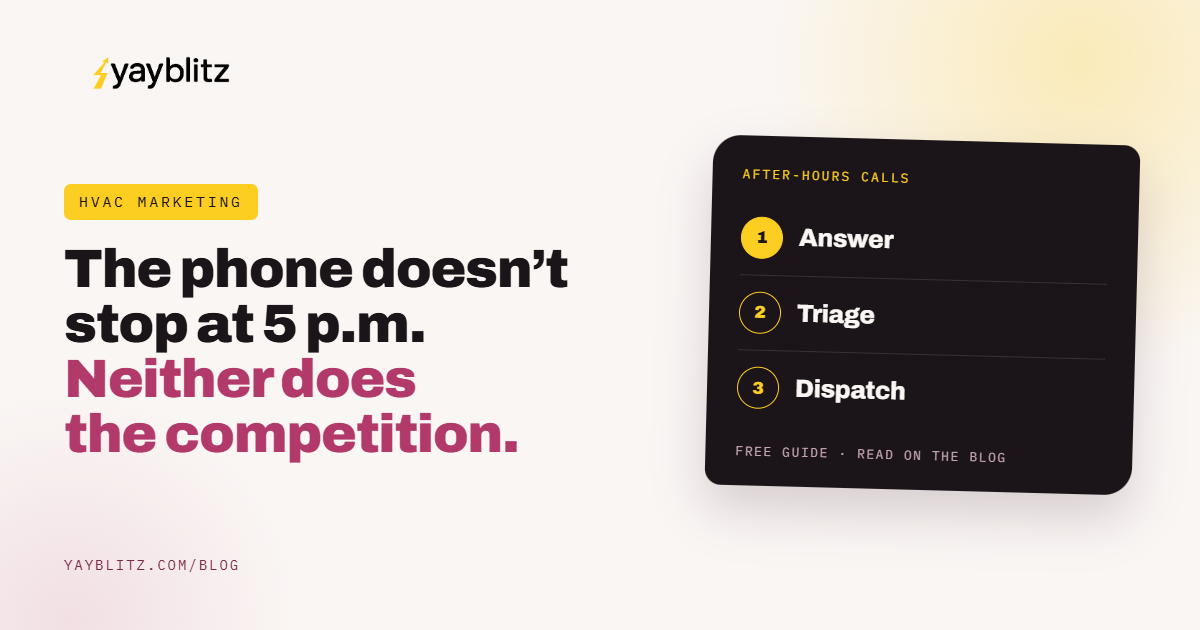
Answer every after-hours call live, with your own team, a trained answering service, or an AI receptionist that books into your schedule and escalates urgent calls.
Triage with written rules: no heat in freezing weather, no cooling for vulnerable people in extreme heat, and safety issues get dispatched; everything else gets the first morning slot.
Why Do After-Hours Calls Matter for HVAC?
Breakdowns don’t keep office hours, the callers are often ready to book now, and the first company that answers usually gets the job.
Invoca’s research found 27% of calls to home services businesses go unanswered overall, and the gap tends to be widest outside business hours when nobody is at the desk.
After-hours callers aren’t browsing. Someone calling at 10 p.m. about a system that stopped working has a problem now. Even if you can’t send a truck tonight, answering and booking them for 8 a.m. usually wins the job.
These calls also tend to lead to bigger work. A failed system on an old unit often becomes a replacement conversation. The company that answered at night is the one invited back to quote it.
What Are the Options for Covering After-Hours Calls?
Your own on-call staff, a trained answering service, an AI receptionist, or a mix. The right choice depends on call volume, budget, and how well each option can book into your system.
Whatever you choose, test it. Call your own number at 11 p.m. on a Saturday and see what a customer hears. Do it once a month in peak season.
The weakest option is “the on-call tech answers.” Techs on a job can’t pick up, and a tired tech at midnight doesn’t give the best phone experience. Our AI receptionist guide covers what automation can and can’t handle.
Which After-Hours Calls Should Get a Truck Tonight?
Decide in advance with written triage rules based on safety, weather, and who lives in the home. Don’t leave the call to whoever answers.
Adjust these rules for your climate and service area. Write them down, put them in front of whoever answers, and review them before each season.
For gas smells and carbon monoxide alarms, your call script should always tell the caller to leave the home and contact their gas utility or emergency services first. Your company follows up after they’re safe.
How Should You Price After-Hours HVAC Service?
Charge a clear after-hours or emergency fee that’s worth it for your techs, say it plainly on the call, and offer the first morning slot at standard rates as an alternative.
Prices above are placeholders; use your own. Offering both options lets callers choose based on their situation. Many will take the morning slot, which protects your techs’ evenings without losing the job.
After-hours pricing should cover overtime, on-call pay, and the real cost of a tech’s night. Shops that underprice it find their best people quitting the on-call rotation.
Reduced after-hours fees are also one of the easiest maintenance plan benefits to explain. Our service agreements guide covers plan design.
How Do You Build a Fair On-Call Rotation?
Rotate weekly, cap the number of night dispatches per tech, pay on-call time and call-outs fairly, and have a backup when volume spikes.
The rotation is a retention issue as much as a service issue. Techs talk. A shop known for fair on-call rules hires more easily, which our HVAC technician recruiting guide covers in detail.
What Should After-Hours Callers Hear?
A live greeting with the company name, empathy, clear safety guidance when needed, a simple triage question set, a clear price, and a confirmed time.
If an answering service or AI receptionist handles the first pickup, give them the same flow. A caller shouldn’t notice which system answered.
How Do You Turn Night Calls Into Morning Jobs?
Book them into reserved first-slot windows, confirm by text the same night, and call or text again early in the morning before competitors open.
Reserving morning slots matters. If the board is already full when the night caller gets booked, “first thing tomorrow” becomes “Thursday,” and the caller goes elsewhere.
How Should After-Hours Coverage Connect to Marketing?
Only advertise 24/7 service if you actually answer 24/7. Match ad schedules to your coverage, and track after-hours calls as their own source.
If your Google Ads say “24/7 emergency service,” your phones must answer at 2 a.m. If they don’t, you pay for clicks and lose the calls. Our Google Ads for HVAC guide covers ad scheduling by hour.
Your Google Business Profile hours should match reality too. Listing 24-hour service while sending calls to voicemail invites bad reviews. See our Google Business Profile for HVAC guide.
Track after-hours calls separately in call tracking. Many shops find nights and weekends book a valuable share of their replacement leads, which changes how they think about coverage costs.
What Are the Most Common After-Hours Mistakes?
Voicemail, techs answering their own phones, no triage rules, unclear pricing, no reserved morning slots, and advertising 24/7 without real coverage.
Fixing just two of these, live answer and reserved morning slots, often recovers a meaningful share of after-hours demand.
What Should You Track for After-Hours Calls?
After-hours call volume, answer rate, booking rate, share dispatched tonight versus booked for morning, revenue from those jobs, and on-call hours per tech.
Review monthly in peak season. If after-hours revenue far exceeds coverage costs, it’s a case for adding a second on-call tech or extending live coverage. Our HVAC booking rate guide covers the daytime side of the same scorecard.
A Worked Example: One July Weekend
Using illustrative numbers, a shop that moved from voicemail to live answer and reserved morning slots turned a weekend of lost calls into a full Monday board.
Picture a six-truck HVAC company in a hot market. Before the change, after-hours calls went to a voicemail greeting and the on-call tech checked messages every couple of hours. Over one July weekend, call tracking showed 46 calls between Friday at 6 p.m. and Monday at 7 a.m. Only four callers left a message. Two of those had already booked elsewhere by the time the tech called back.
The owner made three changes. First, an answering service trained on the company’s call flow picked up every after-hours call and booked directly into the schedule. Second, written triage rules decided which calls got a truck that night. Third, the office held the first two morning windows open every weekday through August.
The next hot weekend brought a similar 44 calls. The service answered all of them. Six met the triage rules and were dispatched that night at the after-hours rate. Twenty-three booked into reserved morning slots at standard rates. The rest were tune-up requests, existing customers, or callers outside the service area. Monday started with a full board instead of a pile of voicemails, and two of the morning visits turned into replacement estimates.
These figures are illustrative, but the pattern is common. The value wasn’t in running more trucks at night; it was in answering, deciding quickly, and booking the rest before the caller called someone else.
Twenty questions about nights and weekends
Answer yes or no. Every no is a place after-hours calls may go to a competitor.
Coverage
5 itemsPrice & book
5 itemsTriage
5 itemsTeam & tracking
5 itemsIf several answers are no, start with a live answer and reserved morning slots. That's fixable.
Frequently Asked Questions About HVAC After-Hours Calls
Should HVAC companies answer calls 24/7?+
How many callers leave a voicemail?+
What counts as an HVAC emergency after hours?+
How much should HVAC companies charge after hours?+
Is an answering service or AI receptionist better?+
How do you prevent on-call burnout?+
Should we reserve morning slots for after-hours callers?+
How do after-hours calls affect marketing?+
Answer Tonight. Fix It Tonight or First Thing Tomorrow.
After-hours calls are some of the most urgent and valuable calls an HVAC company gets. A live answer, clear triage rules, honest pricing, and reserved morning slots turn them into booked work without burning out your team.
No voicemail. Clear rules. First slot tomorrow.
For related guides, see the HVAC Growth Playbook, HVAC booking rate, and AI receptionists for service businesses.
Yay Blitz helps HVAC companies connect Graphic and Web Design, Paid Local Advertising, and AI Lead Management into one measurable system for getting and converting leads.
If night and weekend calls are slipping away, start with a Free Strategy Assessment. We’ll review your coverage, triage rules, and how after-hours calls flow into booked jobs.
 Funnel Strategy
 Graphic & Web Design
 Paid Local Ad
 Social Media Marketing