

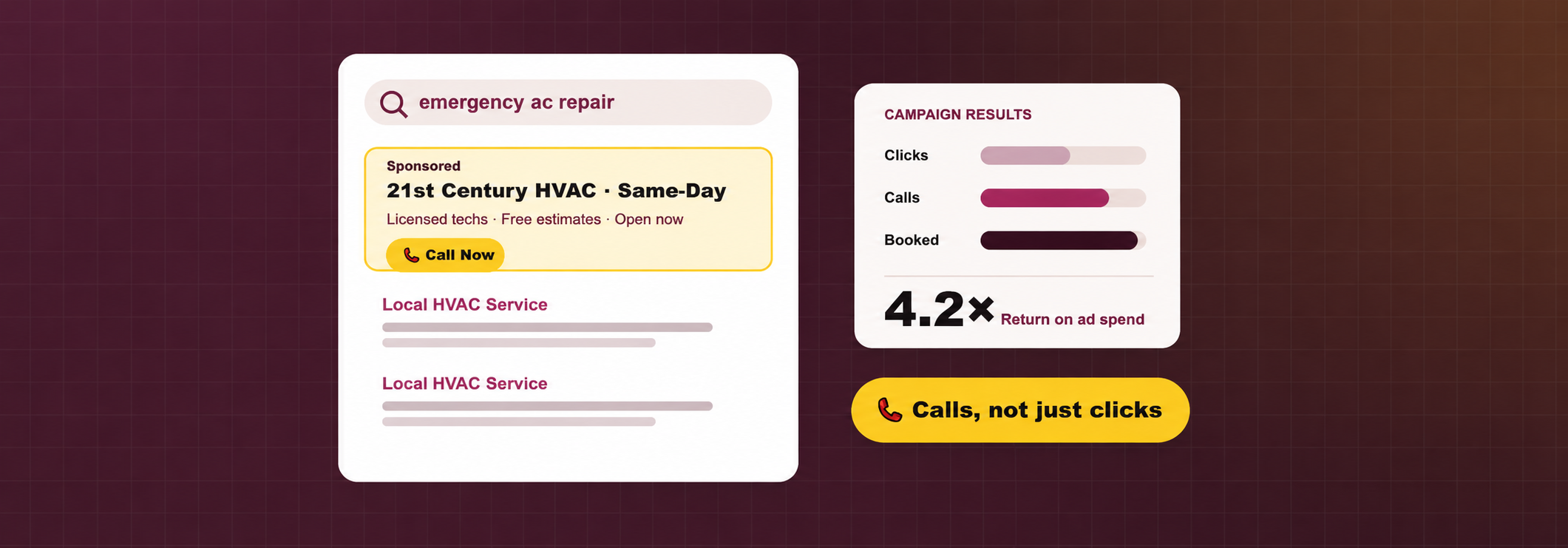
Google Ads can put an HVAC company in front of a homeowner at exactly the moment a heating or cooling problem needs solving. Someone searching for AC repair on a hot afternoon or furnace repair during a cold night is not browsing marketing content. They are looking for a company that can help.
That level of intent is what makes Google Ads attractive for HVAC contractors, and what makes the market competitive. Multiple local companies may bid for the same customer, and every click costs money whether that visitor books a job or disappears in five seconds.
The difference between a profitable campaign and an expensive one usually comes down to more than the ads. Campaign structure, search terms, location targeting, landing pages, call handling, conversion tracking, and follow up all decide whether ad spend becomes booked work. If you are already generating clicks without enough calls, a bigger budget is rarely the first fix, you need to find where the money is being lost.
Why Google Ads Work So Well for HVAC
HVAC is a strong fit for paid search because much of the demand already exists. Google Ads does not need to convince someone a broken air conditioner is a problem, the homeowner already knows, and is actively looking for a solution. Instead of interrupting someone who may need service eventually, you reach customers searching for AC repair, furnace service, replacement, or heat pump installation right now.
The challenge is that not every HVAC search has the same commercial value, and successful campaigns account for those differences instead of treating every keyword as equally valuable. Our broader guide to PPC for Contractors explains why paid campaigns fail when targeting, conversion, and lead handling are treated as separate problems.
Low Commercial Value
Research, not hiring. Paying for this click rarely makes sense. Win it organically through content instead of ad budget.
High Commercial Value
A homeowner ready to hire. This is exactly where paid budget belongs, matched to a service ad and a dedicated page.
Start With the Services You Actually Want to Sell
Before building campaigns, decide which services deserve the budget. An HVAC company may provide dozens, but that does not mean each needs equal promotion. Priorities should reflect job value, margins, capacity, seasonality, technician availability, and the customers you want. AC repair can drive high call volume in summer, while complete replacement produces fewer leads at much higher revenue per job.
These services should not automatically share one campaign. Separating AC repair, heating repair, replacement, heat pumps, and other categories gives you control over budgets, search terms, messaging, and measurement, so you can make decisions on real results, not one blended average.
The goal is not hundreds of campaigns. It is enough separation that you can see which services produce results and control the budget accordingly. Within each, closely related searches stay grouped so the ad and landing page match what the customer typed.
Buying-Intent Keywords
Focus on the language customers use when they want a contractor. Informational terms need caution. This is where HVAC SEO earns free visibility, paid budget belongs on commercial intent.
Negative Keywords
Choosing what not to pay for matters as much as targeting. Review the search terms report regularly, but block carefully. Too aggressive and you cut real customers along with the waste.
Location Targeting Should Match the Real Service Area
A lead that looks excellent inside Google Ads is worthless if the customer lives too far for your technicians to serve efficiently. Campaign geography should reflect where you can realistically accept jobs, a primary city, selected suburbs, ZIP codes, or defined service areas. And the same geography does not fit every service: you may travel farther for a full system replacement than for a low-value maintenance call. Marketing has to stay tied to the economics, generate leads you can profitably service, not just leads willing to submit a form.
Seasonality Should Influence Your Budget
Demand shifts with weather and season. A campaign that runs comfortably in a mild month faces very different competition when temperatures spike. That does not mean changing budgets every few degrees, it means understanding how demand behaves in your market. In peak periods, lean into profitable repair services; in slower ones, shift toward maintenance, replacements, indoor air quality, or heat pumps. Let performance and business capacity drive the decision, not a generic seasonal calendar.
Don't Send Every Ad to the Homepage
The click is only the beginning. If someone searches for AC repair and lands on a general homepage covering heating, cooling, air quality, maintenance, financing, and company history, they have to work to find what they wanted. A dedicated landing page continues the conversation the search started, it doesn't need to be complicated, it needs to remove uncertainty.
Our upcoming HVAC Landing Pages guide goes deeper on conversion, while Yay Blitz Graphic and Web Design builds pages designed around calls, inquiries, and bookings.
Call Handling Is Part of Ads Performance
A campaign can be working correctly inside Google Ads while the business believes the advertising is failing. The customer clicks, calls, nobody answers, and there's no immediate response, so they return to Google and call the next company. The platform recorded an opportunity; the contractor sees budget that produced nothing.
This is why lead response is part of paid-media performance. Our article on AI Lead Management for Contractors covers how automated follow up responds when staff can't reach every inquiry, especially for leads that arrive after hours or during heavy demand. The strongest campaign cannot compensate for a broken lead-handling process. Before increasing spend, make sure someone owns answering calls, responding to forms, and tracking what happens to each lead.
Don't Scale Before Fixing Conversion
Increasing a budget generates more traffic, and it magnifies whatever is already happening. Poor location targeting buys more irrelevant clicks. A weak landing page pays for more visitors who leave. Missed calls create more opportunities nobody handles. Scaling should come after the basic economics make sense. Review the entire path first, the weakest point limits the whole campaign.
This is why Yay Blitz treats paid advertising as part of a broader growth system. Our Paid Local Advertising service connects targeting, creative, conversion, and optimization around business outcomes, not clicks alone.
Google Ads and HVAC SEO Support Each Other
Google Ads creates visibility immediately for important services. SEO takes longer but builds organic visibility that keeps bringing customers over time. Paid-search data also reveals which services, offers, and pages produce response, insight SEO can then expand on without paying for every visit. A business with both channels working is less dependent on a single source of demand. For a broader comparison, read Local SEO vs Paid Ads for Service Businesses , and for the full picture, our HVAC Lead Generation guide.
Common Google Ads Mistakes
Most wasted spend is not one bad setting. It is usually several smaller problems together. Campaigns target too many services at once. Keywords attract research traffic instead of buyers. Search terms go unreviewed. Negative keywords are ignored. Ads send every visitor to the homepage. Geography extends past the profitable service area. Calls are missed. Tracking measures form fills without showing whether leads became customers.
Another mistake is deciding too quickly, whether that is seeing an expensive click and assuming the keyword is bad, or a cheap lead and assuming the campaign works. Neither has enough context alone. Decisions should use meaningful data and business outcomes. The objective is not the cheapest click, or even the cheapest lead, it is acquiring customers at a cost that makes financial sense.
Frequently Asked Questions
Do Google Ads work for HVAC companies? +
What keywords should HVAC companies use? +
Should HVAC companies use broad match keywords? +
What are negative keywords in HVAC Google Ads? +
Should HVAC Google Ads go to the homepage? +
Is Google Ads better than SEO for HVAC companies? +
Turn HVAC Ad Spend Into Booked Work
Google Ads gives HVAC companies access to some of the strongest buying intent online, but access to demand does not automatically create profitable growth. A successful campaign connects the right service with the right search, shows a relevant message, sends the customer to a page that builds confidence, makes contacting the business easy, and ensures the lead gets a fast response. When any one piece fails, advertising gets more expensive. The best place to start is rarely a larger budget, it is a clearer understanding of everything between the search and the booked job.
Yay Blitz helps HVAC and other local service businesses build the complete system, spanning paid advertising, conversion-focused design, lead strategy, and optimization, to turn spend into qualified calls and measurable growth. Start with a free strategy assessment to find where your advertising is losing money before you spend more.
 Funnel Strategy
 Graphic & Web Design
 Paid Local Ad
 Marketing Strategy