

Most homeowners are not searching for plantation shutters today. They will be in a few months, after a hot afternoon in the living room or a move into a new house. Facebook and Instagram are where you can reach them before that search happens.
That is the opportunity, and also the trap. Meta makes it easy to generate a large number of inexpensive leads. Many window treatment owners try it, get a flood of names, and then discover that half of them do not answer the phone and the rest were browsing.
Facebook Ads do not fail because the leads are bad. They fail because the system around the leads was never built.
This guide explains how blinds, shades, and shutters companies can use Meta ads to create demand, filter for real buyers, and measure success by booked consultations instead of cost per lead.
Search Captures Demand. Facebook Creates It.
Google Ads reach people who are already looking. Someone types “shutters near me,” sees your ad, and calls. That intent is why Window Treatment PPC usually produces the highest quality leads.
Facebook and Instagram work differently. Nobody opens Instagram to shop for roller shades. Your ad interrupts them, which means it has to do two jobs at once:
Treat Meta as a demand creation channel with a longer runway, not a cheaper version of Google. Owners who expect search level intent from social leads are usually the ones who decide “Facebook doesn't work.” For the broader trade off, see Local SEO vs Paid Ads.
Who You Are Really Trying to Reach
Meta's detailed targeting options have narrowed over the years, and its algorithm now does much of the audience finding on its own. What you still control is geography and the signal you feed it.
The geographic piece connects directly to location based marketing. A tight, profitable service map usually beats a broad radius that wastes spend on long drives and small orders.
Creative Is the New Targeting
When the algorithm chooses the audience, the ad itself decides who stops scrolling. A luxury motorized shade video attracts a different homeowner than a “blinds from $49” graphic. In window treatments, the formats that tend to work are the ones that show real homes:
Real install footage, shot vertically on a phone, often outperforms polished brand imagery because it looks like a neighbor's home. Product specific creative pays off too. The angles in Motorized Shades Marketing and Plantation Shutters Marketing translate directly into ad concepts.
Offers That Earn a Consultation
“Free in home consultation” is the default offer, and every competitor uses it. It still works, but it works better when the ad explains what the homeowner actually gets from the visit.
Avoid deep discount hooks that attract price shoppers you cannot profitably serve. Timing offers to install lead times and the calendar is covered in Window Treatment Seasonal Marketing.
Instant Forms or Landing Pages
Meta's instant forms open inside the app with the homeowner's details already filled in. Landing pages send them to your website. Both can work. They produce different kinds of leads.
Many companies run both and compare cost per booked consultation, not cost per lead. If you use landing pages, the structure in Blinds Website Design applies: one offer, real project photos, reviews near the form, and a short form that works on a phone.
Filter for Quality Before the Lead Arrives
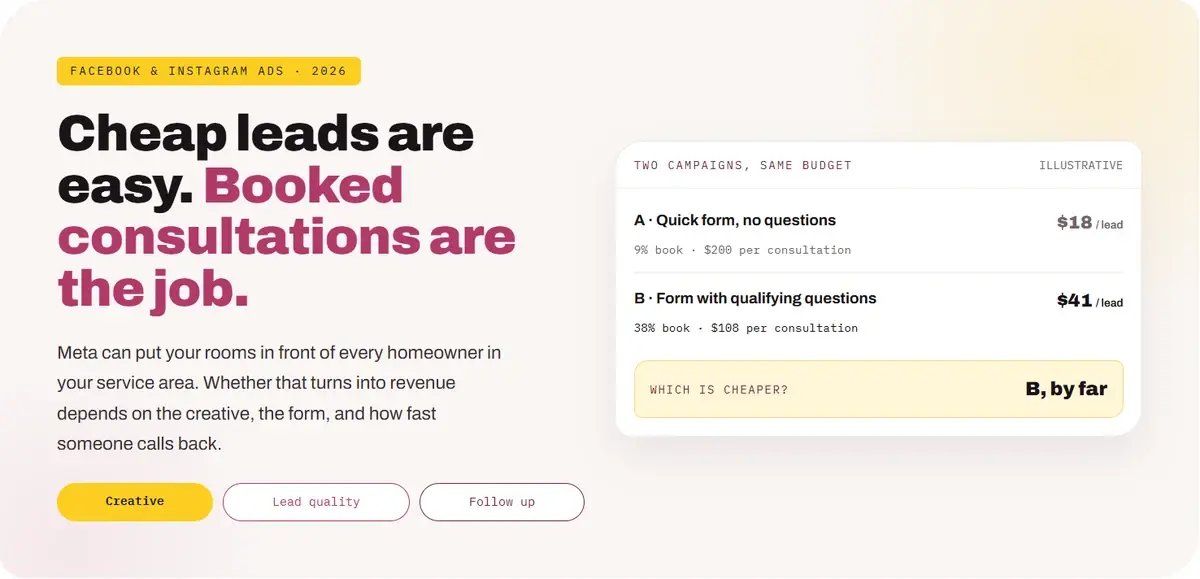
A little friction is healthy. Two or three well chosen questions cost you some volume and save your schedulers hours of chasing people who were never going to buy.
A lead you can't book is not a cheap lead. It's an expensive one.
Meta also offers a higher intent form setting that adds a review step before submission. It usually raises cost per lead and lowers junk submissions. Test it against the standard form and judge by booked appointments.
Speed to Lead Decides the Return
A social lead is warmest in the minutes after they submit, while they are still holding the phone. An hour later they are back to scrolling, and the next day many will not remember filling anything in.
This is where most Facebook budgets are won or lost. Lead Follow Up for Contractors covers the cadence in detail, and AI Lead Management for Contractors shows how to respond instantly even after hours.
Retarget the Homeowners Who Almost Booked
Window treatment decisions take weeks. Many people visit your site from a Google search, look at a gallery, and leave. Retargeting keeps your company in view while they decide, and it is often the most efficient spend in the account.
Good retargeting audiences include website visitors, people who watched most of a video ad, and people who opened a form but did not submit. Show them something new rather than the same ad again: a review from their area, a finished project in a similar home, or a reminder of a seasonal deadline.
Retargeting also supports open proposals. Pair it with the sequence in Window Treatment Quote Follow Up, and surface strong testimonials from your review profile so the homeowner sees proof, not pressure.
Budget and Testing Without Waste
Most small accounts fail by testing too many things at once. The budget gets split so thin that nothing gathers enough data to learn from. A simpler structure learns faster:
Change one thing at a time, and resist editing ads every few days. Refresh creative when performance fades, not on a schedule. Set your budget from the number of consultations your team can actually run, then work backward from a realistic cost per booked appointment.
Measure Booked Consultations, Not Cheap Leads
Meta's dashboard reports leads. Your business runs on appointments, sales, and revenue. Connect the two by tracking every Facebook lead through to its outcome:
In this illustrative example, the campaign with the cheapest leads is the most expensive way to fill the calendar. Getting this view requires lead source tracking in your CRM, and ideally sending booked and sold outcomes back to Meta so delivery improves over time.
Where Meta Fits in Your Marketing
Facebook Ads perform best when the rest of the system is already in place. A homeowner who sees your ad will often search your name before responding. What they find decides whether the ad pays off.
That full picture is laid out in Window Treatment Marketing, and the sales side in Window Treatment Consultation Conversion. Ads without those pieces tend to pay for leads that someone else eventually closes.
What to Review First
Pull the last ninety days of Facebook and Instagram leads from your CRM or inbox. Then ask:
Most owners find the problem is not the platform. It is slow follow up, an unfiltered form, and no view past the lead. Each is fixable in weeks.
Twenty questions for your Meta account
Use this checklist against the last ninety days of social leads.
Audience and creative
5 itemsOffer and form
5 itemsFollow up
5 itemsMeasurement
5 itemsIf many of those answers are no, the platform is not the problem. The system around it is.
Frequently Asked Questions From Blinds and Shutters Owners
Do Facebook Ads work for window treatment companies?+
Should we use Facebook Ads or Google Ads?+
Why are our Facebook leads low quality?+
Are instant forms or landing pages better?+
What kind of ads work best for blinds and shutters?+
How should we measure Facebook Ads success?+
Build the System, Then Scale the Spend
Facebook and Instagram can reach every homeowner in your market long before they search. That reach only pays off when real install creative, a filtered form, and fast follow up are already in place.
Judge every campaign by the consultations it fills, not the leads it counts.
Get those pieces right and Meta becomes a dependable source of blinds leads that complements search instead of competing with it. For more on why ad accounts underperform, see PPC for Contractors.
Yay Blitz helps blinds, shutters, and other local service businesses connect Paid Local Advertising, Graphic and Web Design, and AI Lead Management for Contractors into one measurable acquisition and conversion system.
If your Facebook leads are plentiful but your calendar is not, start with a Free Strategy Assessment. We will review your Meta campaigns, forms, and follow up, and show where leads are being lost between the click and the consultation.
 Funnel Strategy
 Graphic & Web Design
 Paid Local Ad
 Marketing Strategy