

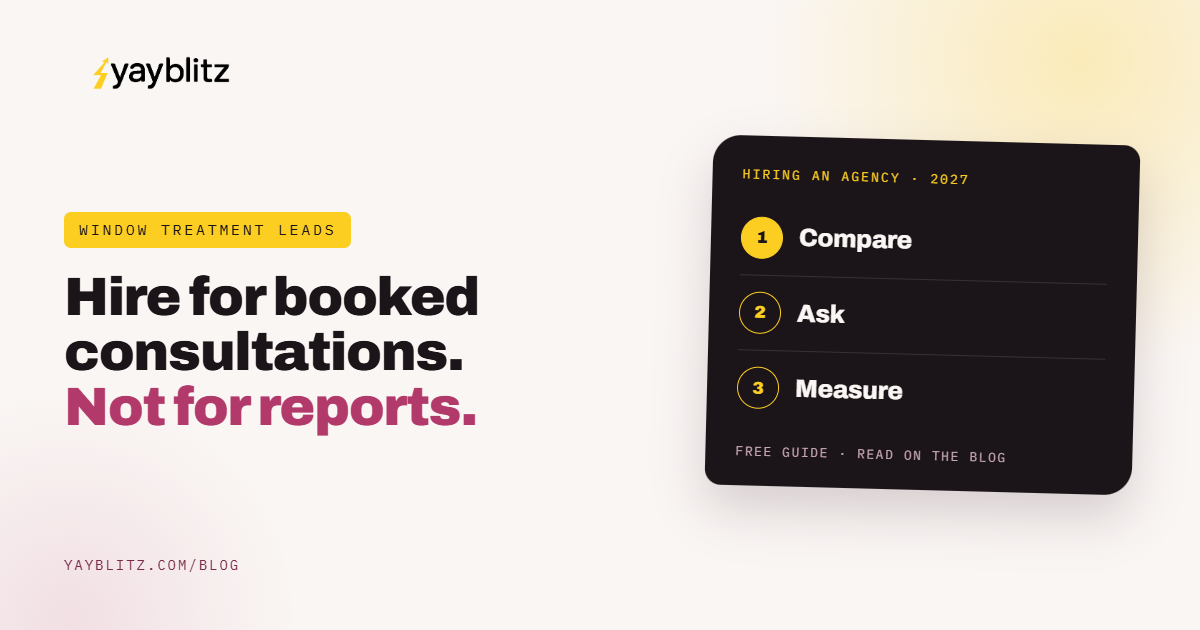
Most dealers hire their first agency after a bad month. The phone slowed down, a competitor’s ads showed up everywhere, and someone promised “more leads.” Six months later there are reports full of impressions and clicks, and the designers’ calendars look about the same.
That’s rarely because the agency is dishonest. It’s usually because nobody agreed up front on what success means for a window treatment business: booked in-home consultations and signed orders, measured by source, at a cost the business can afford.
This guide helps you choose well. It covers when an agency makes sense, how pricing works, what to ask, the red flags, contract terms that protect you, and a 90-day scorecard to judge any partner, including us.
When Does a Window Treatment Dealer Need an Agency?
When you have a clear growth constraint you can’t fix in-house, such as weak search visibility, ads that bring the wrong leads, or no reliable tracking, and the time or skills to fix it aren’t on your team.
Owners of blinds and shutter companies usually wear several hats already: sales, scheduling, installs, vendor relationships. Marketing tends to get whatever time is left, which is rarely enough to run search ads well, keep a Google profile active, and build tracking that tells you what works.
An agency isn’t the answer if the main leak is inside the business, for example leads waiting hours for a call or quotes that never get followed up. More leads into a slow process cost more and change little. Our Dealer Growth Playbook shows how to find your weakest stage first.
Agency vs. Freelancer vs. In-House: Which Fits?
Agencies offer breadth and continuity, freelancers offer specialist skills at lower cost, and in-house hires offer focus and company knowledge. Many dealers combine an in-house coordinator with an agency or specialists.
A practical split for many growing dealers: an in-house person owns reviews, photos, social posts, and CRM hygiene, while an agency owns paid search, SEO, tracking, and reporting. That keeps local knowledge inside and specialist work outside.
What Should a Window Treatment Agency Actually Do?
Connect the full system: Google Business Profile, website, search and paid demand, call tracking and attribution, lead response, follow-up, and a monthly report on cost per booked consultation.
Not every agency needs to do all of this. But every agency should understand how its work connects to the rest. An agency that only runs ads and never asks how fast your team calls leads back is optimizing half the system.
How Much Does a Marketing Agency Cost?
It depends on scope and ad spend. Agencies usually charge a monthly retainer, a percentage of ad spend, a project fee, or a mix. Ad spend is almost always billed separately and paid to the platform.
Avoid comparing proposals on fee alone. A cheaper agency that only reports clicks can cost more per booked consultation than a pricier one that fixes tracking and follow-up.
Work out what you can afford using the same math as your marketing budget. Our marketing budget guide for blinds companies shows how to set the total, and the agency fee should be part of that total, not on top of it.
What Questions Should You Ask Before You Sign?
Ask how they measure success, who does the work, what they’ve done for similar dealers, what you’ll own, and what happens in the first 90 days.
Write down each agency’s answers. The differences show up quickly once you compare them side by side.
What Are the Red Flags?
Guaranteed rankings, reports with no link to booked jobs, owning your accounts, long lock-in contracts, vague scopes, and no questions about your sales process.
One more: an agency that blames your team for every result without offering to help fix response or follow-up. Those parts of the system matter, and a good partner will measure them with you. Our quote follow-up guide covers the part most dealers can fix fastest.
What Should the Contract Include?
A written scope, deliverables, reporting, account ownership, a reasonable term with an exit clause, data handover, and how ad spend is billed.
Compliance is easy to overlook. If the agency sets up texting, AI phone answering, or lead forms, make sure consent and opt-outs are handled correctly. See our SMS compliance guide. This isn’t legal advice; have counsel review any contract.
How Should Onboarding Work?
The first 30 days should cover access, a tracking audit, a baseline, quick fixes, and a written 90-day plan.
Your side matters as much as theirs. Agencies move faster when you send install photos weekly, approve changes quickly, and share honest numbers on close rates and order values.
How Do You Judge an Agency After 90 Days?
Compare booked consultations, cost per booked consultation, and lead quality against the baseline, and check that tracking and reporting are in place.
Allow for ramp-up. SEO takes longer than paid search, and seasonality can hide or exaggerate progress. But by 90 days you should see clean tracking, fewer wasted dollars, and a clear direction. If you don’t, have a frank conversation, then decide.
How Is a Window Treatment Specialist Different?
A specialist understands in-home consultations, long sales cycles, product mix, trade partners, and seasonality, and sets up campaigns and tracking around them.
Industry experience isn’t everything. A generalist with strong tracking discipline can outperform a specialist who doesn’t measure. But a partner who already knows the business spends less of your money learning it.
How Do You Make the Final Decision?
Shortlist two or three agencies, compare their answers, check references, start with a defined first phase, and agree on the 90-day scorecard before signing.
Whoever you choose, use the Dealer Growth Playbook as a shared map, so you and your agency agree on which stage you’re fixing and why.
Twenty questions before you hire anyone
Answer yes or no. The more yes answers you have, the faster any agency can produce results for you.
Access
5 itemsBaseline
5 itemsOperations
5 itemsGoals
5 itemsIf several answers are no, fix those first or make them part of the agency’s first 30 days. That's fixable.
Frequently Asked Questions About Hiring a Window Treatment Marketing Agency
Should a window treatment company hire a marketing agency?+
How much does a marketing agency cost for a blinds company?+
What should an agency report each month?+
Who should own our ad accounts and website?+
How long until we see results?+
What are red flags when hiring an agency?+
Choose a Partner, Not a Vendor.
The right agency will ask about your close rates before your keywords, measure booked consultations instead of clicks, and leave you owning everything it builds. Use the questions and scorecard here with anyone you talk to, including us.
Define the problem. Ask hard questions. Measure what fills the calendar.
For related guides, see the Dealer Growth Playbook, marketing budgets for blinds companies, and cost per booked consultation.
Yay Blitz helps window treatment companies connect Graphic and Web Design, Paid Local Advertising, and AI Lead Management into one measurable system for getting and converting leads.
If you’re comparing agencies, start with a Free Strategy Assessment. We’ll run the same audit we’d run as your agency and share the findings, whether or not you hire us.
 Funnel Strategy
 Graphic & Web Design
 Paid Local Ad
 Social Media Marketing